All species › Swifts › Swifts › Pallid Swift
Pallid Swift | Apus pallidus
Vale gierzwaluw | Vencejo pálido
The brown, somewhat heavier-flying cousin of Common Swift, more widespread and present for longer in the region than its black relative. It breeds from the Atlantic coast of Morocco to the Persian Gulf, in towns, on cliffs and in the mountains of the Sahara; on the Gulf it even breeds in midwinter.

Voice
A scream that sounds lower, fuller and more disyllabic than Common Swift's, sree-uh, with a falling tone at the end.
Recording: Gianluca Congi — CC BY-NC-SA 4.0 · converted to mono · xeno-canto
Identification
Slightly sturdier than Common Swift, with a broader wing base, blunter wing tips and a slightly shorter, shallower tail fork. Plumage drab grey-brown with pale fringes giving a scaled look at close range; the large, diffuse pale throat patch runs up to the pale forehead, against which a dark eye mask stands out. From below the inner primaries and secondaries look paler than the darker outer wing, and from above a dark 'saddle' shows on the back. The wingbeat is slower and more floating.
Confusion species
Common Swift (Apus apus) is darker and more uniform, with a smaller throat patch, more pointed wings and faster beats; the pale eastern form pekinensis and juveniles, however, look very similar. Plain Swift (Apus unicolor) is smaller, blacker and slimmer. Forbes-Watson's Swift (Apus berliozi) of the south Arabian coast is barely separable in the field, with a more sharply defined white throat.
Habitat
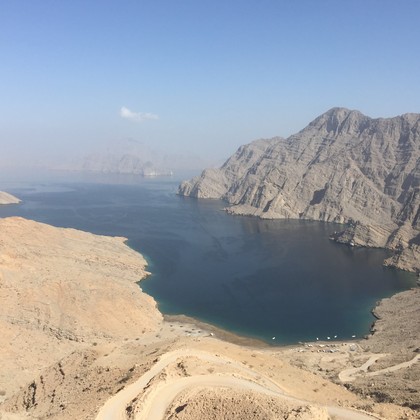
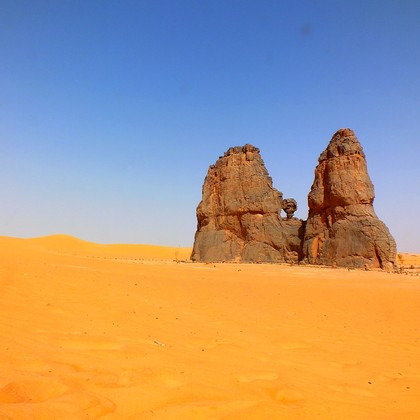
Sea cliffs, rock faces and gorges, old towns and modern buildings, also mosques, minarets and bridges; in the Sahara rocky massifs and oases. Hunts over coasts, towns, wetlands and desert, often with other swifts.
Where the bird is most at home, classified by the habitats of North Africa and the Middle East.

Range and movements
Morocco: common along the Atlantic and Mediterranean coasts, in towns such as Essaouira, Rabat and Tangier, and in the Atlas and the southern oases. Algeria and Tunisia: in coastal towns and mountains, and in the oases and massifs of the Sahara such as the Hoggar and Tassili. Libya: along the coast and in the desert massifs. Egypt: common in Cairo, the Nile Valley and Delta and along the Red Sea; present there in winter too. In the Levant it breeds in Israel, Samaria and Judea, Jordan, Lebanon and Syria, with the first birds as early as January or February. Iraq: breeds in Mesopotamia. Arabian Peninsula: breeds in Saudi Arabia, Kuwait, Bahrain, Qatar, the United Arab Emirates and Oman, where birds arrive in autumn and breed in buildings and cliffs between November and March; in Yemen mainly a passage migrant and winter visitor. Beyond the region it breeds around the Mediterranean and in south-west Asia to Pakistan; most birds winter in the Sahel and West Africa.
- Resident
- Summer visitor (c. Oct–Mar)
- Winter visitor (c. Apr–Sep)
- Passage (Mar–Apr, Oct–Nov)
- dark = core range, pale = thinly spread
How and when to look
To learn it alongside Common Swift, visit a coastal town in Morocco or Israel in March, where both species hunt together, and look down on a flock from above: the brown colour and pale face with a dark mask show best then. In the Gulf states, a swift in December or January is almost always a Pallid.
Conservation status
Not globally threatened and stable. As with other swifts, nest sites are lost to renovation and modern construction.
Scientific name
Apus pallidus | (Shelley, 1870)
Shelley described the species in 1870 as Cypselus pallidus; because it was later moved to another genus, the author and year stand in brackets. The genus Apus was introduced in 1777 by Scopoli. Apus is Latin for a swift, from Greek a- 'without' and pous 'foot', the ancients taking it for a kind of swallow without feet. pallidus is Latin for 'pale', after the bird's paler plumage. The specimen the first description was based on came from Egypt.