All species › Waterfowl › Ducks, geese and swans › Marbled Teal
Marbled Teal | Marmaronetta angustirostris
Marmereend | Cerceta pardilla
A small, pale, sandy duck with a dark eye mask that likes to hide in waterside vegetation. The marshes of Mesopotamia in southern Iraq hold a large share of the world population; the Maghreb is the region's second stronghold. Numbers fluctuate strongly with rainfall: in wet years breeding pairs appear at sites where the species had been absent for years.

Voice
A quiet species. In display the male gives a soft, nasal squeak, jeep, the female a thin two-syllable call. Small groups are often heard only when they take off.
Recording: Stanislas Wroza — CC BY-NC-SA 4.0 · converted to mono · xeno-canto
Identification
About 40 cm, slim and long-necked, with a fairly long dark bill. The whole plumage is grey-brown with cream spots, giving a marbled look. A dark patch runs back from the eye and contrasts with the pale head; the male has a shaggy, slightly drooping crest on the hindcrown. There is no coloured speculum: in flight the wings look uniformly pale with paler secondaries. The sexes are alike; the female has a shorter crest and juveniles are less clearly spotted.
Confusion species
The female Garganey (Spatula querquedula) has a striped head with a pale supercilium and a grey-green speculum, and the female Eurasian Teal (Anas crecca) a green speculum and a white line along the tail. The female Gadwall (Mareca strepera) is larger, with orange bill sides and a white speculum. No other duck in the region combines the pale spotted pattern with the dark eye mask and wings without a speculum.
Habitat
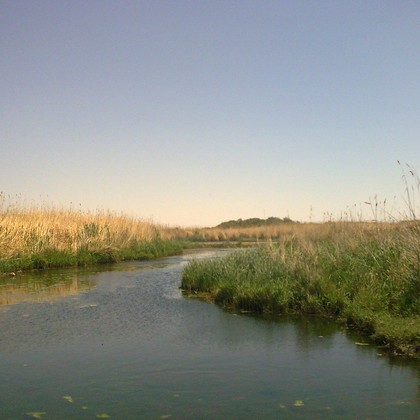
Shallow fresh to brackish waters with plenty of fringing and floating vegetation: reed and rush margins, temporarily flooded depressions, coastal lagoons and the marshes of large rivers. Outside the breeding season also on open lakes, reservoirs and salt lakes, often in groups. It dabbles and up-ends in shallow water for seeds, aquatic plants and invertebrates; it rarely dives.
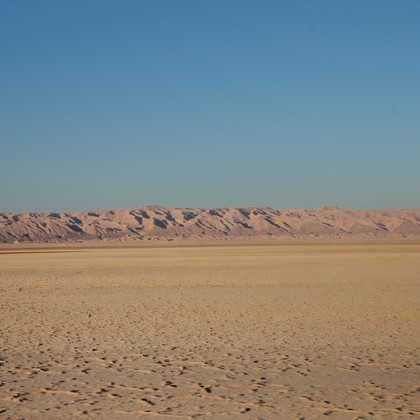
Where the bird is most at home, classified by the habitats of North Africa and the Middle East.

Range and movements
In Morocco it breeds mainly in the wetlands along the Atlantic coast (including Sidi Bou Ghaba and the mouth of the Oued Massa), in the Souss and at the mouth of the Moulouya, and in wet years also on lakes of the Middle Atlas. In Algeria on the lakes of the north-east near El Kala, on the Hauts Plateaux and in the wetlands of the northern Sahara. In Tunisia scarce and irregular; in Egypt and Israel now rare, though it formerly bred in the Nile Delta and the Hula Valley. The Middle Eastern stronghold lies in the marshes of southern Iraq along the Euphrates and Tigris, where it both breeds and winters; a rare visitor to Syria, Kuwait, Saudi Arabia and the Gulf states. Beyond the region in Spain, Turkey, Iran and Central Asia east to Pakistan; birds wintering from West Africa reach the Sahel.
- Resident
- Summer visitor (c. Oct–Mar)
- Winter visitor (c. Apr–Sep)
- Passage (Mar–Apr, Oct–Nov)
- dark = core range, pale = thinly spread
How and when to look
In Morocco Sidi Bou Ghaba near Kenitra is the best-known site, especially in late summer and autumn, when families and small groups swim along the reed edge. Come early in the day and scan the shaded margin of the vegetation: the pale birds stand out only when they move. In Iraq the Central Marshes and the Hawizeh Marshes hold the largest numbers.
Conservation status
Near Threatened. The species declined steeply in the twentieth century through wetland drainage, and in Iraq most of its habitat vanished in the 1990s. After parts of the Mesopotamian marshes were restored from 2003 onwards, numbers there rose again, but drought, upstream dams, hunting and disturbance remain threats. In the Maghreb breeding success depends heavily on spring water levels.
Scientific name
Marmaronetta angustirostris | (Ménétries, 1832)
Ménétries described the species in 1832 as Anas angustirostris; because it was later moved to another genus, the author and year stand in brackets. The genus Marmaronetta was introduced in 1853 by Reichenbach. Marmaronetta is Greek, from marmaros 'marble' and netta 'duck', after the marbled plumage. angustirostris is Latin, from angustus 'narrow' and rostrum 'bill'. The specimen the first description was based on came from Lankaran, Azerbaijan.