All species › Passerines › Shrikes › Masked Shrike
Masked Shrike | Lanius nubicus
Maskerklauwier | Alcaudón núbico
The Masked Shrike is the smallest and slimmest shrike of the region, a long-tailed black-and-white bird with orange flanks that breeds in the olive groves and open woods of the Levant. On spring migration it is a familiar sight in the Jordan Valley, Sinai and western Arabia.

Voice
The call is a dry chrrr or repeated chek, and a rasping rattle when alarmed. The song, also heard on spring passage, is soft and sustained, a mix of grating and scratchy notes with twittering whistles, recalling a large Hippolais warbler such as Olive-Tree Warbler.
Recording: Stanislas Wroza — CC BY-NC-SA 4.0 · shortened to the first 60 s, mono · xeno-canto
Identification
17–18.5 cm. Slender and long-tailed. The male is jet black above with a white forehead and white supercilium sharply framing the black mask, large white scapular patches and a white primary patch; the long black tail has white sides. Underparts white with warm orange flanks. The female is duller, blackish-grey to brownish-grey above with less orange. Juveniles are cold grey, finely barred above and below, already with a pale forehead and white scapular patch; they lack the rufous tones of young Woodchat and Red-Backed Shrikes.
Confusion species
Woodchat Shrike (Lanius senator) also has white scapular patches, but has a chestnut crown and nape, a black forehead and a white rump. Young Woodchats are warmer brown, with a pale scapular patch and pale rump; a young Masked Shrike is greyer, longer-tailed and shows white patches on the primaries. Great Gray Shrike (Lanius excubitor) is much larger and grey above.
Habitat
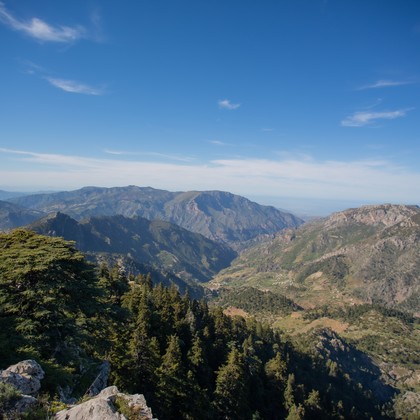
Breeds in semi-open woodland and scrub with tall bushes and trees: olive groves, old orchards, oak and pine woodland with clearings, riverine woodland and gardens. Likes to sit hidden at the edge of a canopy rather than in the open on top. On migration in any wooded terrain: oases, gardens, parks and acacia wadis.
Where the bird is most at home, classified by the habitats of North Africa and the Middle East.


Range and movements
Breeds in Israel (Galilee, Golan, Carmel and the central hills), in the hills of northern and central Jordan, in Lebanon and western Syria, and in northern and eastern Iraq (Kurdistan); possibly also locally in northern Saudi Arabia. On spring passage in March and April numerous in Israel, Sinai, eastern Egypt, Jordan and western Saudi Arabia, fewer in autumn. Scarce east to Kuwait, the Gulf states and Oman. Small numbers winter in south-west Arabia (Asir, Yemen). A vagrant in the Maghreb and Libya. Beyond the region it breeds in Greece, Bulgaria, Turkey and western Iran and winters in the Sahel from Chad to Ethiopia.
- Resident
- Summer visitor (c. Apr–Sep)
- Winter visitor (c. Oct–Mar)
- Passage (Mar–Apr, Oct–Nov)
- dark = core range, pale = thinly spread
How and when to look
In April Eilat, the kibbutz gardens in the Arava and the park at Ein Gedi are good places for migrants. Look for breeders in May and June in the olive groves of Galilee or the oak woods of Dibbeen and Ajloun in Jordan. Watch for a slim bird sitting low in the shade of a tree that suddenly drops to the ground.
Conservation status
Not globally threatened. Locally declined in the breeding range through the felling of old olive groves and woodland and through pesticide use. Trapping occurs on migration.
Scientific name
Lanius nubicus | Lichtenstein, 1823
Lichtenstein described the species in 1823 and placed it straight away in the genus where it still stands. The genus Lanius was introduced in 1758 by Linnaeus. Lanius is Latin for 'butcher', from shrikes' habit of impaling prey on thorns and barbed wire. nubicus means 'Nubian', after Nubia in north-east Africa, where the species winters. The specimen the first description was based on came from Nubia.