All species › Passerines › Shrikes › Long-Tailed Shrike
Long-Tailed Shrike | Lanius schach
Langstaartklauwier | Alcaudón schach
A large, long-tailed shrike from South and Central Asia that reaches the area only as a rare visitor. The western subspecies erythronotus breeds as far as south-east Iran and Pakistan; from there a few birds wander to Oman and the Emirates every year or two, some wintering for months on the same farm or in the same park.
Voice
Wintering birds occasionally give a harsh, nasal chaek or a grating rattle. The song, sometimes given quietly even in winter, is a varied chatter with much mimicry of other birds.
No recording with a suitable Creative Commons licence is available for this species yet.
Identification
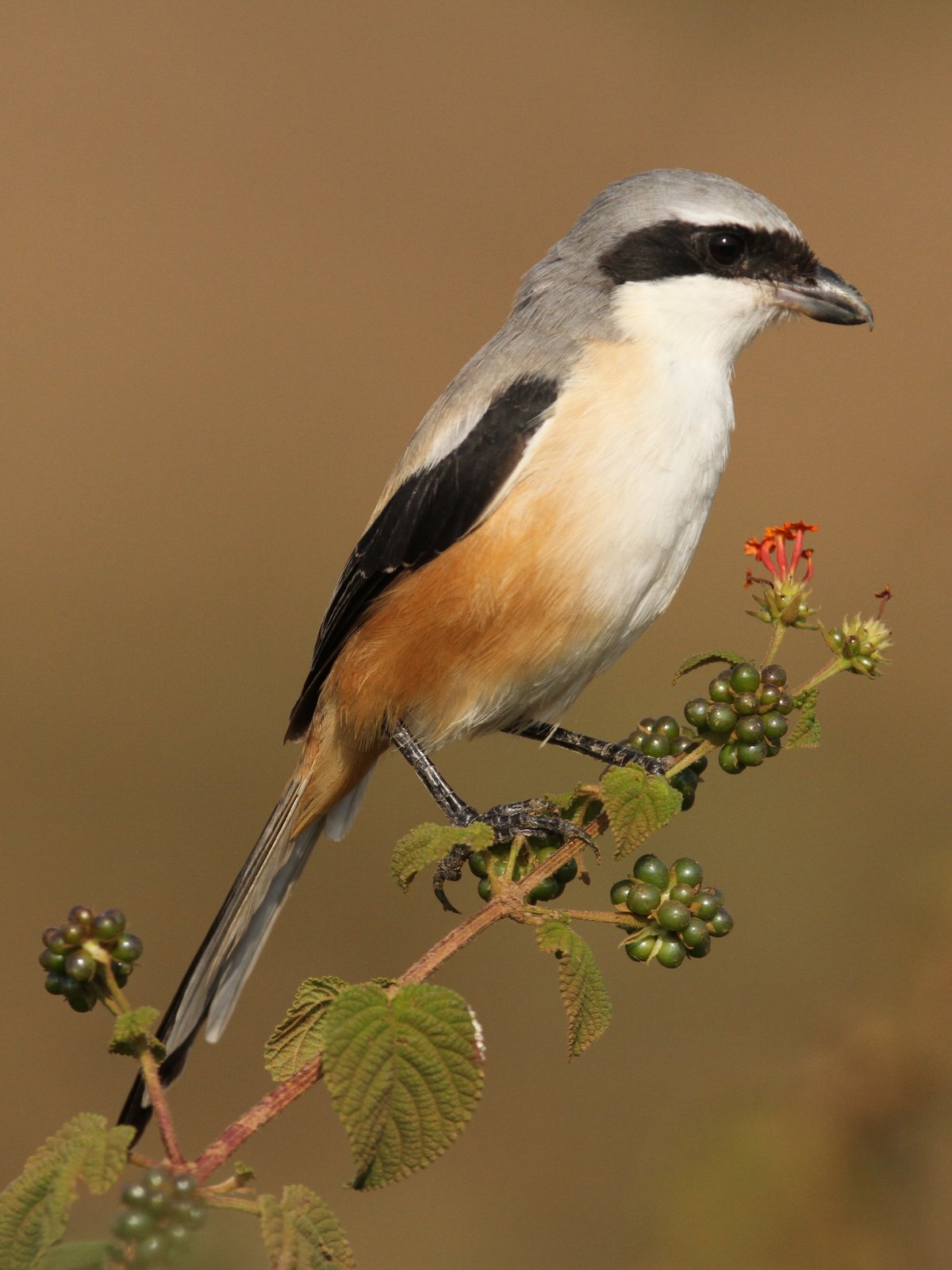
24–27 cm, almost half of it tail. Crown, nape and upper mantle are grey; lower mantle, scapulars and rump bright rusty orange. A broad black mask runs from the bill to behind the eye and, in adults, as a narrow black band across the forehead. The wings are black with a small white patch at the base of the primaries; the long, strongly graduated tail is black with rufous or pale edges. The underparts are white with warm rusty-buff flanks and undertail. Juveniles are browner and scaled, with a brown mask, but already show the long tail and rusty rump.
Confusion species
Bay-backed Shrike (Lanius vittatus) is much smaller, with a chestnut mantle, a broad black forehead, a white rump and a black-and-white tail. Lesser Gray Shrike (Lanius minor) has a grey back, a black forehead and a large white wing patch, with no rufous. Red-tailed Shrike (Lanius phoenicuroides) is smaller and shorter-tailed, with a rufous crown and red tail. Young birds can recall a young Red-backed Shrike (Lanius collurio); check the proportion of tail to body.
Habitat
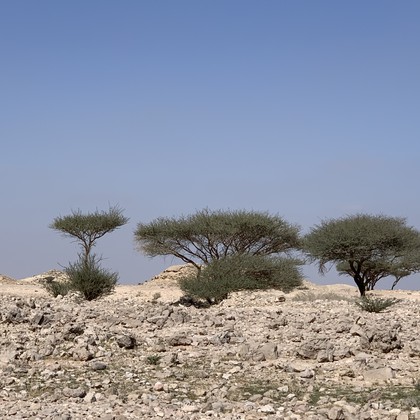
In the area mainly farmland with trees and hedges: farms, nurseries, irrigated cultivation, parks and golf courses; also acacia and prosopis scrub at the edge of cultivation. Perches conspicuously on wires, fences and treetops, dropping to the ground for prey.
Where the bird is most at home, classified by the habitats of North Africa and the Middle East.


Range and movements
Oman: rare passage migrant and winter visitor, mainly in the north and in Dhofar. United Arab Emirates: nine records accepted by 2021, mostly wintering birds at farms and nurseries, some staying for months. Kuwait: two records, October 2004 and October 2007 to April 2008. Saudi Arabia: one record, Dhahran, February–April 2015. Bahrain: first records in October 2021 and October 2022 at Barbar and Galali, possibly the same bird. Also a few reports from Qatar and Israel. Unknown in North Africa. Beyond the area erythronotus breeds from Turkmenistan and Uzbekistan through Afghanistan and Pakistan to north-west India and in south-east Iran; other subspecies occupy India, China and South-East Asia to New Guinea. A rare vagrant to Europe.
- Winter visitor (c. Oct–Mar)
- Passage (Mar–Apr, Oct–Nov)
- dark = core range, pale = thinly spread
How and when to look
In winter, search farms and nurseries in the Emirates and northern Oman, where rare shrikes often stay for a long time; follow local birders' reports. A shrike on a wire with a strikingly long black tail and rusty-orange rump is almost certainly this species here.
Conservation status
Not globally threatened (IUCN: Least Concern). Widespread and common in Asia. In the area a rare visitor that has been seen more often in recent decades, probably owing to more observers and more greenery in the Gulf states.
Scientific name
Lanius schach | Linnaeus, 1758
Linnaeus described the species in 1758 and placed it straight away in the genus where it still stands. He introduced the genus Lanius in that same work. Lanius is Latin for 'butcher', from shrikes' habit of impaling prey on thorns and barbed wire. The origin of schach is uncertain: it is probably onomatopoeic, possibly from a Chinese name for the bird; the Persian shāh 'king' has also been suggested. The specimen the first description was based on came from Guangzhou (Canton), China.