All species › Passerines › Wagtails and pipits › Meadow Pipit
Meadow Pipit | Anthus pratensis
Graspieper | Bisbita pratense
The Meadow Pipit is the small, olive-brown, heavily streaked pipit that arrives in large numbers from Europe and western Siberia to winter in the north of the region. On the fields of the Maghreb, in the Nile Delta and on the farmland of the Levant and Iraq it is one of the commonest songbirds from October to March; towards the south, into the Sahara and the Arabian Peninsula, it quickly becomes scarcer.

Voice
The call is the best feature: a thin, high ist or tseep, nearly always repeated two to four times in quick succession, ist-ist-ist, in a stuttering series on take-off. Tree and Water Pipits give single, fuller calls. The song, an accelerating series of tsip-tsip-tsip in a parachuting display flight ending in a slower sia-sia-sia, is heard in the region at most briefly in March.
Recording: Philippe Grange — CC0 · converted to mono · xeno-canto
Identification
14–15.5 cm, small and slim, with a thin, pointed bill. The upperparts are olive-brown to grey-brown with dark streaks, the underparts dirty white to yellowish buff, with streaks that run equally heavy across both breast and flanks. The legs are pale flesh to orange-pink; the hind claw is long, thin and almost straight, longer than the hind toe. The face is plain: a narrow pale eye-ring, a faint supercilium and no pale spot behind the ear-coverts. The outer tail feathers are white. It walks low and jerkily over the ground and flushes with a light, bouncing, somewhat hesitant flight.
Confusion species
Tree Pipit (Anthus trivialis) is mainly a passage migrant in the region in March–April and September–October, just outside the Meadow Pipit's season; it is warmer in colour, with heavy breast streaks but fine flank streaks, a short, curved hind claw and a single hoarse bzeez call. Red-throated Pipit (Anthus cervinus) winters on the same wet fields, including along the Nile; apart from the red throat it has a streaked rump, white mantle stripes, black flank streaks and a long, thin, fading pseeeh. Water Pipit (Anthus spinoletta) is larger, with dark legs, a white supercilium and a full, single call. A young Tawny Pipit (Anthus campestris) is larger, longer-legged and paler.
Habitat
In winter open, low-growing land with some moisture: fields, fallow and pasture, wet grassland along rivers and lakes, irrigated farmland and alfalfa, muddy marsh edges, coastal plains and open garrigue, in the Atlas up onto the high plateaux. It often feeds in loose flocks, also with Red-Throated Pipits and wagtails. It avoids true desert, but turns up on migration at oases and irrigated fields deep in the Sahara and Arabia.
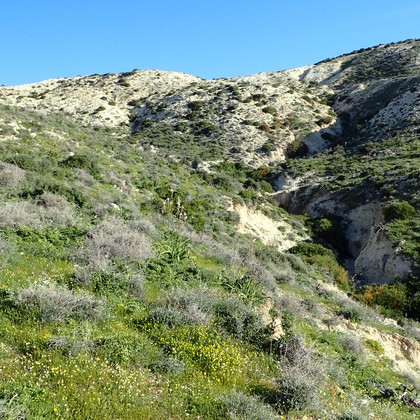
Where the bird is most at home, classified by the habitats of North Africa and the Middle East.


Range and movements
Not a breeding bird in the region. A common winter visitor to northern Morocco, Algeria and Tunisia and along the coast of Libya, also on the high plateaux and to the northern edge of the Sahara. In Egypt common in the Nile Delta and Nile Valley, scarcer in Sinai and the oases. In the Levant (Israel, Samaria and Judea, Lebanon, Syria, north-west Jordan) and in Iraq common to abundant; in Kuwait and northern and eastern Saudi Arabia common. In Bahrain, Qatar, the United Arab Emirates and northern Oman an irregular, mostly scarce winter visitor, rare further south and in Yemen. Beyond the region it breeds from Iceland and the British Isles through northern and central Europe to western Siberia, and winters in western and southern Europe, North Africa and the Middle East east to Iran.
- Winter visitor (c. Apr–Sep)
- Passage (Mar–Apr, Oct–Nov)
- dark = core range, pale = thinly spread
How and when to look
In December or January walk along the edge of a wet field or irrigated plot in the Maghreb, the Nile Delta or the Hula Valley: Meadow Pipits flush from under your feet in loose groups with their stuttering ist-ist-ist. Look among them for Red-Throated and Water Pipits, which often share the same spot.
Conservation status
Not globally threatened, but it has declined across much of its European breeding range through agricultural intensification and the loss of rough grassland. In the region it is still numerous as a winter visitor; its distribution across the wintering grounds is shifting with milder winters.
Scientific name
Anthus pratensis | (Linnaeus, 1758)
Linnaeus described the species in 1758 as Alauda pratensis; because it was later moved to another genus, the author and year stand in brackets. The genus Anthus was introduced in 1805 by Bechstein. Anthus is the Latin word for a small bird of grasslands mentioned by Pliny the Elder. pratensis is Latin for 'of the meadow', from pratum 'meadow'. The specimen the first description was based on came from Sweden.