All species › Passerines › Larks › Mediterranean Short-Toed Lark
Mediterranean Short-Toed Lark | Alaudala rufescens
Kleine kortteenleeuwerik | Terrera marismeña
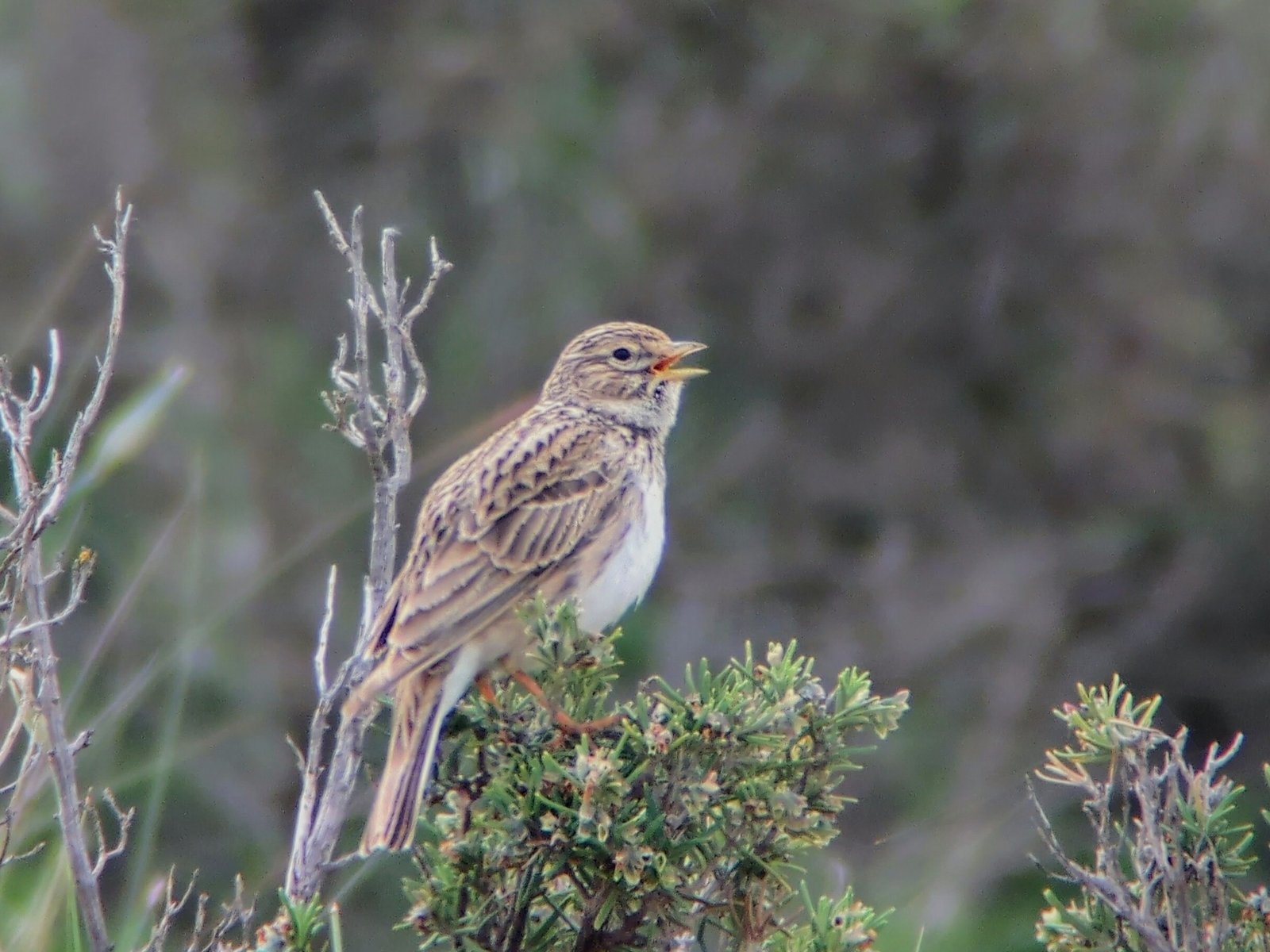
Mediterranean Short-toed Lark is a small, greyish lark of salt flats, bare steppe and dry fields. It closely resembles Greater Short-toed Lark, but stays in the region all year and seeks out even barer, often saline ground. In winter it forms flocks of hundreds of birds, especially on the Arabian Peninsula.
Voice
The song is longer and more varied than that of Greater Short-toed Lark: a fast, continuous stream of twittering and buzzing notes with much mimicry, given in a high, circling song flight. The call is a dry, buzzing prrrt or drrrd, rounder and more rattling than that of Greater Short-toed Lark.
Recording: Esperanza Poveda — CC BY-NC-SA 4.0 · converted to mono · xeno-canto
Identification
13–14 cm, small and compact, with a short, stubby conical bill. Upperparts grey-brown to sandy with dark streaks; the breast has a band of fine dark streaks continuing onto the flanks, without a dark neck patch. The face is rather plain, with a weak pale supercilium. The tertials are shorter than in Greater Short-toed Lark, so three to four primary tips are visible. Tail dark with white outer edges. The form nicolli of the Nile Delta is darker and more heavily streaked than the pale form minor of the rest of the region. Sexes alike.
Confusion species
Greater Short-toed Lark (Calandrella brachydactyla) has an unstreaked breast with a small dark neck patch, longer tertials covering the primaries, a longer, more pointed bill and often a rufous crown. Blanford's Lark (Calandrella blanfordi) of the highlands of south-western Arabia has a uniform rufous cap and an unstreaked breast. Eurasian Skylark (Alauda arvensis) is larger, with a small crest and a white trailing edge to the wing.
Habitat
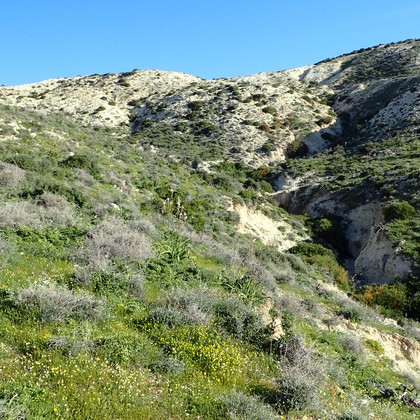
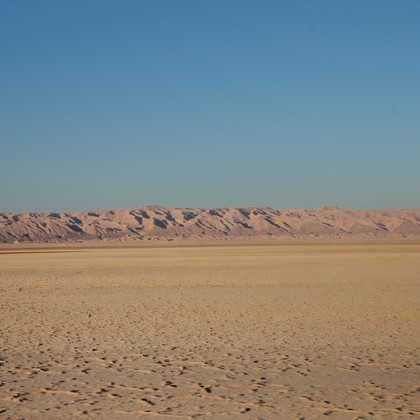
Bare, flat ground with very low, sparse vegetation: the edges of chotts, sebkhas and saltmarshes with salt-tolerant plants, dry steppe and semi-desert, fallow and stubble. In winter also on fields, lawns and coastal plains.
Where the bird is most at home, classified by the habitats of North Africa and the Middle East.

Range and movements
Resident in Morocco (mainly in the east and south, into Western Sahara), in Algeria and Tunisia on the plateaux and around the chotts on the edge of the Sahara, and in northern Libya. In Egypt its own form nicolli breeds in the Nile Delta and on the north coast; elsewhere in Egypt, including Sinai, it is mainly a passage migrant and winter visitor. In the Levant it breeds in Israel (the Negev, the Arava and around the Dead Sea), Jordan and Syria, and further in Iraq. On the Arabian Peninsula it breeds in northern and eastern Saudi Arabia and in small numbers in Kuwait; there and in the other Gulf states it is mainly a numerous winter visitor and passage migrant, scarcer in Oman. Beyond the region it breeds in Spain, the Canary Islands and from Turkey to Iran.
- Resident
- Summer visitor (c. Oct–Mar)
- Winter visitor (c. Apr–Sep)
- Passage (Mar–Apr, Oct–Nov)
- dark = core range, pale = thinly spread
How and when to look
In winter flocks are easy to find on salt flats and bare fields in Kuwait, eastern Saudi Arabia and the northern Arava; in spring in Tunisia around the chotts. In flocks of Greater Short-Toed Larks look for the streaked breast and the visible primary tips, and listen for the rattling call.
Conservation status
Not threatened. Overgrazing, reclamation and building on coastal plains and salt flats reduce habitat locally, but in most of the region it is still common.
Scientific name
Alaudala rufescens | (Vieillot, 1819) (GBIF: Calandrella rufescens)
Vieillot described the species in 1819 as A[lauda] rufescens; because it was later moved to another genus, the author and year stand in brackets. The genus Alaudala was introduced in 1856 by Horsfield & Moore. Alaudala is a Latin diminutive of Alauda, so 'little lark'. rufescens is Latin for 'reddish', from rufus 'red', after the rufous plumage. The specimen the first description was based on came from Tenerife, Canary Islands.