All species › Passerines › Cisticolas › Cricket Warbler
Cricket Warbler | Spiloptila clamans
Krekelprinia | Prinia charlatana
The Cricket Warbler is a small, pale, long-tailed songbird of the Sahel that just reaches the southern edge of the region. Since 2007 it has bred in a dry acacia wadi in the south of Western Sahara, and in 2022 it was also found breeding in the far south of Algeria. One of the most sought-after species for anyone visiting Western Sahara.

Voice
A high, thin, insect-like trill, tsirrrrr, which gives the bird its name, and a repeated, sharp tseep-tseep. Pairs and family parties call almost incessantly while foraging.
Recording: Bram Piot — CC BY-NC-SA 4.0 · shortened to the first 60 s, mono · xeno-canto
Identification
11–12 cm. Very pale sandy grey above, with a long, graduated black tail that is often cocked or fanned and has broad white tips. The wing coverts are black with broad white edges and tips, giving a striking black-and-white wing pattern; the rump is warm rusty brown. Underparts white with a soft buff wash on the flanks. The male has a dark, white-speckled forecrown, the female a warm rufous forecrown. Bill fine, eyes pale.
Confusion species
Graceful Prinia (Prinia gracilis) does not occur in the same area; it is streaked above and lacks the black-and-white wing pattern and the rusty rump. Streaked Scrub Warbler (Scotocerca inquieta) has a streaked crown, a dark eye-stripe and a plain grey-brown wing. African Desert Warbler (Curruca deserti) is sandy with a rufous tail and a yellow eye, but has no white wing markings.
Habitat
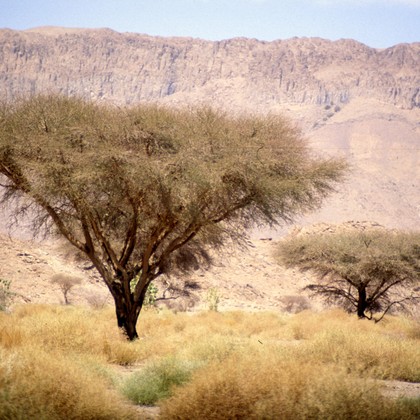
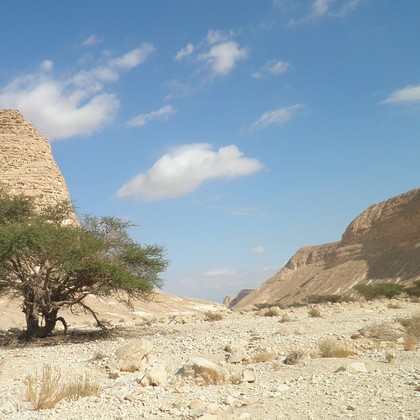
Open, dry Sahelian scrub on sand: acacia wadis with scattered Leptadenia, Panicum and other desert shrubs. Forages low in bushes and on the ground, in pairs or small groups. Eats small insects and seeds. Builds a domed nest low in a bush or at the base of an acacia.
Where the bird is most at home, classified by the habitats of North Africa and the Middle East.
Range and movements
In the region only in the far south: in Western Sahara (Morocco) around Oued Jenna near Aousserd, where breeding pairs have been known since 2007 (the first breeding record for the Western Palearctic), and in Algeria near Timiaouine in the extreme south, where breeding was confirmed in October 2022. Beyond the region from Mauritania and northern Senegal through the Sahel of Mali, Niger and Chad to Sudan and Eritrea.
- Resident
- Passage (Mar–Apr, Oct–Nov)
- dark = core range, pale = thinly spread
How and when to look
The well-known site is the wadi at Oued Jenna on the road to Aousserd in Western Sahara, often visited together with African Desert Warbler and other Sahelian species. Listen in the early morning for the high, cricket-like chirping and watch for the flicking, white-tipped tail.
Conservation status
Not globally threatened. In the region a very small, isolated breeding population at the northern edge of the range, probably partly dependent on wet years; overgrazing of desert scrub is a potential threat.
Scientific name
Spiloptila clamans | (Cretzschmar, 1826)
Cretzschmar described the species in 1826 as Malurus clamans; because it was later moved to another genus, the author and year stand in brackets. The genus Spiloptila was introduced in 1872 by Sundevall. Spiloptila is Greek, from spilos 'spot' and ptilon 'feather'. clamans is Latin for 'calling', from clamare 'to call out, to shout'. The specimen the first description was based on came from Nubia, Sudan.