All species › Passerines › Cisticolas › Graceful Prinia
Graceful Prinia | Prinia gracilis
Westelijke gestreepte prinia | Prinia grácil
The Graceful Prinia is a tiny, long-tailed songbird that is one of the commonest birds of gardens, field edges and reedbeds in the Nile Valley, the Levant and western and southern Arabia. It is noisy and restless and constantly flicks its long, graduated tail.

Voice
The song is a rhythmic, dry, repeated tsirrup-tsirrup-tsirrup or zerwit-zerwit, at about three phrases per second, often from a prominent twig. The call is a sharp, snapping chit and a purring trrrt; a faint snapping of the wings can sometimes be heard in flight.
Recording: David Darrell-Lambert — CC BY-NC 4.0 · converted to mono · xeno-canto
Identification
10–11 cm. Pale grey-brown above with fine dark streaks on the crown, mantle and wing coverts; underparts off-white with a soft buff wash on the flanks. The long, strongly graduated tail is often cocked or flicked; from below it shows dark round spots before white tips. Head rather plain with pale lores and an orange-yellow eye. Wings short and rounded; the flight is weak and jerky, low over vegetation. Sexes alike.
Confusion species
Delicate Prinia (Prinia lepida), in Iraq and eastern Arabia, is almost identical: from below it has narrower, fainter bands in the tail rather than round dark spots, often more distinctly barred uppertail and a faster song. Zitting Cisticola (Cisticola juncidis) is more heavily streaked, has a much shorter tail and a rusty rump. Streaked Scrub Warbler (Scotocerca inquieta) has a dark eye-stripe, a pale supercilium and lives in dry, rocky terrain.
Habitat
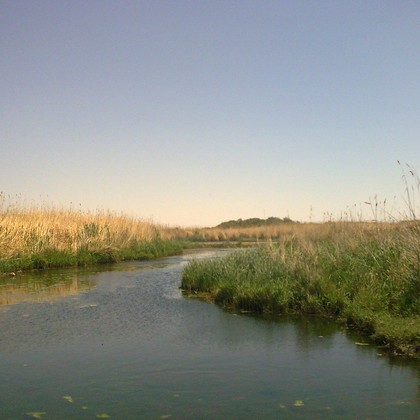
Dense, low vegetation in both wet and dry areas: reedbeds and tamarisk along canals and lakes, field edges, orchards, date-palm gardens, bushes in gardens and parks right into cities, and in Arabia also coastal scrub and mangroves. Eats small insects and spiders. The nest is a fine, oval ball with a side entrance, low in a bush or grass tussock.
Where the bird is most at home, classified by the habitats of North Africa and the Middle East.


Range and movements
Common in Egypt in the Nile Valley and Delta, along the Suez Canal and on the north coast of Sinai; in Israel, the Palestinian territories, Jordan (Jordan Valley, Dead Sea, Aqaba), Lebanon and western Syria. In Saudi Arabia along the Red Sea and in the Tihama, and in the east (Al-Ahsa oasis and the coast at Al-Uqair) with its own subspecies, which also occurs on Bahrain and possibly in Qatar; further in Yemen in the Tihama and along the south coast. Beyond the region in Sudan along the Nile, Eritrea and Somalia.
- Resident
- Summer visitor (c. Oct–Mar)
- Winter visitor (c. Apr–Sep)
- Passage (Mar–Apr, Oct–Nov)
- dark = core range, pale = thinly spread
How and when to look
In any garden, kibbutz or field edge in Israel and along the Nile its dry, rhythmic song soon gives it away. In eastern Saudi Arabia and Qatar, where Delicate Prinia also occurs, identify only singing birds and photograph the underside of the tail.
Conservation status
Not globally threatened. Benefits from irrigation, gardens and plantations and expanded with agriculture during the 20th century. The boundary with Delicate Prinia in eastern Arabia is still poorly known.
Scientific name
Prinia gracilis | (Lichtenstein, 1823)
Lichtenstein described the species in 1823 as S[ylvia] gracilis; because it was later moved to another genus, the author and year stand in brackets. The genus Prinia was introduced in 1821 by Horsfield. Prinia comes from prinya, the Javanese name for Prinia familiaris, the prinia of that island. gracilis is Latin for 'slender, slim', after its fine build and long thin tail. The specimen the first description was based on came from Nubia.