All species › Passerines › Sylvia warblers › Ménétriés's Warbler
Ménétriés's Warbler | Curruca mystacea
Ménétriés' zwartkop | Curruca de Ménétries
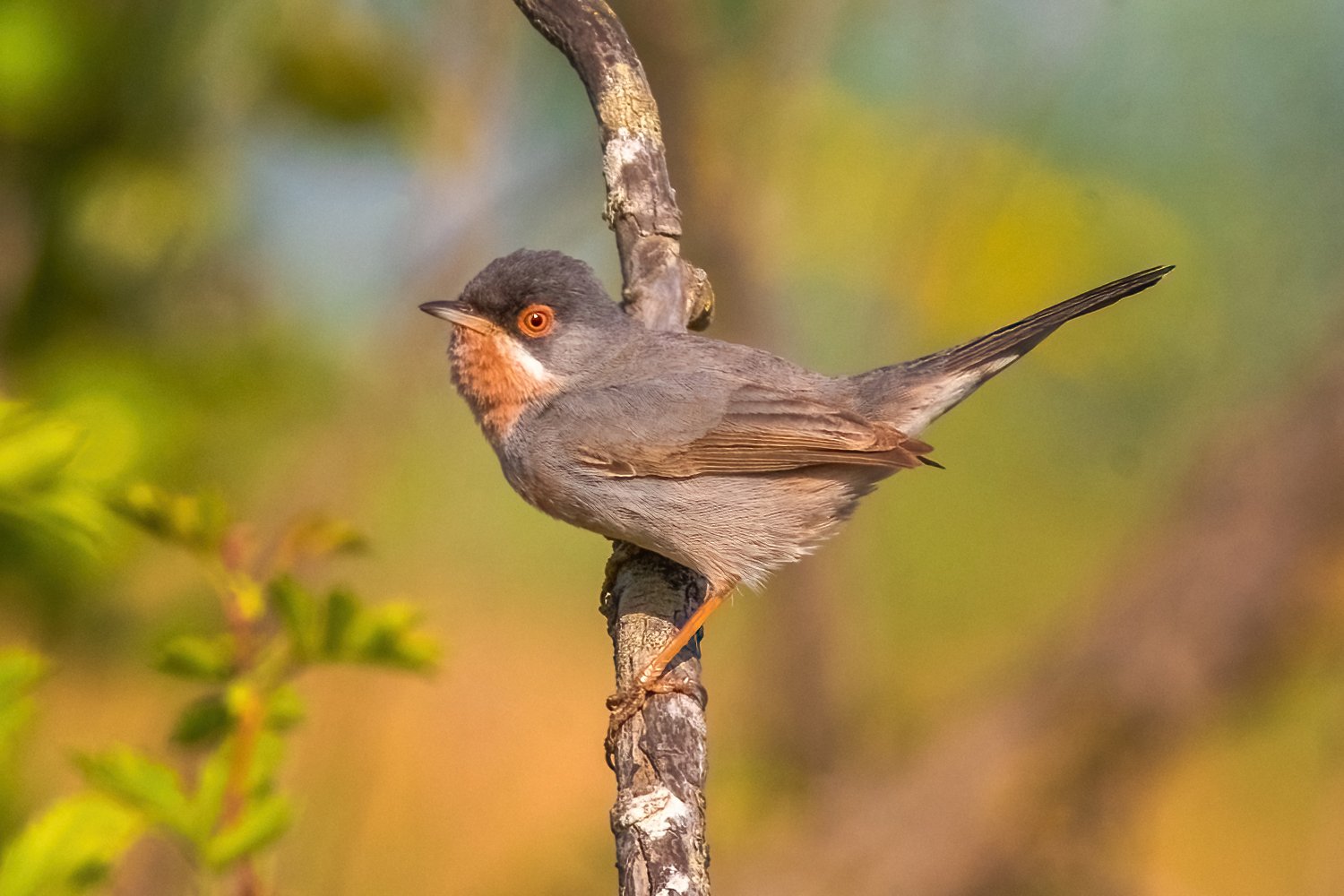
Ménétriés's Warbler is a pale eastern relative of Sardinian Warbler that breeds in the tamarisk scrub of the river valleys of Syria and Iraq and in winter is spread across the whole east of the region, from Arabia to the Red Sea. It is noted for its long blackish tail, which it waves around constantly.
Voice
The song is a fast, scratchy chatter of two to four seconds, thinner and weaker than Sardinian Warbler's, with occasional sweet whistles, given from the top of a tamarisk or in a short song flight. The call is a dry, buzzing, somewhat nasal dzhair and a hard chek. In winter quarters usually only the buzzing call.
Recording: Kasper Wieck — CC BY-NC-SA 4.0 · converted to mono · xeno-canto
Identification
12–13 cm. Small and slim, with a long blackish tail against a pale, sandy grey-brown back. The male has a dull black crown and a black mask around the eye fading into grey on the nape and cheeks, an orange-red eye-ring, a white throat and a soft pink wash on the breast and flanks. Tertials and greater coverts are plain. Females and young are sandy grey with off-white underparts, a pale eye-ring and the same dark tail. Swings and rotates the tail incessantly.
Confusion species
Sardinian Warbler (Curruca melanocephala) has a glossy jet-black hood sharply bordered against the white throat, darker upperparts and clean white underparts, and flicks the tail rather than swinging it. Male Rüppell's Warbler (Curruca ruppeli) has a black throat with a broad white moustache. Lesser Whitethroat (Curruca curruca) has dark ear-coverts against a grey crown, but a shorter, greyer tail and no pink wash. Arabian Warbler (Curruca leucomelaena) is larger, with a black cap and a dark eye without a coloured ring.
Habitat
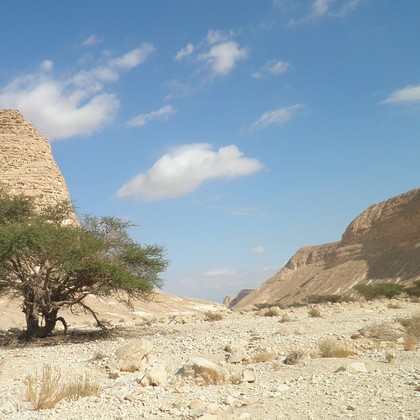
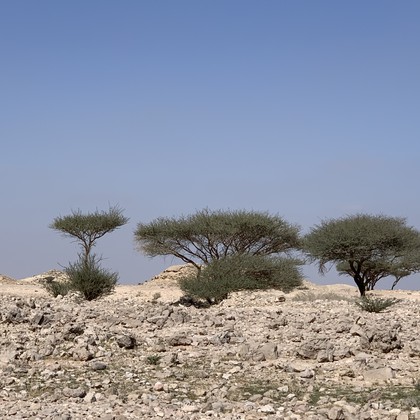
In the breeding season tamarisk and willow scrub along rivers and canals, rank banks, orchards and scrub in dry hills. In winter and on passage mainly tamarisk, acacia and Prosopis in wadis, bushes around oases and palm groves, and planted greenery in coastal deserts.
Where the bird is most at home, classified by the habitats of North Africa and the Middle East.

Range and movements
Within the region it breeds in the Euphrates valley and along its tributaries in northern and eastern Syria and in northern and central Iraq along the Tigris and Euphrates. On passage and in winter across almost all of Arabia: scarce in Kuwait, Bahrain, Qatar and the Emirates, scarce to fairly common in Saudi Arabia (mainly the west and south-west), Oman and Yemen, where many birds winter. In Jordan, Israel (especially Eilat and the Arava) and Sinai a scarce passage migrant and winter visitor; rare along Egypt's Red Sea coast. Beyond the region it breeds from south-east Turkey and the Caucasus across Iran to Central Asia and Afghanistan, and winters in Sudan, Eritrea, Ethiopia and Somalia.
- Summer visitor (c. Apr–Sep)
- Winter visitor (c. Oct–Mar)
- Passage (Mar–Apr, Oct–Nov)
- dark = core range, pale = thinly spread
How and when to look
In winter in the wadis and tamarisks of south-west Saudi Arabia, Yemen and Dhofar (Oman), and on passage in March and April in the scrub around Eilat and in the Emirates at sites such as Mushrif Park. Listen for the buzzing dzhair from a tamarisk and watch for a pale bird swinging its dark tail.
Conservation status
Not globally threatened. Little studied in its breeding range in Syria and Iraq, where riverine scrub is under pressure from clearance, irrigation and conflict. As a winter visitor to Arabia fairly stable.
Scientific name
Curruca mystacea | (Ménétries, 1832) (GBIF: Sylvia mystacea)
Ménétries described the species in 1832 as Sylvia mystacea; because it was later moved to another genus, the author and year stand in brackets. The genus Curruca was introduced in 1802 by Bechstein. Curruca is Latin, the name of an unidentified small bird mentioned by the Roman poet Juvenal. mystacea derives from Greek mystax 'moustache, upper lip' and means 'moustached', after the white malar stripe. The specimen the first description was based on came from Salyan, Azerbaijan.