All species › Passerines › Thrushes › Mistle Thrush
Mistle Thrush | Turdus viscivorus
Grote lijster | Zorzal charlo
The Mistle Thrush is the largest thrush of the region, a pale, upright bird of open woodland and forest edge in the mountains. In the Maghreb the form deichleri breeds in the cedar and oak forests of the Atlas and the Rif; in the Middle East it is mainly a scarce winter visitor to the northern mountains.

Voice
The call is a dry, rattling trrrrrt, like a wooden rattle, often given in flight; also a short tuk. The song, delivered from a tall treetop and heard from winter onwards, recalls Common Blackbird but consists of shorter, harder and more monotonous phrases with pauses between, lacking the slow, mellow ending of the Blackbird.
Recording: Stanislas Wroza — CC BY-NC-SA 4.0 · converted to mono · xeno-canto
Identification
27–28 cm. Large and long-tailed, with a bulky, upright silhouette. Upperparts grey-brown, cooler and paler than in Song Thrush, with pale fringes to the greater coverts and secondaries forming a paler wing panel. Underparts white to pale buff with large, round black spots, set as bold dots on the flanks and belly; the breast sides are often densely spotted. The tail has white corners. Underwing bright white, conspicuous in every flight. The form deichleri of north-west Africa is paler and sandier above, with larger spots. Flight is strong and undulating, with long closed-wing phases; it often lands at the top of a tree.
Confusion species
Song Thrush (Turdus philomelos) is clearly smaller and warmer brown, with small arrow-shaped spots in rows, a warm yellowish wash to the breast and an orange-buff underwing. Fieldfare (Turdus pilaris) has a grey head and rump, a chestnut mantle and a dark tail without white corners. Juvenile Mistle Thrushes with pale drops on the upperparts can briefly confuse, but size, white underwing and white tail corners decide.
Habitat
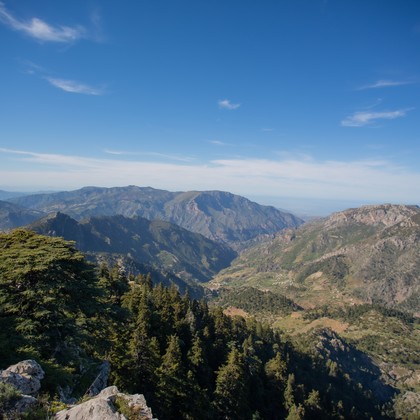
Breeds in open montane woodland: cedar, oak and pine forest of the Atlas and the Rif, forest edges, clearings and tree lines, in Morocco high into the mountains. In winter also in olive groves, orchards, parks and open country with scattered trees, often near berry-bearing shrubs such as juniper and mistletoe. Forages on open ground and short grass.
Where the bird is most at home, classified by the habitats of North Africa and the Middle East.

Range and movements
Resident in northern Morocco (Rif, Middle and High Atlas), northern Algeria (Tell Atlas, Kabylie, Aurès) and north-west Tunisia. In the Middle East it breeds scarcely and locally in the mountains of Lebanon and north-west Syria. In winter scarce in northern Israel (Hermon, Golan), the highlands of Jordan, Syria and northern Iraq; in Libya, Egypt and the Arabian Peninsula at most a rare vagrant. Beyond the region it breeds across almost all of Europe and through Turkey and Iran to Central Asia and the western Himalaya.
- Resident
- Summer visitor (c. Apr–Sep)
- Winter visitor (c. Oct–Mar)
- Passage (Mar–Apr, Oct–Nov)
- dark = core range, pale = thinly spread
How and when to look
In the cedar forests near Azrou and Ifrane in the Middle Atlas it is easy to find in spring: listen at dawn for the powerful song from a treetop and for the rattling call of birds flying over a clearing. The white underwing is the best feature in flight.
Conservation status
Not globally threatened. In the Maghreb it depends on montane forest and is thus vulnerable to logging and overgrazing of the cedar forests; in the Middle East the breeding range is small and fragmented and the population poorly known.
Scientific name
Turdus viscivorus | Linnaeus, 1758
Linnaeus described the species in 1758 and placed it straight away in the genus where it still stands. He introduced the genus Turdus in that same work. Turdus is the ordinary Latin word for 'thrush'. viscivorus is Latin for 'mistletoe eater', from viscum 'mistletoe' and vorare 'to devour', after its fondness for mistletoe berries. The specimen the first description was based on came from Berechurch, England.