All species › Passerines › Thrushes › Ring Ouzel
Ring Ouzel | Turdus torquatus
Beflijster | Mirlo capiblanco
The Ring Ouzel is a mountain thrush that in this region winters mainly in the juniper woodland of the Atlas. Birds from the Alps and Pyrenees (form alpestris) and from north-west Europe gather there, seeking juniper berries and water. In the Middle East it is a scarce passage migrant and winter visitor to the northern mountains.
Voice
The call is a hard, dry tak-tak-tak, harder and stonier than Blackbird's, often on take-off; in winter also soft chattering in small groups. The song, sometimes heard in spring in the Atlas, consists of short, clear fluty phrases of two to four notes, monotonously repeated.
Recording: Thierry THOMAS — CC BY-NC-SA 4.0 · converted to mono · xeno-canto
Identification
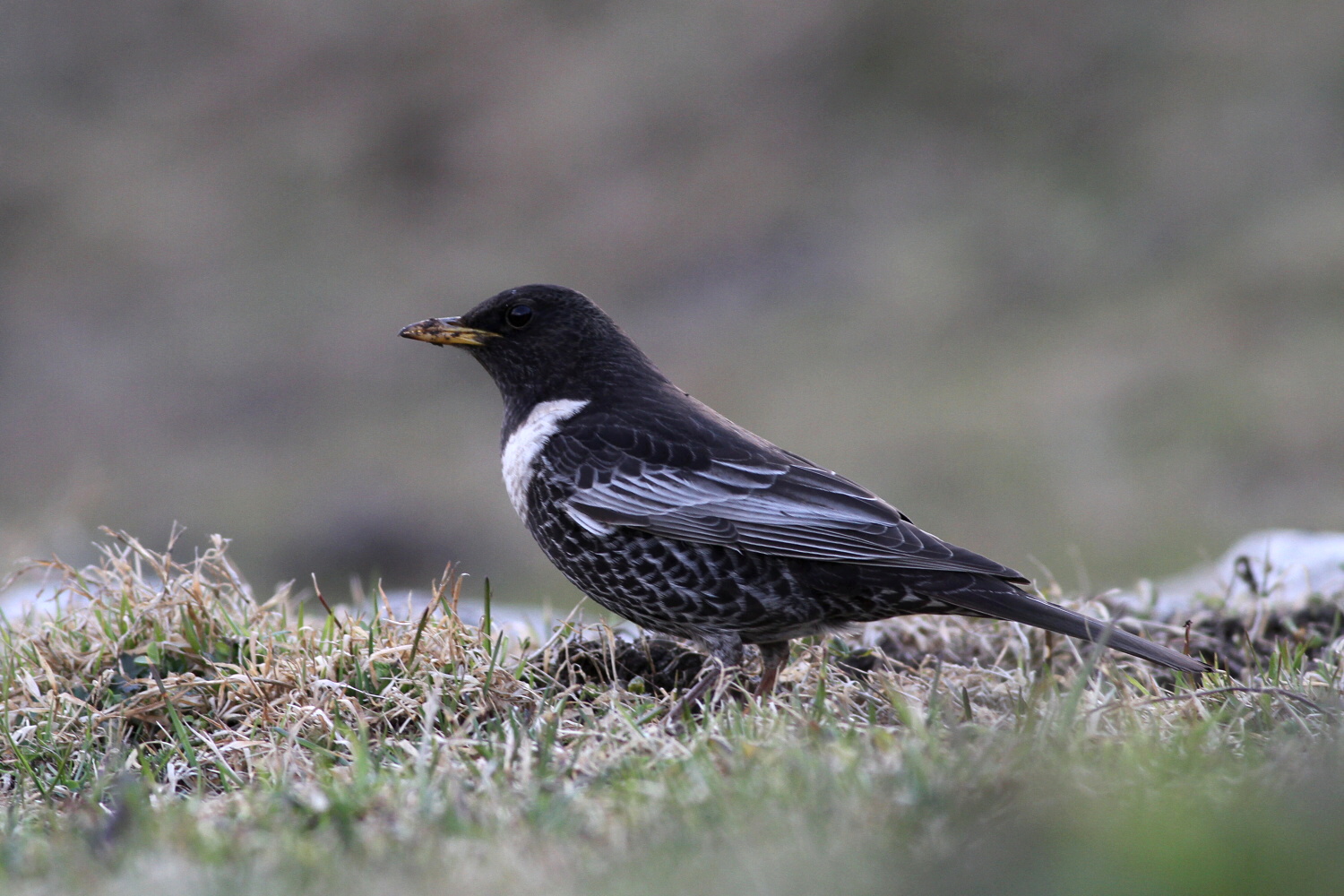
23–24 cm. A blackbird-like thrush with longer wings. The male is blackish with a broad, white, crescent-shaped breast band and pale fringes to the wing feathers that make the closed wing look silvery-grey; the bill is yellow with a dark tip. The female is browner, with a narrower, off-white and brown-scaled breast band. In winter all birds have pale fringes on the underparts and look scaly; first-winter birds sometimes barely show a breast band. The form alpestris is more heavily white-scaled below than the nominate.
Confusion species
Common Blackbird (Turdus merula) lacks the breast band and pale wing fringes; female Blackbirds are plainer brown and shorter-winged. Blue Rock-Thrush (Monticola solitarius) is smaller with a long, dark bill, and the male is slate-blue. Females and young Ring Ouzels without a clear band can resemble a dark Blackbird; then check for the silvery wing.
Habitat
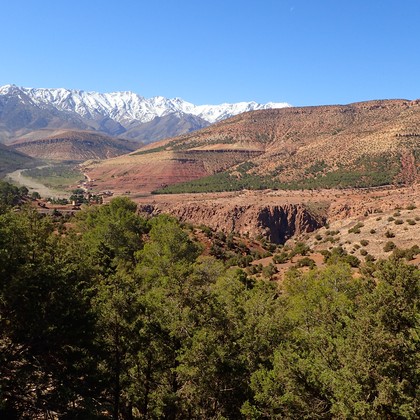
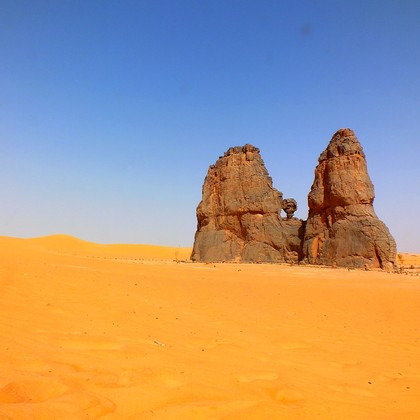
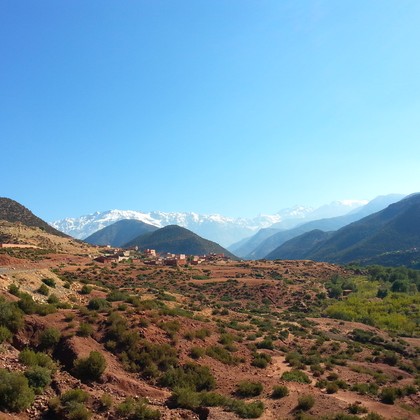
In winter open juniper and cedar woodland, scrub and rocky mountain slopes in the Atlas, mainly between about 1,500 and 2,500 m, where its presence is linked to fruiting juniper and nearby water. On passage also in orchards, fields and scrub lower in the mountains.
Where the bird is most at home, classified by the habitats of North Africa and the Middle East.
Range and movements
Winters from October to April in the High and Middle Atlas and the Rif in Morocco and in the mountains of northern Algeria, with birds from the Alps, the Pyrenees, Britain and Scandinavia. In the Middle East a scarce passage migrant and winter visitor to the mountains of Lebanon, Syria, northern Israel (Hermon) and northern Iraq, involving the eastern form amicorum from Turkey, the Caucasus and Iran; rare in Jordan, Egypt (Sinai) and the Arabian Peninsula. Breeds in north-west Europe, the European mountains, Turkey, the Caucasus and Iran to Turkmenistan.
- Resident
- Summer visitor (c. Apr–Sep)
- Winter visitor (c. Oct–Mar)
- Passage (Mar–Apr, Oct–Nov)
- dark = core range, pale = thinly spread
How and when to look
In winter in the juniper woodland of the High Atlas, for example around Oukaïmeden, or in the Middle Atlas near Ifrane: look for fruiting junipers near a stream and listen for the hard tak-tak.
Conservation status
Not globally threatened, but strongly declined in parts of its breeding range, such as Britain. The Atlas wintering grounds are therefore important; logging and overgrazing of juniper woodland threaten them.
Scientific name
Turdus torquatus | Linnaeus, 1758
Linnaeus described the species in 1758 and placed it straight away in the genus where it still stands. He introduced the genus Turdus in that same work. Turdus is the ordinary Latin word for 'thrush'. torquatus is Latin for 'collared', from torques 'neck-ring', after the white band across the breast. The specimen the first description was based on came from Sweden.