All species › Birds of prey › Hawks, eagles and kites › Montagu's Harrier
Montagu's Harrier | Circus pygargus
Grauwe kiekendief | Aguilucho cenizo
Montagu's Harrier is a slender, lightly built harrier that hunts low over cereal fields and steppes with a buoyant, almost tern-like flight. In northwest Africa it breeds in loose groups in cereal crops; over the rest of the region it migrates on a broad front between Europe and Asia and its wintering grounds in the Sahel and East Africa.

Voice
Silent away from the breeding grounds. Around the nest a fast, high kek-kek-kek, higher than in Hen Harrier, and a plaintive pee-yeh from the female at food passes.
Recording: Esperanza Poveda — CC BY-NC-SA 4.0 · shortened to the first 60 s, mono · xeno-canto
Identification
39–48 cm, wingspan 102–116 cm. Slim, with long, pointed wings with four fingers and a long tail; flies lightly and buoyantly with the wings in a V. The male is slate-grey on head, breast and upperparts, with a black bar across the secondaries on the upperwing, two black bars across the underwing, fine rufous streaks on flanks and belly, an extensively black wingtip and a grey rump. The female is brown and streaked, with a barred tail, a narrow white rump patch and a finely barred underwing. The juvenile has plain warm rufous-brown underparts, a dark facial mask, an incomplete pale collar and a dark inner underwing. A dark morph, with sooty-black plumage, occurs mainly in Iberia and Morocco.
Confusion species
Pallid Harrier (Circus macrourus) is the trickiest. The male is paler, almost white, with only a narrow black wedge in the wingtip and no black bars on the wings; females and juveniles have a closed pale collar, a dark mask and a pale, unbarred base to the primaries on the underwing. Hen Harrier (Circus cyaneus) is bulkier and broader-winged, with five fingers, a sharply defined black wingtip and, in the female, a much larger white rump patch. A dark bird may resemble a juvenile Western Marsh Harrier (Circus aeruginosus), but that is much more heavily built.
Habitat
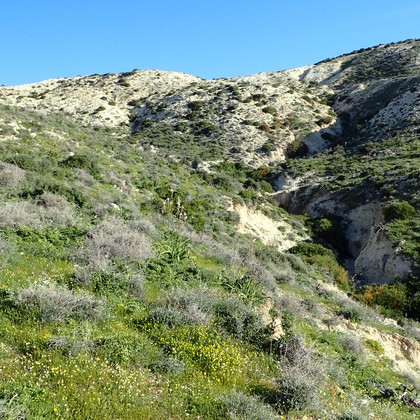
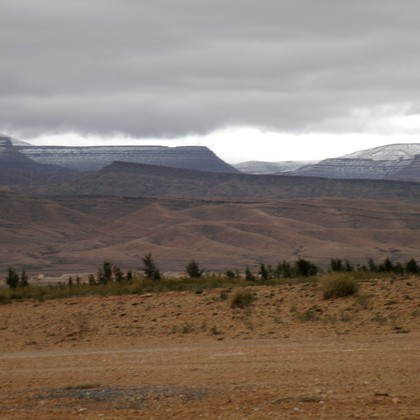
Breeds in cereal fields, fallow land, young plantations and rough herbaceous steppe, also on high plateaus and in damp plains with tall grass. On migration over all kinds of open country, including the desert, with stopovers in steppes and farmland. Hunts small rodents, small birds, lizards and large insects.
Where the bird is most at home, classified by the habitats of North Africa and the Middle East.

Range and movements
Breeds in Morocco, mainly in the plains of the northwest and the Atlantic coast and on the high plateaus of the Middle Atlas, and in northern Algeria and Tunisia; in Libya at most a rare breeder. Throughout the region a passage migrant on a broad front across the Sahara and Arabia: numerous in Morocco, which is an important spring stopover for western European birds, and fairly common in Tunisia, Libya, Egypt, Israel, Jordan, Lebanon, Syria, Iraq and Arabia. A few also winter in southwest Arabia and Yemen. Beyond the region it breeds from Europe to Central Asia; winters in the Sahel, East Africa and India.
- Summer visitor (c. Oct–Mar)
- Winter visitor (c. Apr–Sep)
- Passage (Mar–Apr, Oct–Nov)
- dark = core range, pale = thinly spread
How and when to look
In Morocco Montagu's Harrier hunts in April and May over the cereal fields of the northwest and the high plateaus near Midelt. In Israel it can be seen on migration over the Arava and Hula valleys. On a gliding male look for the black bar across the secondaries.
Conservation status
Not threatened, but vulnerable because it nests in cereal fields: nests and young are lost to early harvesting. In Morocco the major spring stopover has deteriorated through drought and overgrazing, reducing prey. Pesticides, shooting and habitat loss in the Sahel also play a role.
Scientific name
Circus pygargus | (Linnaeus, 1758)
Linnaeus described the species in 1758 as Falco Pygargus; because it was later moved to another genus, the author and year stand in brackets. The genus Circus was introduced in 1799 by De Lacépède. Circus is from the Ancient Greek kirkos, a bird of prey named for its circling flight. pygargus goes back to the Ancient Greek pugargos 'white-rumped', from puge 'rump' and argos 'white'. The specimen the first description was based on came from England.