All species › Birds of prey › Hawks, eagles and kites › Western Marsh Harrier
Western Marsh Harrier | Circus aeruginosus
Bruine kiekendief | Aguilucho lagunero occidental
The Western Marsh Harrier is the largest and heaviest harrier of the region, gliding slowly and rocking over reedbeds and marshes with raised wings. It breeds in the large marshes of the Maghreb, the Levant and Mesopotamia, and in winter it is the commonest harrier of the Nile Delta, the Gulf and the wetlands of Arabia.
Voice
Usually silent. In the breeding season the male calls a high, nasal kwee-a in display flight, and the female begs at food passes with a whining pee-pee.
Recording: Lars Edenius — CC BY-NC-SA 4.0 · converted to mono · xeno-canto
Identification
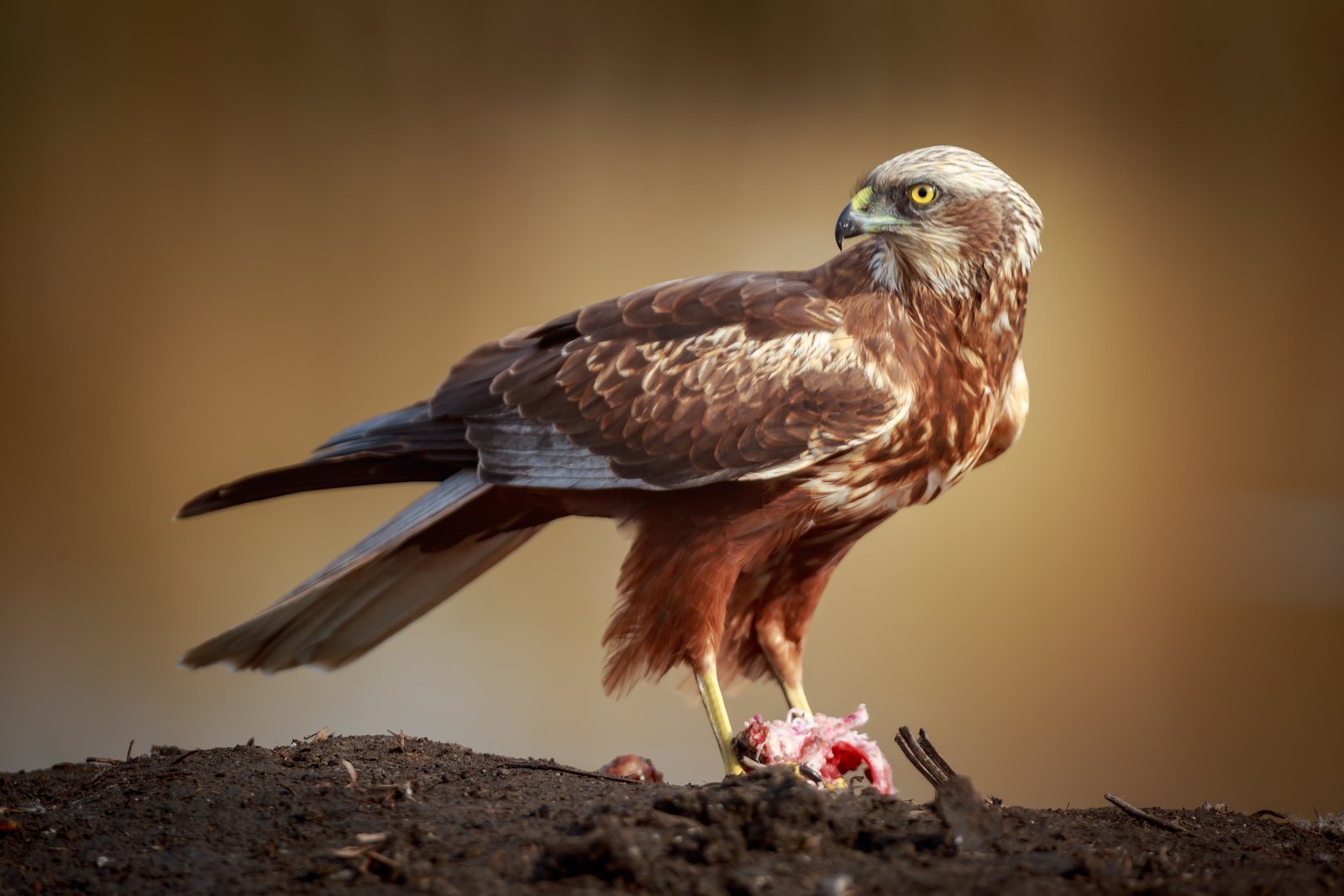
43–55 cm, wingspan 115–140 cm. Broader-winged and heavier than the other harriers, with the wings held in a clear V. The male has a brown back and belly, a pale, streaked head and breast, grey wing panels and a grey tail, and black primaries. The female is dark chocolate-brown with a cream crown and throat and often a pale leading edge to the wing. The juvenile resembles the female but is sometimes almost entirely dark, with at most a pale crown. Males of the North African race harterti are darker on the back and wing coverts, with a paler, heavily streaked head and breast.
Confusion species
Hen Harrier (Circus cyaneus) and Montagu's Harrier (Circus pygargus) are slimmer and more lightly built and always have a white or grey rump, which Western Marsh Harrier lacks. A dark juvenile may resemble Black Kite (Milvus migrans), but that has a forked tail and soars on flat wings. A dark Montagu's Harrier is also a possibility, but it is much slimmer and more pointed-winged.
Habitat
Breeds in extensive reedbeds and marshes, along lakes, lagoons, rivers and canals. In winter also over wet fields, rice paddies, fish farms, coastal marshes, salt flats, mangroves and irrigated farmland. Hunts low for waterbirds and their young, small mammals, frogs and fish, and also takes carrion.
Where the bird is most at home, classified by the habitats of North Africa and the Middle East.



Range and movements
Breeds in the marshes of northern Morocco (among others Merja Zerga, Sidi Bou Ghaba and the Moulouya mouth), northern Algeria (the lakes near El Kala) and Tunisia (Ichkeul). In the Middle East it breeds in small numbers in Israel, in Syria and in the marshes of southern Iraq. In winter and on passage a common sight in wetlands throughout the region: numerous in the Nile Delta and Nile valley of Egypt, in Israel and in Iraq, and a common winter visitor to the wetlands of Saudi Arabia, Kuwait, Bahrain, Qatar, the Emirates, Oman and Yemen; also crosses the Sahara on migration. Beyond the region it breeds from western Europe to Central Asia; winters in southern Europe, Africa and South Asia.
- Resident
- Summer visitor (c. Oct–Mar)
- Winter visitor (c. Apr–Sep)
- Passage (Mar–Apr, Oct–Nov)
- dark = core range, pale = thinly spread
How and when to look
In winter Western Marsh Harrier can be expected at any reedbed in the Nile Delta in Egypt, and in Israel in the Hula Valley and at the fish ponds of the Bet She'an valley. In Morocco at Merja Zerga all year round. Look for the cream head of the female, which stands out against the dark body.
Conservation status
Not threatened. In the region vulnerable to the drainage of marshes, as in southern Iraq in the 1990s, to poisoning by pesticides and to shooting. The European population has recovered strongly since the 1970s.
Scientific name
Circus aeruginosus | (Linnaeus, 1758)
Linnaeus described the species in 1758 as Falco aeruginosus; because it was later moved to another genus, the author and year stand in brackets. The genus Circus was introduced in 1799 by De Lacépède. Circus is from the Ancient Greek kirkos, a bird of prey named for its circling flight. aeruginosus is Latin for 'rusty', from aerugo 'rust, verdigris'. The specimen the first description was based on came from Sweden.