All species › Pelicans, herons and ibises › Ibises and spoonbills › Northern Bald Ibis
Northern Bald Ibis | Geronticus eremita
Heremietibis | Ibis eremita
One of the rarest birds of the region: a black ibis with a bare red head and a shaggy ruff, now breeding in the wild only on the Atlantic coast of south-west Morocco. The birds nest on ledges in sea cliffs and feed in flocks on the bare coastal steppe, often among sheep and goats.

Voice
At the colony a guttural, hoarse hyoh or chrup, and a series of gurgling and cackling notes during greetings; usually silent elsewhere.
Recording: SonoNatura — CC BY-NC-SA 4.0 · converted to mono · xeno-canto
Identification
Large and stocky, short-legged for an ibis. The plumage is black with a metallic green and purple gloss and a coppery patch on the upper wing; long, narrow feathers on the hindneck form a ragged ruff. Head and throat are bare and reddish, with a dark crown in older birds; bill long, decurved and red, legs pinkish-red. Juveniles have a feathered grey head, a duller bill and little gloss. Flies with powerful wingbeats on broad, deeply fingered wings, often in flocks in formation.
Confusion species
Glossy Ibis (Plegadis falcinellus) is slimmer and longer-legged, with a dark bill and feathered head, and lives in marshes. Grey-headed juvenile Northern Bald Ibises can resemble a dark ibis but are plumper and shorter-legged. At a distance a flying flock can look like crows or Great Cormorants (Phalacrocorax carbo) until the curved bills show.
Habitat
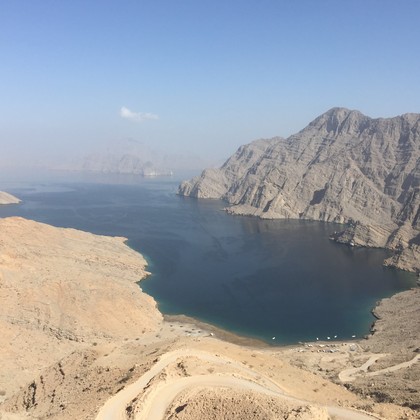
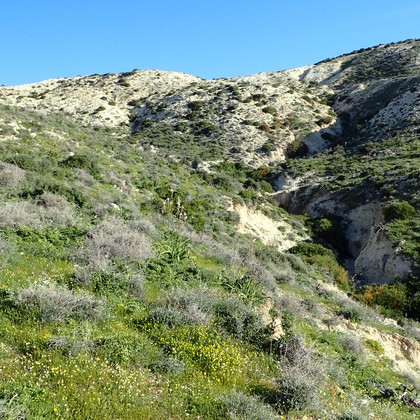
Breeds on ledges and in niches on coastal cliffs and rock faces, in Morocco within a few kilometres of the sea. Feeds on open, bare or short-vegetated ground: coastal steppe, fallow fields, grazed land and sandy plains, where it probes the soil for beetles, larvae, grasshoppers and lizards. Drinks and bathes at river mouths and springs.
Where the bird is most at home, classified by the habitats of North Africa and the Middle East.

Range and movements
In the wild now only in south-west Morocco, in Souss-Massa National Park and on the cliffs around Tamri north of Agadir. The birds stay in this coastal strip year-round and wander along the coast outside the breeding season; occasional birds are seen further north, as near Larache, some possibly from the released population in Andalusia. Formerly it also bred in Morocco's Middle and High Atlas, in Algeria and in the Middle East. In Syria a relict colony of a few pairs was found at Palmyra in 2002 and disappeared around 2014; these eastern birds wintered in the Ethiopian highlands and migrated via Saudi Arabia and Yemen, where tagged and unmarked birds were recorded. In Jordan, Israel and elsewhere in Arabia it is now a very rare vagrant. Beyond the region semi-wild and reintroduced populations exist in Turkey (Birecik), Spain and central Europe.
- Resident
- Summer visitor (c. Oct–Mar)
- Winter visitor (c. Apr–Sep)
- Passage (Mar–Apr, Oct–Nov)
- dark = core range, pale = thinly spread
How and when to look
The birds are best seen in the coastal strip between Agadir and Tamri and in Souss-Massa National Park, especially early in the morning when flocks feed on the steppe or in fields. Keep away from the colonies and do not visit the cliffs on your own: the wardens know where the flocks are, and disturbance at breeding sites is one of the main threats.
Conservation status
Endangered. After centuries of decline only the Moroccan population survived; colony wardening, artificial drinking sites and cooperation with local people raised it to a record 147 breeding pairs in 2018, and in 2018 the species was downlisted from Critically Endangered to Endangered. The population has grown further since, but remains vulnerable because of its small size, coastal development around Agadir, disturbance and loss of feeding habitat.
Scientific name
Geronticus eremita | (Linnaeus, 1758)
Linnaeus described the species in 1758 as Upupa Eremita; because it was later moved to another genus, the author and year stand in brackets. The genus Geronticus was introduced in 1832 by Wagler. Geronticus comes from Greek gerōn 'old man', alluding to the bald, wrinkled head. eremita is Late Latin for 'hermit', from Greek erēmia 'desert', after the arid country the bird inhabits. The specimen the first description was based on came from Switzerland.