All species › Pelicans, herons and ibises › Ibises and spoonbills › Eurasian Spoonbill
Eurasian Spoonbill | Platalea leucorodia
Lepelaar | Espátula común
A large white wader with a long bill broadened into a spoon at the tip, which walks through shallow water sweeping its head from side to side. In the region a distinct subspecies breeds on islets and in mangroves of the Red Sea, while birds from Europe and Asia winter on the lagoons of North Africa and the Persian Gulf.

Voice
Almost silent. At the colony a low grunting and croaking and a dry bill-clattering.
Recording: Sonothèque ADVL — CC0 · converted to mono · xeno-canto
Identification
Large and all white, with long black legs and a long, flat black bill with a yellow spatulate tip. In the breeding season a long, drooping white crest, an ochre-yellow breast band and a bare yellow throat patch. In winter plumage without crest and breast band. Juveniles have a flesh-coloured to pinkish-grey bill, paler legs and black tips to the primaries, conspicuous in flight. Flies with neck and legs extended, alternating flaps and glides, often in lines. The Red Sea subspecies archeri is smaller with a shorter crest.
Confusion species
African Spoonbill (Platalea alba) has a bare red face, red legs and a grey bill with red edges, and is a rare vagrant in the region. Great Egret (Ardea alba) and Little Egret (Egretta garzetta) have pointed bills and fly with the neck retracted; the white morph of Western Reef Heron (Egretta gularis) is slimmer with a yellow or brownish dagger bill.
Habitat
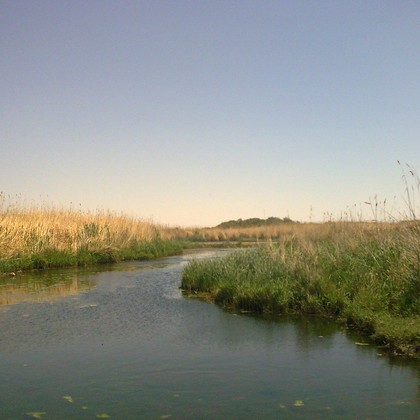
Shallow salt, brackish and fresh water: coastal lagoons, tidal flats, mangroves, salt pans, estuaries, marshes and fishponds. Feeds by sweeping the half-open bill sideways through the water for shrimps, small fish and aquatic insects, often in small groups. Breeds in colonies on islets, in mangroves and in reed marshes.
Where the bird is most at home, classified by the habitats of North Africa and the Middle East.


Range and movements
The subspecies archeri breeds on islets and in mangroves along the Red Sea in Egypt, Saudi Arabia and Yemen and stays there year-round; birds of this type also occur along the coast of Oman. The nominate form breeds in small numbers in the marshes of southern Iraq. Otherwise a passage migrant and winter visitor from Europe and Asia: along Morocco's Atlantic coast (Merja Zerga, Oualidia, Khnifiss and Dakhla Bay), in Tunisia (Gulf of Gabès), in Egypt (delta lakes and Bardawil), in Israel, and along the whole Persian Gulf from Kuwait to the Emirates and Oman. Inland mainly on passage, including in the Jordan Valley. Beyond the region it breeds from the Netherlands and Spain to East Asia and India, with a distinct subspecies on the Banc d'Arguin in Mauritania; western European birds winter as far as West Africa.
- Resident
- Summer visitor (c. Oct–Mar)
- Winter visitor (c. Apr–Sep)
- Passage (Mar–Apr, Oct–Nov)
- dark = core range, pale = thinly spread
How and when to look
In winter, flocks are often present along the Gulf of Gabès, on the Egyptian delta lakes and in the lagoons of Kuwait and Abu Dhabi. In Morocco, Merja Zerga is a good site in winter and on passage, and colour rings of Dutch and Spanish birds can regularly be read there. Along the Red Sea, for example in the mangroves near Jizan, the breeding archeri birds can be seen year-round.
Conservation status
Not globally threatened, and strongly increased in western Europe after protection. In the region it is vulnerable to loss and disturbance of wetlands, coastal development along the Gulf and the Red Sea, mangrove cutting and egg collecting at colonies. The small breeding populations in Iraq and on the Red Sea are poorly known.
Scientific name
Platalea leucorodia | Linnaeus, 1758
Linnaeus described the species in 1758 and placed it straight away in the genus where it still stands. He introduced the genus Platalea in that same work. Platalea is the Latin word for the spoonbill, going back to Greek platus 'broad, flat', after the bill. leucorodia comes from Greek leukerōdios 'spoonbill', formed from leukos 'white' and erōdios 'heron'. The specimen the first description was based on came from Sweden.