All species › Pelicans, herons and ibises › Ibises and spoonbills › African Sacred Ibis
African Sacred Ibis | Threskiornis aethiopicus
Heilige ibis | Ibis sagrado
The sacred bird of ancient Egypt, mummified by the hundreds of thousands in the temples, has not bred along the Nile since the nineteenth century. In the region it now lives in two guises: as a native breeder in the marshes of southern Iraq and on the Red Sea coast of Yemen, and as a feral escape in Israel and the Gulf states.

Voice
Usually silent. At colonies and in squabbles a hoarse, groaning and squealing croak.
Recording: African Bioacoustics Community — CC BY-NC-SA 4.0 · converted to mono · xeno-canto
Identification
Large and white, with a bare black head and neck and a long, thick, decurved black bill. The elongated black tertials hang as a dark plume over the tail. In flight white with a narrow black trailing edge to the wing; a reddish strip of bare skin runs under the wing. Legs black. Juveniles have a feathered, white-mottled blackish head and neck and less black in the wing.
Confusion species
With its black head and neck on a white body it is hardly confusable. White Stork (Ciconia ciconia) is much larger, with a red bill and legs and black wings. Eurasian Spoonbill (Platalea leucorodia) is all white with a straight spatulate bill. Juveniles may recall Glossy Ibis (Plegadis falcinellus) but have a pale body.
Habitat
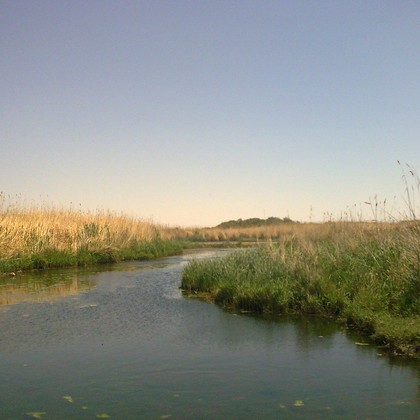
Marshes, riverbanks, coastal lagoons, tidal flats and mangroves; also farmland, rubbish dumps, sewage ponds, fishponds, zoos and city parks. An omnivore taking insects, crustaceans, frogs, eggs and young of other birds, and refuse. Breeds in colonies in trees, bushes or on islets, often with herons.
Where the bird is most at home, classified by the habitats of North Africa and the Middle East.


Range and movements
Native in the marshes of southern Iraq (including the Hawizeh marshes), where a small, declining population breeds, and on the Red Sea coast of Yemen, where it breeds on islets and near Hodeidah and Aden; it also visits the coast of south-west Saudi Arabia and is a vagrant to Socotra. In Egypt it was common until the early nineteenth century but had disappeared by about 1850; later sightings concern vagrants or escapes. Feral populations, derived from zoos and bird parks and not native to the region, have bred since the 1990s in Israel (coastal plain and Hula Valley) and in the United Arab Emirates, mainly around Dubai and Abu Dhabi, with single birds and small groups in Bahrain, Qatar and Oman. Beyond the region native to sub-Saharan Africa; feral in France, Italy, Spain and Taiwan, among others.
- Resident
- Summer visitor (c. Oct–Mar)
- Winter visitor (c. Apr–Sep)
- Passage (Mar–Apr, Oct–Nov)
- dark = core range, pale = thinly spread
How and when to look
In the Emirates it is almost guaranteed in parks, at sewage ponds and at Ras al Khor in Dubai. In Israel flocks feed at the rubbish dumps and fishponds of the coastal plain and the Hula Valley. Native birds are best looked for along the Tihama coast of Yemen and in the marshes of southern Iraq.
Conservation status
Not globally threatened. The small native population in Iraq is vulnerable to drainage and drying of the marshes. The feral populations in Israel and the Gulf states are growing and, as in Europe, are regarded as invasive because they raid colonies of other waterbirds.
Scientific name
Threskiornis aethiopicus | (Latham, 1790)
Latham described the species in 1790 as Tantalus aethiopicus; because it was later moved to another genus, the author and year stand in brackets. The genus Threskiornis was introduced in 1842 by Gray. Threskiornis is Greek, from thrēskos 'religious' and ornis 'bird', after the veneration of the ibis in ancient Egypt. aethiopicus means 'Ethiopian'; to classical writers the name stood for Africa south of Egypt. The specimen the first description was based on came from Egypt.