All species › Gannets and cormorants › Gannets › Northern Gannet
Northern Gannet | Morus bassanus
Jan-van-gent | Alcatraz atlántico
The largest seabird of the North Atlantic, a cigar-shaped plunge-diver that drops into the sea from a great height with folded wings. It breeds far outside the region, but every winter thousands, mostly young birds, move south along the Moroccan coast; in the Mediterranean it becomes ever scarcer to the east.
Voice
Almost always silent in the region. At colonies and feeding frenzies a harsh, rasping arrah-arrah.
Recording: Christian Kerihuel — CC BY-NC-SA 4.0 · converted to mono · xeno-canto
Identification
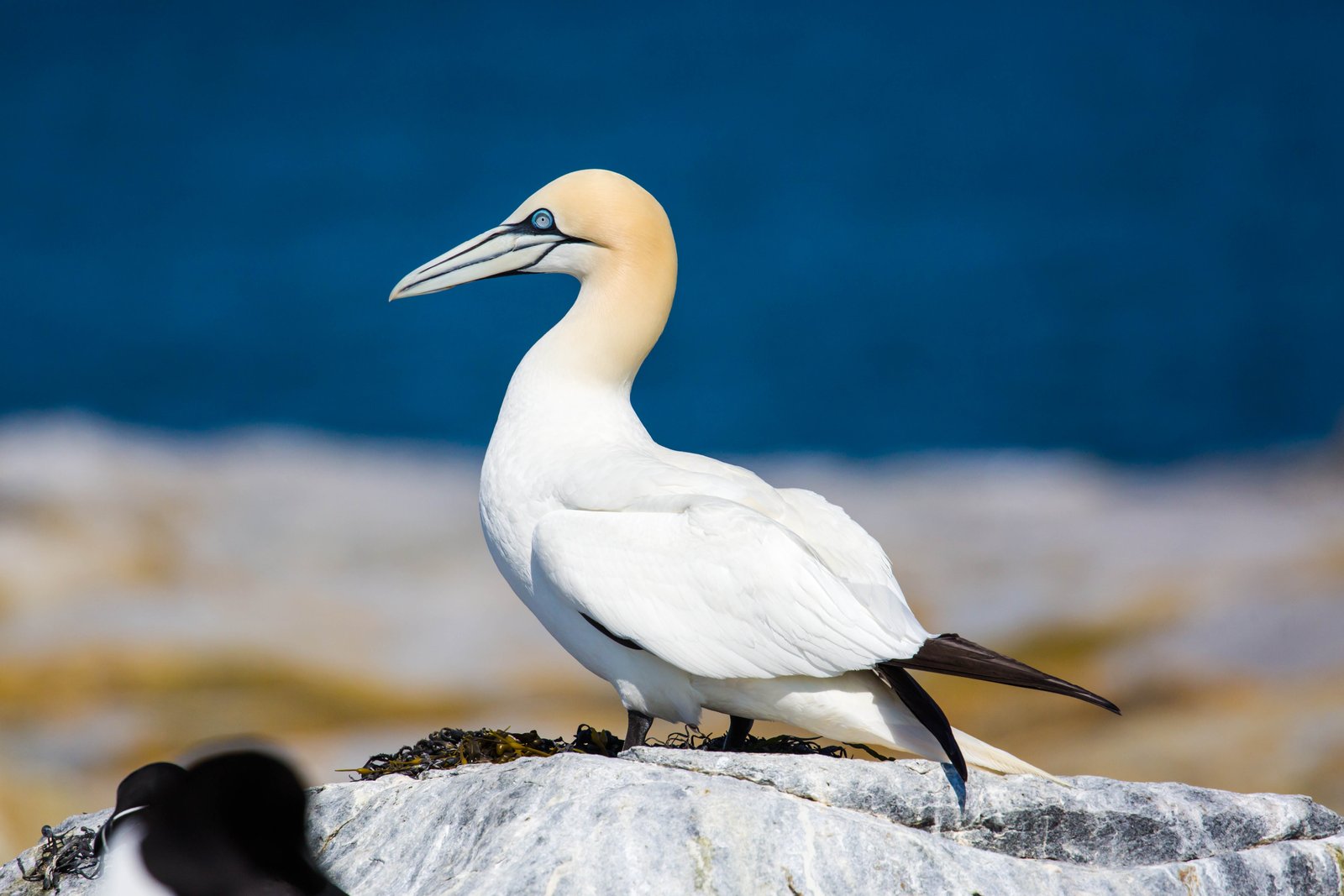
Large and slender, with a long, pointed bill, a pointed tail and long, narrow wings: in flight a cross with four points. The adult is brilliant white with sharply defined black primaries, an ochre-yellow head and neck, a blue-grey bill and a pale blue eye set in black bare facial skin. Juveniles are dark grey-brown with fine white spotting in their first year; over the next four years they whiten in stages, first on the head and belly, with a pied, chequered black-and-white wing pattern. Flies with stiff, powerful beats alternating with glides, often in long lines low over the waves.
Confusion species
Cape Gannet (Morus capensis), an extreme vagrant to the region, has an all-black tail, black secondaries and a much longer black throat stripe. Masked Booby (Sula dactylatra) is smaller with a white head, a black mask and also black secondaries and tail; the two hardly overlap in the region. Dark juveniles can recall Scopoli's Shearwater (Calonectris diomedea) or Great Skua (Stercorarius skua) at a distance, but are much larger, with a long pointed bill and a pointed tail.
Habitat
Open sea over the continental shelf, often within a few kilometres of the coast, and large bays and straits. It follows shoals of sardine, mackerel and anchovy, often hunting in groups and behind fishing boats. Rests on the water; comes ashore only when exhausted or sick.
Where the bird is most at home, classified by the habitats of North Africa and the Middle East.


Range and movements
Morocco: common winter visitor and passage migrant along the whole Atlantic coast, from Tangier via Essaouira and Agadir to Western Sahara at Dakhla; young birds continue to Mauritania and Senegal. Also in the Strait of Gibraltar and along the Moroccan Mediterranean coast. Algeria and Tunisia: regular winter visitor in smaller numbers, for example in the Gulf of Tunis, around Cap Bon and in the Gulf of Gabès. Libya: scarce, east to the Gulf of Sirte. Israel: since the 1990s a small but regular winter visitor off the Mediterranean coast; rare in Lebanon, Syria and on the Egyptian Mediterranean coast. A vagrant in the Red Sea, with sightings at El Gouna in Egypt in 2013 and 2014. Breeds in the North Atlantic, from Canada and Iceland to Norway, the British Isles and Brittany.
- Resident
- Winter visitor (c. Apr–Sep)
- Passage (Mar–Apr, Oct–Nov)
- dark = core range, pale = thinly spread
How and when to look
Seawatching from a headland on the Moroccan Atlantic coast, such as Cap Ghir, Cap Sim near Essaouira or Cap Spartel near Tangier, often yields tens to hundreds of birds from November to March, especially in westerly winds. In the east of the region, scan the sea in winter from the piers of Haifa or Tel Aviv.
Conservation status
Not globally threatened; the population grew for decades, but the avian influenza outbreak of 2022 killed tens of thousands of breeding birds in nearly all colonies. In the region, wintering birds are threatened mainly by bycatch in fishing gear, oil pollution and overfishing of small shoaling fish.
Scientific name
Morus bassanus | (Linnaeus, 1758)
Linnaeus described the species in 1758 as Pelecanus Bassanus; because it was later moved to another genus, the author and year stand in brackets. The genus Morus was introduced in 1816 by Vieillot. Morus goes back to the Greek mōros 'foolish, stupid': early travellers remarked that gannets and boobies at their colonies allowed a close approach and were easily killed. bassanus means 'of Bass Rock', the rock in the Firth of Forth that holds one of the largest colonies. The specimen the first description was based on came from Bass Rock, Scotland.