All species › Passerines › Chats and flycatchers › Pied Wheatear
Pied Wheatear | Oenanthe pleschanka
Bonte tapuit | Collalba pía
The Pied Wheatear breeds from the Black Sea to Mongolia and migrates in large numbers through the east of the region in spring and autumn to its winter quarters in East Africa and south-west Arabia. Especially in spring it is one of the commonest wheatears in Iraq, Kuwait and eastern Arabia; west of Egypt it is scarce.
Voice
The call is a hard chak and a whistled weet. The song is a short, varied phrase of scratchy notes, whistles and mimicry, sometimes heard on spring passage.
Recording: Richard E. Webster — CC BY-NC-SA 4.0 · shortened to the first 60 s, mono · xeno-canto
Identification
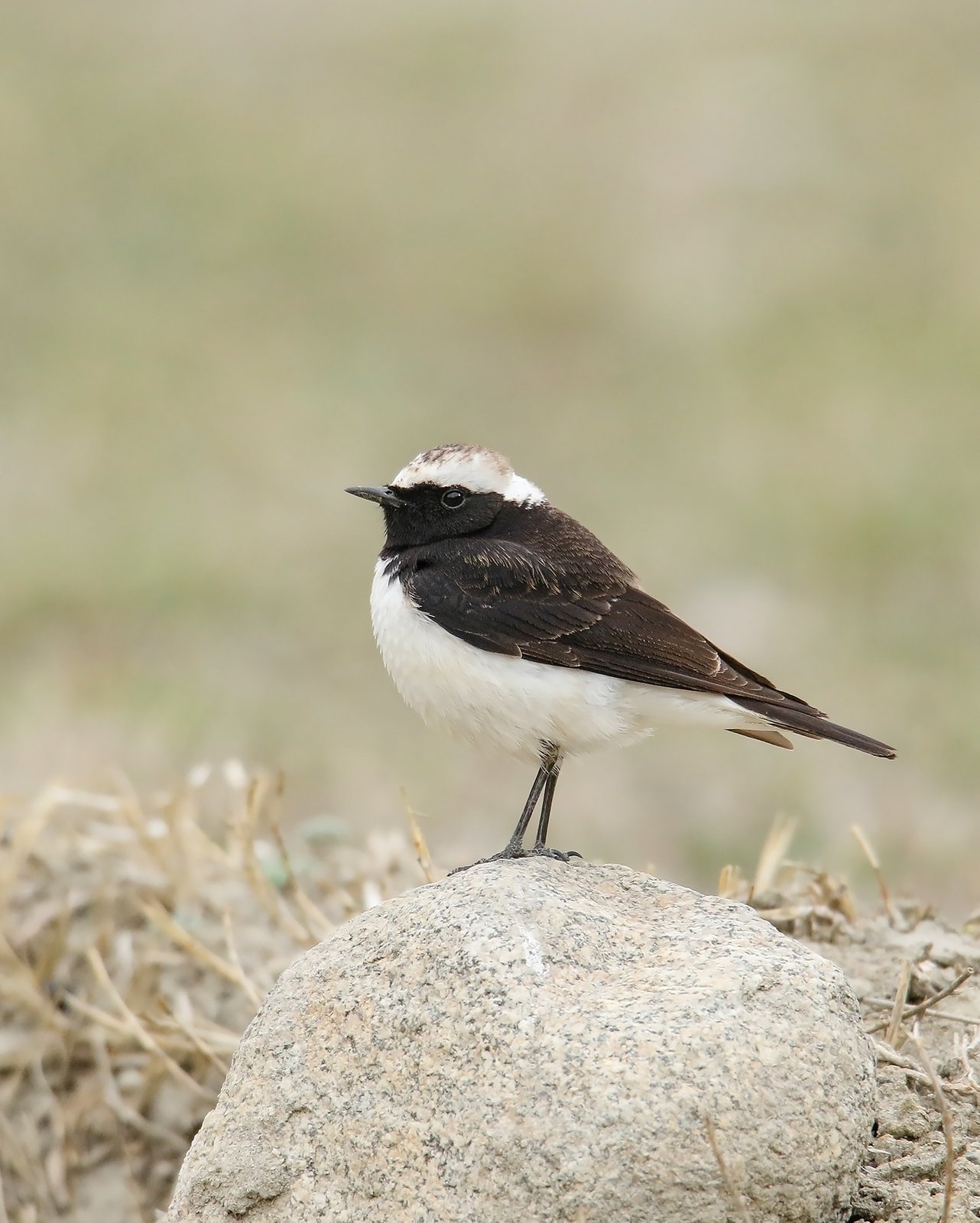
14–16.5 cm. The spring male is black and white: a white to greyish-white crown and nape, and a black face, throat, mantle and wings, the black of the throat continuing unbroken along the side of the neck to the black mantle. Breast and belly are white with a creamy to pale orange wash on the breast; rump and tail white, with a black T-pattern of central feathers and a narrow terminal band, broader on the outer feathers. In fresh autumn plumage pale fringes give crown and mantle a scaly, grey-brown look. The female is cold grey-brown with a dark throat or breast and a faint supercilium. A rare white-throated morph (vittata) exists.
Confusion species
Cyprus Wheatear (Oenanthe cypriaca), which migrates through Israel and Egypt to Sudan, is very similar but smaller and shorter-winged, with a darker, blackish-grey crown, a warmer orange-buff breast and a narrower white rump; its song is a buzzing, insect-like bizz-bizz. Eastern Black-eared Wheatear (Oenanthe melanoleuca) has a pale mantle; in black-throated males the black of the throat does not continue onto the back. Mourning Wheatear (Oenanthe lugens) is bulkier, with a pure white crown and warm buff undertail-coverts. Females are hard to separate from females of Eastern Black-eared Wheatear and Northern Wheatear (Oenanthe oenanthe); look for the cold grey-brown tone and dark throat.
Habitat
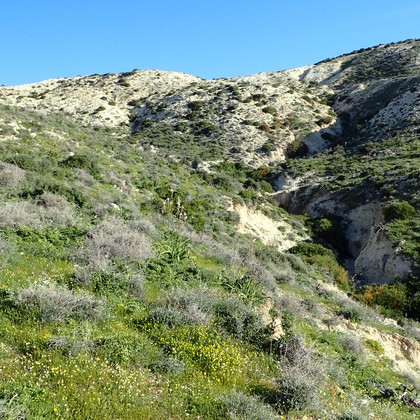
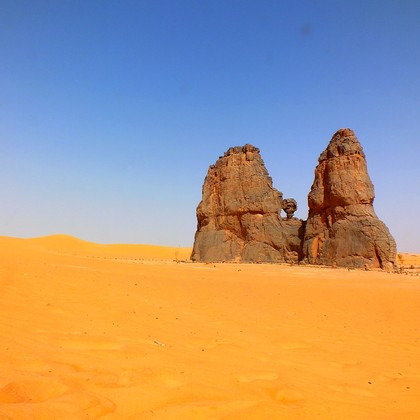
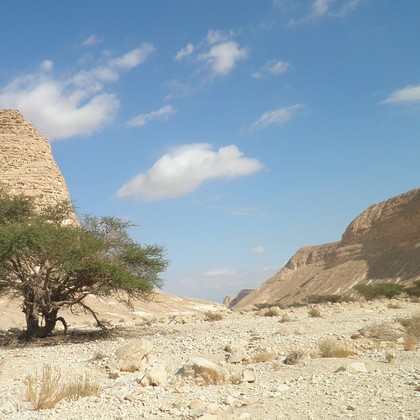
On migration almost any open country with perches: steppe, semi-desert, rocky slopes, wadis, field edges, parks and gardens, often on low walls, fences and stones. In its winter quarters in south-west Arabia on dry, rocky slopes with scattered bushes.
Where the bird is most at home, classified by the habitats of North Africa and the Middle East.
Range and movements
A common passage migrant in Iraq, Kuwait, Bahrain, Qatar, Saudi Arabia (especially in the east; in spring from February to mid-May, peaking in March; in autumn less common, September to mid-December), the Emirates and Oman. Scarcer in Jordan, Syria and Israel, and scarce to rare in Egypt; further west in North Africa a vagrant. Winters in small numbers in Yemen and south-west Saudi Arabia. Beyond the region the species breeds from eastern Romania and Bulgaria through Ukraine, the Caucasus and northern Iran to Central Asia and Mongolia, wintering mainly in East Africa, from Ethiopia and Somalia to Kenya.
- Summer visitor (c. Oct–Mar)
- Winter visitor (c. Apr–Sep)
- Passage (Mar–Apr, Oct–Nov)
- dark = core range, pale = thinly spread
How and when to look
Visit the coast and fields of eastern Saudi Arabia, Kuwait or Bahrain in March: after a north-westerly wind Pied Wheatears may sit on every post and wall. In the Emirates and Oman, parks, golf courses and farmland such as Sun Farms in Sohar are good places.
Conservation status
Not globally threatened, with a large breeding range. No trends are known for the numbers on passage in the region.
Scientific name
Oenanthe pleschanka | (Lepekhin, 1770)
Lepekhin described the species in 1770 as Motacilla pleschanka; because it was later moved to another genus, the author and year stand in brackets. The genus Oenanthe was introduced in 1816 by Vieillot. Oenanthe was used by Aristotle for a bird that can no longer be identified; the word comes from the Greek oinos, oinoē 'wine, vine' and anthos 'flower, bloom'. pleschanka is the Russian name for the bird, from plesch 'bald spot on the head', after the white crown. The specimen the first description was based on came from Saratov on the Volga.