All species › Passerines › Chats and flycatchers › Seebohm's Wheatear
Seebohm's Wheatear | Oenanthe seebohmi
Seebohms tapuit | Collalba de Seebohm
Seebohm's Wheatear is the wheatear of the high plateaus of the Atlas: a breeding bird confined to Morocco and Algeria that winters in the western Sahel. It was long treated as a subspecies of Northern Wheatear; the black face and throat of the male usually make it easy to recognise in the field.

Voice
The call is a hard chak and a whistled weet, as in Northern Wheatear. The song is a fast, scratchy phrase with whistles, somewhat slower and lower than Northern Wheatear's and with more distinct rising and falling phrases, often in song flight.
Recording: Tero Linjama — CC BY-NC-SA 3.0 · converted to mono · xeno-canto
Identification
14.5–15.5 cm, built like Northern Wheatear. The breeding male has a blue-grey crown and mantle with a broad white forehead band and supercilium, and a black face in which mask, chin and throat merge into a black bib, sometimes reaching the upper breast. Wings black, underwing coverts black. Underparts whiter than in Northern Wheatear, with at most a faint buff wash. Tail pattern as in Northern Wheatear, a white rump with a black inverted T, but with a slightly narrower terminal band. Females are variable: some closely resemble a female Northern Wheatear, others have a dark chin and lores with pale fringes and greyer upperparts.
Confusion species
Male Northern Wheatear (Oenanthe oenanthe) has a white to orange-buff throat and only a black mask; females often cannot be separated without good views of throat and underwing, and Northern Wheatears pass through the Atlas in the same months. The black-throated male of Western Black-eared Wheatear (Oenanthe hispanica) has a cream to ochre back without grey and much more white along the tail sides. Mourning Wheatear (Oenanthe lugens) has a black back and a white crown.
Habitat
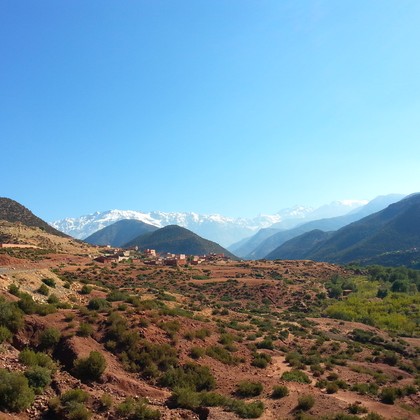
Stony plateaus and sparsely vegetated slopes with scattered boulders and cushion plants, mainly between 1700 and 2300 m; locally much lower in Algeria. It nests in a hole in the ground or between stones. On passage in semi-desert and farmland at the foot of the Atlas.
Where the bird is most at home, classified by the habitats of North Africa and the Middle East.

Range and movements
Breeds in Morocco in the Rif, the Middle Atlas, the High Atlas and the central Anti-Atlas, and in north-east Algeria in the Aurès and the Djurdjura. Migrates through southern Morocco and Western Sahara, in March – April and August – October; a few birds sometimes winter in southern Morocco. Beyond the region it winters in the western Sahel, mainly in south-west Mauritania, northern Senegal and western Mali.
- Summer visitor (c. Apr–Sep)
- Winter visitor (c. Oct–Mar)
- Passage (Mar–Apr, Oct–Nov)
- dark = core range, pale = thinly spread
How and when to look
The Oukaïmeden plateau and the Middle Atlas passes around Ifrane and Zad are the best sites in May – June, when males sing from roadside boulders. Watch for Northern Wheatears passing through at the same time.
Conservation status
Not globally threatened. The population is small and confined to a narrow altitude band, and therefore sensitive to overgrazing and climate change in the Atlas; in the West African winter quarters the decline of savanna also plays a part.
Scientific name
Oenanthe seebohmi | (Dixon, 1882) (GBIF: Oenanthe oenanthe)
Dixon described the species in 1882 as Saxicola seebohmi; because it was later moved to another genus, the author and year stand in brackets. The genus Oenanthe was introduced in 1816 by Vieillot. Oenanthe was used by Aristotle for a bird that can no longer be identified; the word comes from the Greek oinos, oinoē 'wine, vine' and anthos 'flower, bloom'. seebohmi honours the English ornithologist Henry Seebohm (1832–1895), who wrote extensively on Palearctic songbirds. The specimen the first description was based on came from Djebel Mahmel, Algeria.