All species › Passerines › Shrikes › Red-Backed Shrike
Red-Backed Shrike | Lanius collurio
Grauwe klauwier | Alcaudón dorsirrojo
The Red-backed Shrike is the familiar shrike of European scrub and hedges, with a grey head, a black mask and a rufous back. In the region it is mainly a numerous passage migrant in the east, travelling between Europe and western Asia and its winter quarters in southern Africa; it breeds here only in the mountains of the Levant and northern Iraq.

Voice
The call is a hard chek or chak, speeding up to a rattling chek-chek-chek when alarmed. The song is a soft, sustained warble with much mimicry, heard in the region only at breeding sites.
Recording: Azens — CC BY-NC-SA 4.0 · converted to mono · xeno-canto
Identification
16–18 cm. The male has a blue-grey crown, nape and rump, a narrow black mask reaching the base of the bill, and a warm rufous back and wing-coverts. The tail is black with white sides at the base; underparts white with a pink wash on breast and flanks. The female is rufous-brown to greyish-brown above with a brown mask and fine crescent-shaped barring on the whitish underparts. Juveniles are warm brown, densely scaled above and below, with dark subterminal fringes to the coverts.
Confusion species
Isabelline Shrike (Lanius isabellinus) and Red-tailed Shrike (Lanius phoenicuroides) have a rufous tail and rump and a plainer sandy or greyish-brown back; females and young are best identified on these features. Bay-backed Shrike (Lanius vittatus) has a black forehead, a whitish rump and a white primary patch. Young Woodchat Shrikes (Lanius senator) are greyer, with a pale scapular patch and pale rump.
Habitat
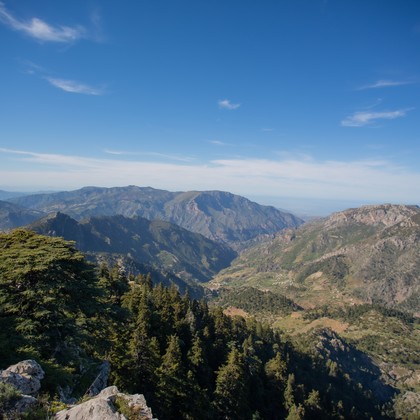
Breeds in semi-open terrain with thorny bushes: scrub on mountain slopes, hedges, woodland edges and rough pastures, on Mount Hermon above the tree line. On migration in any terrain with bushes or trees: oases, gardens, parks, acacia wadis, olive groves and coastal scrub. Hunts from a bush for beetles, bumblebees and grasshoppers and impales prey on thorns.
Where the bird is most at home, classified by the habitats of North Africa and the Middle East.


Range and movements
Breeds in small numbers in the mountains of Israel (mainly on Mount Hermon, scarce on the Golan and in Upper Galilee), in Lebanon, western Syria and northern Iraq (Kurdistan). Numerous on passage through the eastern part of the region: in autumn, August to October, mainly through Egypt, Israel, Jordan and western Arabia, and in spring, late April and May, further east through Iraq, Kuwait, Saudi Arabia, the Gulf states, Oman and Yemen. Scarce in Libya, a rare migrant in the Maghreb. Beyond the region it breeds across almost all of Europe to western Siberia and Iran and winters in eastern and southern Africa.
- Resident
- Summer visitor (c. Oct–Mar)
- Passage (Mar–Apr, Oct–Nov)
- dark = core range, pale = thinly spread
How and when to look
In May the parks and farmland of Kuwait, Qatar and the Emirates can be full of migrants; in September it sits on every bush at Eilat and in Sinai. To see breeders, visit the slopes of Mount Hermon in June.
Conservation status
Not globally threatened. In Europe locally recovered after a long decline. The small Israeli population is listed as Vulnerable on the national Red List, owing to afforestation, agriculture and the construction of roads and ski runs on Mount Hermon. Trapping occurs on migration.
Scientific name
Lanius collurio | Linnaeus, 1758
Linnaeus described the species in 1758 and placed it straight away in the genus where it still stands. He introduced the genus Lanius in that same work. Lanius is Latin for 'butcher', from shrikes' habit of impaling prey on thorns and barbed wire. collurio goes back to Ancient Greek kollurion, a bird mentioned by Aristotle. The specimen the first description was based on came from Sweden.