All species › Passerines › Shrikes › Red-Tailed Shrike
Red-Tailed Shrike | Lanius phoenicuroides
Turkestaanse klauwier | Alcaudón colirrojo
A slim shrike with a rusty red tail that breeds in Central Asia and Iran and winters in East Africa and southern Arabia. In the area of this guide it is chiefly a passage migrant along the Persian Gulf and through inland Arabia; in Oman it has also been proved to breed on a few occasions since 2005.

Voice
Usually silent on migration and in winter. Alarm is a hard, rattling chek-chek-chek and a harsh chair. The song, sometimes heard from spring migrants, is a soft, scratchy chatter with much mimicry.
Recording: Hsishu — CC BY-NC-SA 4.0 · converted to mono · xeno-canto
Identification
16.5–18 cm. The male has a warm rufous crown that contrasts clearly with a grey-brown mantle, a broad black mask that continues across the base of the bill, a crisp white supercilium and clean white underparts with at most a creamy wash on the flanks. Rump and tail are rusty red; a small white patch usually shows at the base of the primaries. The female is duller, with a browner mask and fine vermiculation on breast and flanks. First-year birds are browner and finely scaled above and below, with pale lores. Birds of the karelini type, breeding in north-east Iran, have a greyer crown and less contrast.
Confusion species
Isabelline Shrike (Lanius isabellinus) also has a red tail but is pale sandy with almost no contrast between crown and mantle, a narrower mask that often fails to reach the bill base and a diffuse supercilium; the underparts are warmer and creamier. In females and first-years the two often cannot be separated. Brown Shrike (Lanius cristatus) is uniform warm brown above, with a duller, more graduated tail, a heavier bill and shorter primary projection without a white patch. Red-backed Shrike (Lanius collurio) has a chestnut back and, in the male, a grey head and black-and-white tail; beware of hybrids with mixed tail patterns.
Habitat
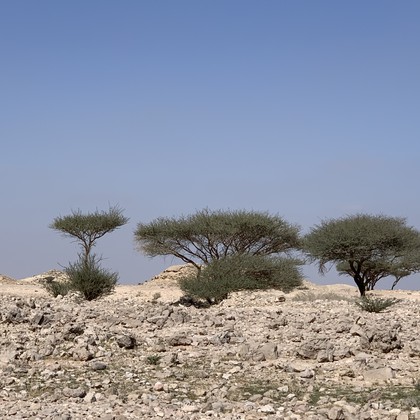
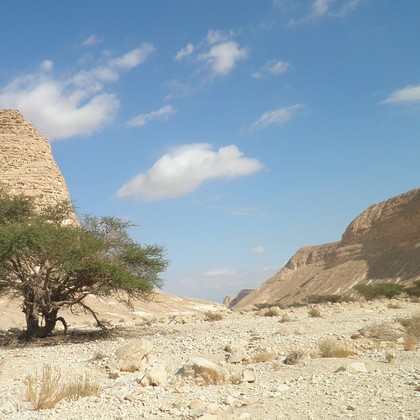
On migration any open ground with bushes and lookout perches: thorn scrub and acacias on the Arabian plains, wadis with tamarisks, field edges, date gardens, parks and golf courses in the Gulf states. Wintering birds use scrub, irrigated farmland and orchards. The few breeding records in Oman came from high plateaus in the Hajar Mountains, in scrub with almond and juniper bushes.
Where the bird is most at home, classified by the habitats of North Africa and the Middle East.

Range and movements
Passage migrant through the east of the area: Iraq, Kuwait, eastern Saudi Arabia, Bahrain, Qatar, the United Arab Emirates and Oman, in spring from March to May and in autumn from August to October, common in the Gulf states. In winter in smaller numbers in Oman, the Emirates, Yemen and south-west Saudi Arabia; in eastern Saudi Arabia it is seen mainly on passage. Bred in 2005 on the Saiq Plateau in Oman, with a few later indications of breeding in Oman and the northern Emirates; a few dozen pairs at most, and not every year. In Israel a scarce migrant, mainly in the Arava and at Eilat; very rare in Jordan, Syria, Lebanon and Egypt, and unknown in the Maghreb. Beyond the area it breeds from the Iranian Plateau and the Kopet Dag through Central Asia to western Xinjiang and winters mainly in East Africa.
- Resident
- Summer visitor (c. Apr–Sep)
- Winter visitor (c. Oct–Mar)
- Passage (Mar–Apr, Oct–Nov)
- dark = core range, pale = thinly spread
How and when to look
In April and September in the Gulf states: check parks, golf courses and farms around Dubai, Abu Dhabi or in Kuwait for shrikes on low bushes and fences. Look first at the contrast between crown and mantle and at the mask above the bill, and do not judge colour against the light.
Conservation status
Not globally threatened (IUCN: Least Concern). Only recently treated as a species separate from Isabelline Shrike, so older Arabian data on the two can partly no longer be disentangled. The small breeding population in Oman is irregular and vulnerable.
Scientific name
Lanius phoenicuroides | (Schalow, 1875)
Schalow described the species in 1875 as Otomela phoenicuroides; because it was later moved to another genus, the author and year stand in brackets. The genus Lanius was introduced in 1758 by Linnaeus. Lanius is Latin for 'butcher', from shrikes' habit of impaling prey on thorns and barbed wire. phoenicuroides means 'resembling a redstart', after the genus Phoenicurus, from Greek phoinix 'red' and -ouros 'tailed', in reference to the rufous tail. The specimen the first description was based on came from Shymkent, Kazakhstan.