All species › Passerines › Shrikes › Brown Shrike
Brown Shrike | Lanius cristatus
Bruine klauwier | Alcaudón pardo
An East Asian shrike that breeds in Siberia, Mongolia, China and Japan and winters in India and South-East Asia. In the area of this guide it is a rare winter visitor, with most records from the United Arab Emirates, Oman and Kuwait; a few birds have stayed the whole winter.
Voice
In winter often calls from a perch: a hard, rattling chrrr-chrrr and a harsh cheh. The song, rarely heard in the area, is a quiet chatter with mimicry.
Recording: João Ferreira Tomás — CC BY-NC-SA 4.0 · shortened to the first 60 s, mono · xeno-canto
Identification
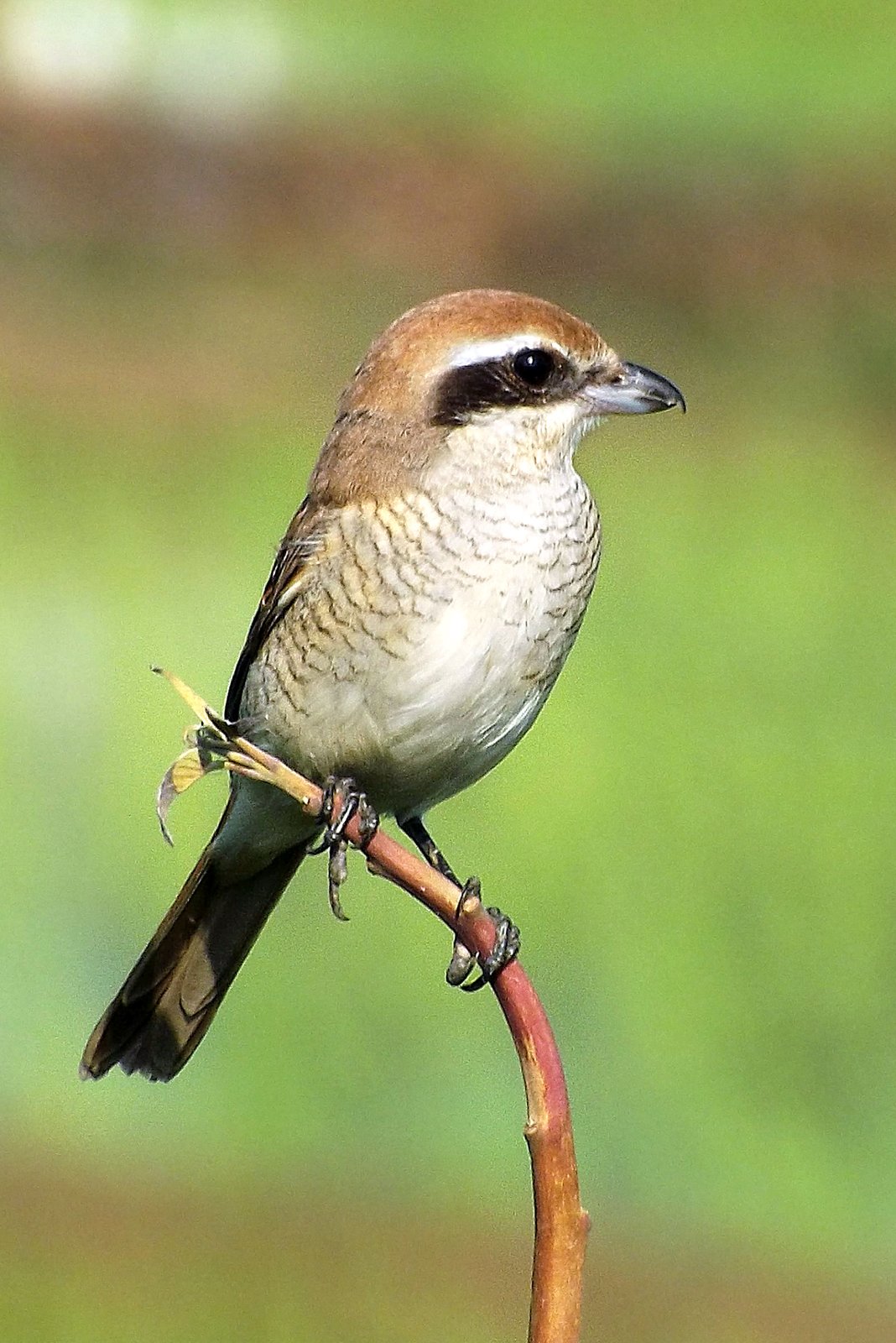
17–20 cm. A fairly robust, uniform warm brown shrike with a relatively large head, a heavy hooked bill and a long, narrow, strongly graduated tail. Upperparts, crown and tail are rufous-brown to warm brown, lacking the contrast of a rusty tail against a greyer back. The black mask is broad and sharp, topped by a white supercilium and often a white forehead. Underparts white with warm buff flanks. The wing is plain brown without a white patch and has a short primary projection (four or five tips). First-years show fine dark scaling on flanks and upperparts and a browner mask. The subspecies lucionensis has a grey crown and mantle.
Confusion species
Red-tailed Shrike (Lanius phoenicuroides) and Isabelline Shrike (Lanius isabellinus) have a rusty red tail contrasting with a greyer or sandy back, a finer bill, longer primary projection and usually a white wing patch. A young Red-backed Shrike (Lanius collurio) has a shorter, less graduated tail with white sides, longer primary projection and heavier scaling above. With a brown-looking shrike in the Gulf every feature must fit; hybrids and moulting birds are known.
Habitat
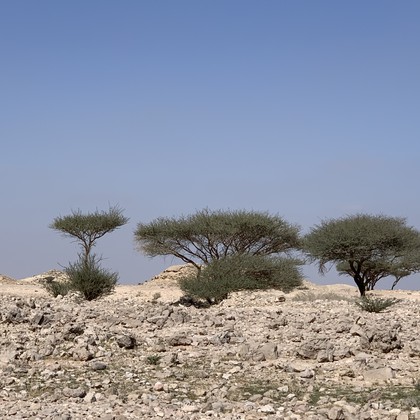
In the area mainly parks, gardens, golf courses, farms and nurseries with bushes and open lawns; also scrub along irrigated farmland and stands of trees in wadis. Wintering birds hold a fixed territory and use the same perches day after day.
Where the bird is most at home, classified by the habitats of North Africa and the Middle East.


Range and movements
United Arab Emirates: a rare but by now regular winter visitor, with several birds wintering in parks and on farms. Oman: first record on 28 November 2008 at Ayn Hamran in Dhofar, three records by 2018. Kuwait: a few records. Saudi Arabia: a single report. Not reliably recorded elsewhere in the area. Beyond the area it breeds from western Siberia and Mongolia to Kamchatka, Korea, China and Japan and winters from India and Sri Lanka to southern China, the Philippines and Indonesia. A rare vagrant to Europe, mainly in autumn.
- Winter visitor (c. Oct–Mar)
- Passage (Mar–Apr, Oct–Nov)
- dark = core range, pale = thinly spread
How and when to look
In winter, check the parks and golf courses of the Emirates, and Ayn Hamran and Salalah in Dhofar, for shrikes among the Isabelline and Red-tailed Shrikes. Look for uniform warm brown without contrast to the tail, a heavy bill and a short wing.
Conservation status
Not globally threatened (IUCN: Least Concern). Locally declining, for example in Japan, but still widespread. In the area a rare winter visitor reported more often in recent decades, partly thanks to better knowledge of identification.
Scientific name
Lanius cristatus | Linnaeus, 1758
Linnaeus described the species in 1758 and placed it straight away in the genus where it still stands. He introduced the genus Lanius in that same work. Lanius is Latin for 'butcher', from shrikes' habit of impaling prey on thorns and barbed wire. cristatus is Latin for 'crested', used here in a broader sense than the word suggests. The specimen the first description was based on came from Bengal.