All species › Passerines › Finches › Red Crossbill
Red Crossbill | Loxia curvirostra
Kruisbek | Piquituerto común
In North Africa a bird of the cedar, pine and fir forests of the Atlas and the Tell mountains, home of its own form poliogyna. With its crossed bill tips it prises open the scales of cones, and its whole life revolves around the seed crop of the trees.
Voice
The flight call is a hard, metallic kyip kyip kyip, in short series and audible at long range; passing flocks usually give themselves away by this first. Feeding birds give a softer chuk. The song is a mixture of calls, trills and clear whistles. Several call types exist within the species; the North African birds have their own type, which makes a sonogram worthwhile.
Recording: Stanislas Wroza — CC BY-NC-SA 4.0 · converted to mono · xeno-canto
Identification
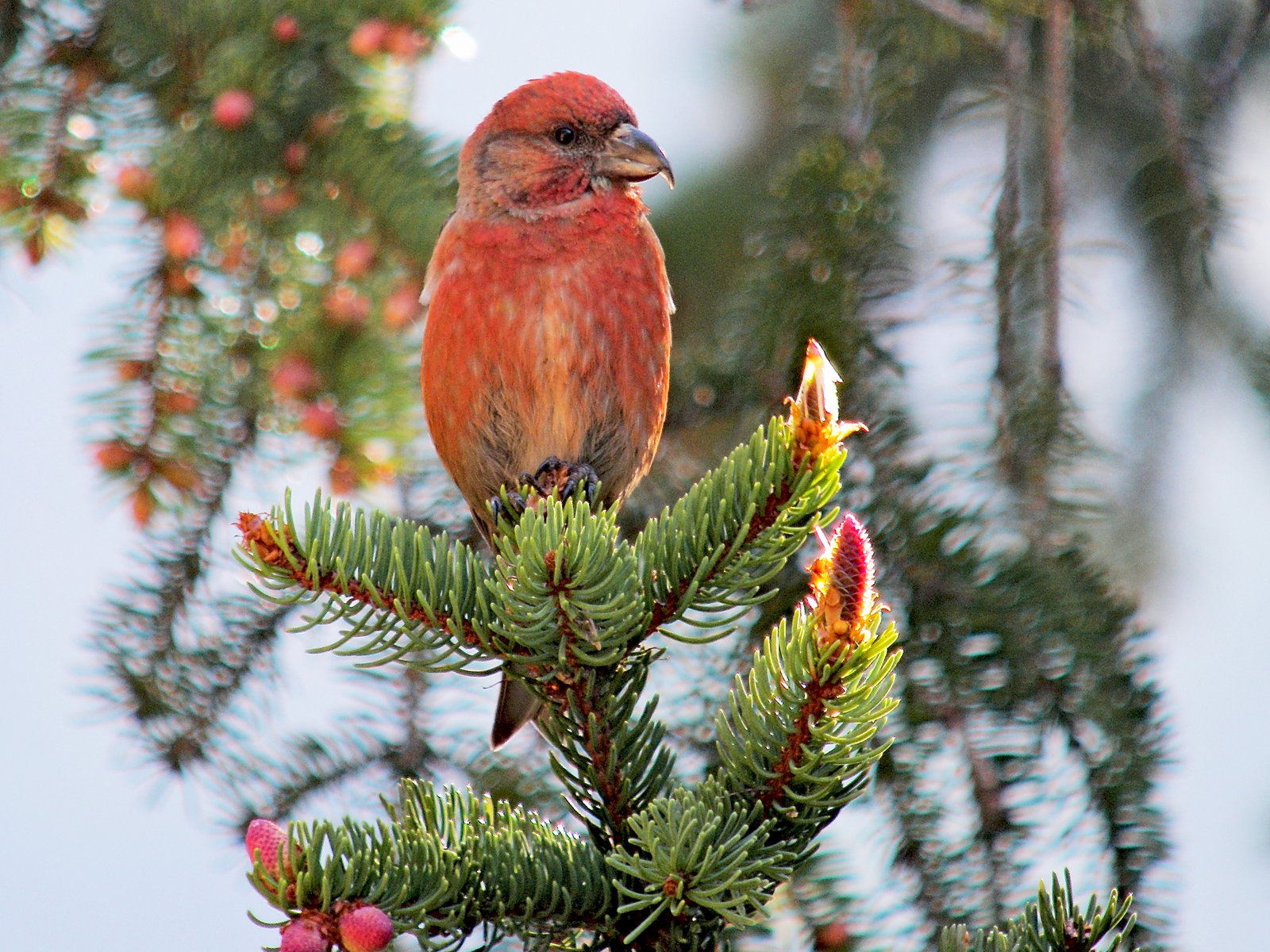
A heavy, compact finch with a large head, a short, deeply notched tail and a thick bill whose tips cross. The male is brick-red to orange-red, the female grey-green with a yellowish rump, and juveniles are grey-brown and heavily streaked. Wings and tail are plain dark brown, with no wing-bars. The North African form poliogyna is somewhat duller: males are often orange or yellowish rather than red, and females are greyer. Clambers parrot-like through the canopy and regularly comes down to drink.
Confusion species
There is no other crossbill in the region; with a good view of the bill it is unmistakable. At a distance and in flight a party may suggest European Greenfinch (Chloris chloris), which has yellow patches in wing and tail; females and juveniles may also resemble young Common Rosefinch (Carpodacus erythrinus), which is smaller with a normal bill and pale wing-bars.
Habitat
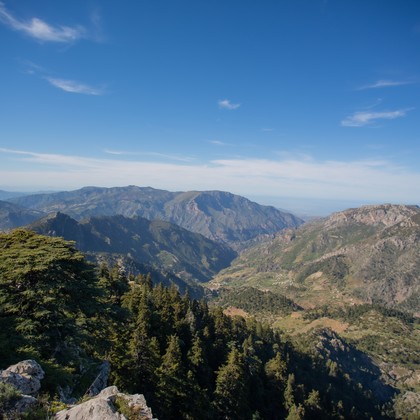
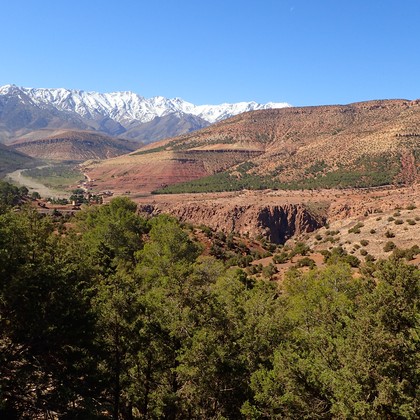
Mountain forests with conifers: Atlas cedar, Aleppo pine, maritime pine and Algerian fir (Abies numidica) and locally juniper, mostly between 1000 and 2500 m. In the Levant during irruptions in planted pine woods. Visits drinking places, springs and leaks along forest tracks.
Where the bird is most at home, classified by the habitats of North Africa and the Middle East.
Range and movements
In Morocco in the Rif and the Middle and High Atlas, in northern Algeria in the mountain forests of the Tell and the Aurès, and in north-west Tunisia in the Kroumirie and the northern hills. In the Levant irregular in irruption years, mainly in northern Israel (Galilee, Carmel) and on Mount Hermon; elsewhere in the Middle East very rare. Beyond the region across the conifer forests of Europe, Asia and North America, with isolated mountain populations as far as Cyprus, the Balearics and the Himalayas.
- Resident
- Summer visitor (c. Apr–Sep)
- Winter visitor (c. Oct–Mar)
- Passage (Mar–Apr, Oct–Nov)
- dark = core range, pale = thinly spread
How and when to look
In the cedar forests around Azrou and Ifrane in the Middle Atlas, wait by a pool or a leaking water pipe: in the dry months small flocks come in to drink in the morning. Listen above all for the kyip kyip over the canopy.
Conservation status
Not globally threatened. In North Africa locally fairly common but closely tied to the mountain forests; degradation of the cedar forests through overgrazing, logging and drought is a threat to the isolated populations.
Scientific name
Loxia curvirostra | Linnaeus, 1758
Linnaeus described the species in 1758 and placed it straight away in the genus where it still stands. He introduced the genus Loxia in that same work. Loxia comes from Ancient Greek loxos 'crosswise', after the crossed tips of the bill. curvirostra is Latin for 'curved bill', from curvus 'bent' and rostrum 'bill'. The specimen the first description was based on came from Sweden.