All species › Passerines › Finches › Yemen Linnet
Yemen Linnet | Linaria yemenensis
Jemenkneu | Pardillo yemení
One of the endemic finches of the south-west Arabian highlands, where it takes the place of Eurasian Linnet. It was long treated as a subspecies of the African Warsangli Linnet, but is a species in its own right, found only in Yemen and south-west Saudi Arabia.

Voice
The call is a nasal, linnet-like tsweeh and a dry chirping chit-chit, especially in flight. The song is a cheerful, varied twitter with trills and whistles, very like that of Eurasian Linnet, delivered from a bush, a boulder or in a short song flight.
Recording: bert de bruin — CC BY-NC-SA 4.0 · converted to mono · xeno-canto
Identification
A slim, linnet-like finch with a short, conical grey bill and a fairly long, forked tail. The male has a plain grey head, a warm chestnut mantle, rufous-washed breast and flanks and a white belly; there is no red at all. The most striking feature is a large, bright white patch at the base of the primaries, which shows in flight as a broad white wing-bar, together with white edges at the base of the tail. The female is duller and browner and finely streaked on head and breast, with less white in the wing. Juveniles are streaked throughout.
Confusion species
Eurasian Linnet (Linaria cannabina) does not occur in the Yemen highlands; its male has a red crown and breast and a narrower white wing-stripe. Yemen Serin (Crithagra menachensis) and Arabian Serin (Crithagra rothschildi) are drabber, lack the chestnut back and the white wing patch and have a thicker bill. Females of Crimson-winged Finch (Rhodopechys sanguineus) are larger and more heavily built, with pink in wing and tail.
Habitat
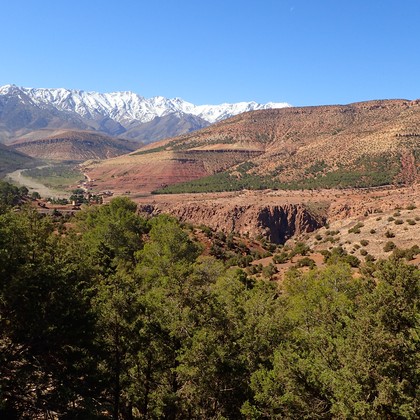
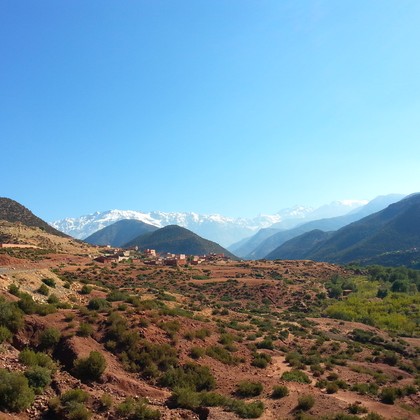
Open highlands with juniper woodland, acacia scrub and rocky slopes, and above all terraced fields, fallow land and rank margins around villages; usually between about 1800 and 3000 m. Feeds in small flocks on the ground and on seeding herbs.
Where the bird is most at home, classified by the habitats of North Africa and the Middle East.

Range and movements
Endemic to the south-west Arabian highlands: in Saudi Arabia in the Asir and the Sarawat mountains from roughly Taif south to the border, and in Yemen in the central and western highlands, including around Sana'a, Ibb and Taizz. Absent elsewhere in the region and beyond.
- Resident
- Summer visitor (c. Oct–Mar)
- Passage (Mar–Apr, Oct–Nov)
- dark = core range, pale = thinly spread
How and when to look
The high juniper woods and terraced fields around Abha and the Soudah in the Asir are the easiest place; watch for a small party of finches flushing from a field edge with a flashing white wing patch. Arabian Serin and Yemen Serin share the same habitat.
Conservation status
Not globally threatened. Locally common within its small range, especially in traditionally farmed terraces; abandonment of terrace farming and spreading building in the highlands may affect it locally.
Scientific name
Linaria yemenensis | (Ogilvie-Grant, 1913)
Ogilvie-Grant described the species in 1913 as Pseudacanthis yemenensis; because it was later moved to another genus, the author and year stand in brackets. The genus Linaria was introduced in 1802 by Bechstein. Linaria is the Latin word for a linen-weaver, from linum 'flax'. yemenensis refers to Yemen, where the species occurs. The specimen the first description was based on came from Manakhah, Yemen.