All species › Passerines › Finches › Eurasian Linnet
Eurasian Linnet | Linaria cannabina
Kneu | Pardillo común
Eurasian Linnet is a slender brown finch with a short grey bill, the breeding male wearing a crimson breast and forehead. In the region it is a common breeder in garrigue, scrub and farmland in the Maghreb and the Levant, and a winter visitor as far as Egypt and northern Arabia.

Voice
The song is a fast, musical twitter of chattering and fluting notes, often in chorus from a bush top or wire. The call is a light, nasal, rapidly repeated chek-ek-ek, by which passing flocks can be identified.
Recording: Adrien Peillon — CC BY-NC-SA 4.0 · converted to mono · xeno-canto
Identification
13–14 cm, slender, with a short, grey conical bill and a fairly long, forked tail. The breeding male has a grey head, an unstreaked chestnut-brown mantle and a crimson patch on forehead and breast; outside the breeding season the red is largely hidden by brown fringes. The female is brown and streaked, without red. Both sexes have a whitish, finely streaked throat and show white patches along the primaries and white tail edges in flight.
Confusion species
Yemen Linnet (Linaria yemenensis) of the highlands of south-western Arabia has a greyer head, a rufous back and a bright white wing patch, and the male lacks red. Desert Finch (Rhodospiza obsoleta) is unstreaked sandy with a black bill and pink in the wing. Females and juveniles can recall European Serin (Serinus serinus), but that is smaller and yellowish, with a tiny bill and a yellow rump.
Habitat
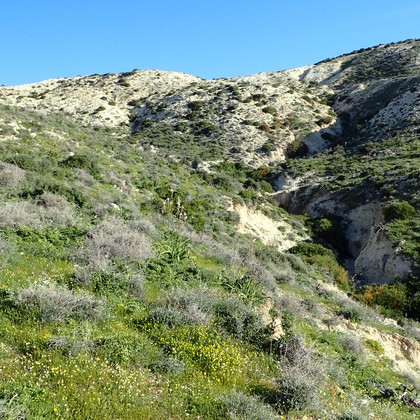
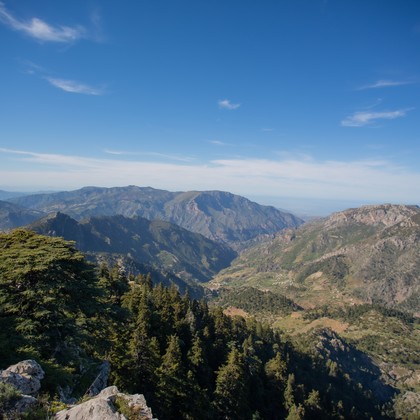
Garrigue, maquis, scrub on slopes, vineyards, olive groves, hedges and field margins, from the coast up into the high mountains of the Atlas; also coastal dune scrub. In winter in flocks on fields, fallow, steppe and saltmarsh edges. It eats almost exclusively small seeds, mainly of weeds.
Where the bird is most at home, classified by the habitats of North Africa and the Middle East.

Range and movements
Breeds in Morocco, northern Algeria, northern Tunisia, north-western Libya and Cyrenaica, and in Israel, Samaria and Judea, Lebanon, northern and western Jordan, Syria and northern Iraq. More numerous and widespread in winter, with flocks along the north coast of Egypt, in Sinai, central and southern Iraq, Kuwait and northern Saudi Arabia; a rare visitor further south. Beyond the region across almost all of Europe, western Asia to Central Asia, and on the Atlantic islands.
- Resident
- Summer visitor (c. Oct–Mar)
- Winter visitor (c. Apr–Sep)
- Passage (Mar–Apr, Oct–Nov)
- dark = core range, pale = thinly spread
How and when to look
In spring males sing from bush tops in garrigue and vineyards; the red breast is most visible in April and May. In winter check flocks of small finches on fields and fallow: the white wing patches and nasal chek-ek-ek give the linnet away.
Conservation status
Not threatened. In Europe it has declined through agricultural intensification; in the region it is still common, but it is trapped on a large scale as a cage bird, especially in the Maghreb.
Scientific name
Linaria cannabina | (Linnaeus, 1758)
Linnaeus described the species in 1758 as Fringilla cannabina; because it was later moved to another genus, the author and year stand in brackets. The genus Linaria was introduced in 1802 by Bechstein. Linaria is the Latin word for a linen-weaver, from linum 'flax'. cannabina is Latin for 'of hemp', after the seeds the bird feeds on. The specimen the first description was based on came from Sweden.