All species › Passerines › Finches › Arabian Serin
Arabian Serin | Crithagra rothschildi
Arabische kanarie | Serín árabe
Arabian Serin is an inconspicuous, grey-brown serin with an olive-yellow rump, living only in the mountains of south-western Arabia. It is fairly common there in wooded wadis and on vegetated slopes, but draws attention mainly by its song.

Voice
The song is a long, continuous run of musical whistles and trills, canary-like and very varied, from a treetop or bush. The call is a soft, rising tsuee.
Recording: David Darrell-Lambert — CC BY-NC-SA 4.0 · converted to mono · xeno-canto
Identification
12–13 cm, slender, with a small, pointed grey bill and a fairly long, slightly forked tail that is often flicked. The plumage is plain grey-brown above, with faint dark streaks on the back, and somewhat paler below, with a pale chin and faint, blurry streaking on breast and flanks. The rump is olive-yellow and shows mainly in flight. The head lacks a clear pattern: at most a faint pale supercilium. Sexes alike; juveniles are more heavily streaked.
Confusion species
Yemen Serin (Crithagra menachensis) is browner with a clearer face pattern, a pale supercilium and stronger streaking below, and has a brown rump without olive; it lives more often in bare rocky terrain and around villages. Yemen Linnet (Linaria yemenensis) has a grey head, a rufous back and white patches in the wing. A female Arabian Golden-winged Grosbeak (Rhynchostruthus percivali) is much bulkier, with a heavy bill and yellow in the wing.
Habitat
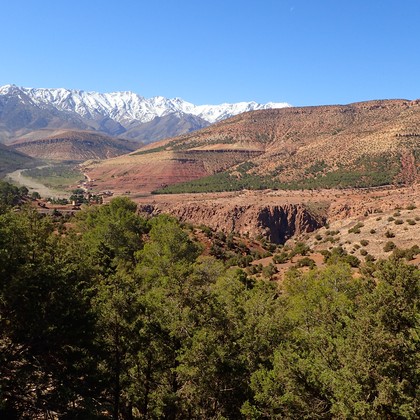
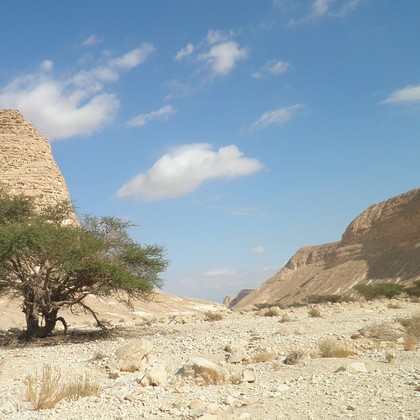
Dry woodland and scrub on rocky slopes and in wadis of the highlands, from dense juniper and acacia woodland to open ground with scattered trees and bushes, also terraced fields and gardens at village edges; roughly between 1,000 and 2,800 m. Usually in pairs or small groups, which feed on seeds in bushes and on the ground.
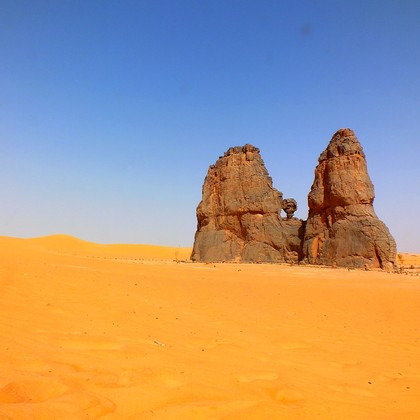
Where the bird is most at home, classified by the habitats of North Africa and the Middle East.
Range and movements
Endemic to south-western Arabia, in the Sarawat Mountains: in Saudi Arabia from the Ta'if area via Al Baha and Asir southwards, and in Yemen in the western highlands south to Ta'izz. Occurs nowhere else.
- Resident
- Summer visitor (c. Oct–Mar)
- Passage (Mar–Apr, Oct–Nov)
- dark = core range, pale = thinly spread
How and when to look
In wooded wadis around Abha, Tanomah or Al Baha listen for the long, musical song; the singer often sits high in an acacia or juniper. On birds flushing, look for the olive-yellow rump to separate it from Yemen Serin.
Conservation status
Not threatened and fairly common within its range. Woodland clearance, overgrazing and the drying out of wadis may reduce numbers locally. Little recent information exists from Yemen.
Scientific name
Crithagra rothschildi | (Ogilvie-Grant, 1902)
Ogilvie-Grant described the species in 1902 as Serinus rothschildi; because it was later moved to another genus, the author and year stand in brackets. The genus Crithagra was introduced in 1827 by Swainson. Crithagra comes from the Greek krithē, 'barley', and agra, 'hunting' — a 'barley hunter', for the seed-eating diet of these canaries and seedeaters. rothschildi honours the British banker and zoologist Walter Rothschild (1868–1937). The specimen the first description was based on came from the Haushabi area, Yemen.