All species › Pigeons and doves › Pigeons and doves › Red-Eyed Dove
Red-Eyed Dove | Streptopelia semitorquata
Roodoogtortel | Tórtola ojirroja
The largest and darkest collared dove in the region, an African species that in Arabia lives only in the wooded wadis of the south-west. More often heard than seen: its emphatic, rhythmic call is a familiar sound in the green valleys of the Asir and Yemen.
Voice
A loud, emphatic, rhythmic coo of six to eight notes, coo-COO, coo-coo-COO-coo, stressed on the second and fifth notes; in Africa often rendered as 'I am a red-eyed dove'. On landing a nasal krrroo.
Recording: Richard White — CC BY-NC-SA 4.0 · shortened to the first 60 s, mono · xeno-canto
Identification
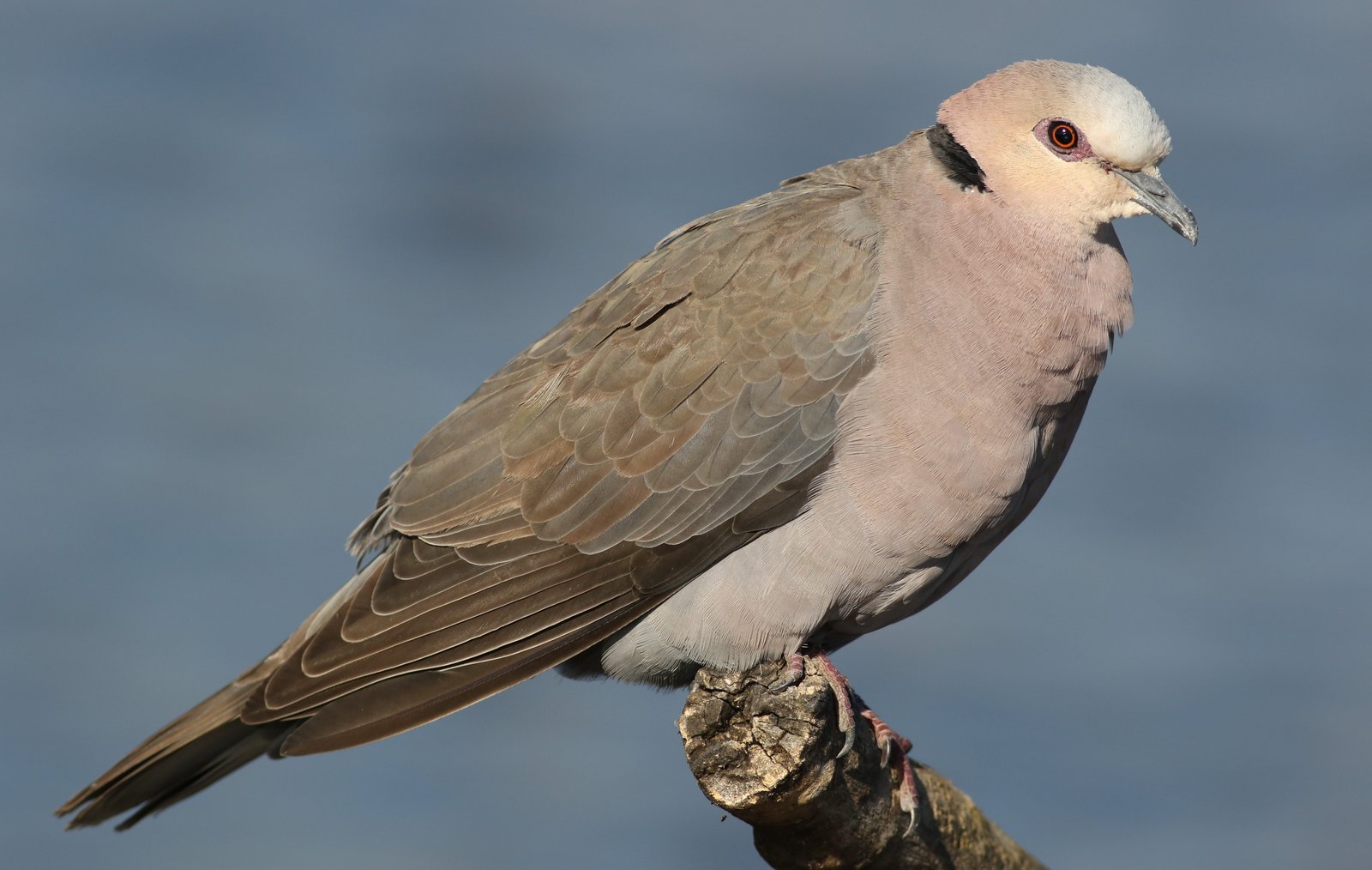
Large, dark dove with a plain dark brown back and wing, a deep vinous-pink breast and a greyish-pink head with a pale, greyish-white forehead. A narrow black half-collar on the nape. Dark eye with a conspicuous bare dark red eye-ring, visible only at close range. The tail is black at the base below with a pale grey, not white, outer half. Juveniles are duller and lack the collar.
Confusion species
Eurasian Collared-Dove (Streptopelia decaocto) and African Collared Dove (Streptopelia roseogrisea) are smaller and much paler, with a white tail tip. Dusky Turtle Dove (Streptopelia lugens) has a black neck patch instead of a collar and rufous-scaled wing coverts. Laughing Dove (Spilopelia senegalensis) is much smaller and has no collar.
Habitat
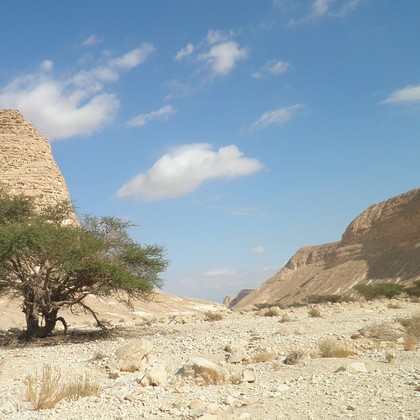
Wooded wadis with figs, tamarind and acacia, riverine woodland along permanent streams, palm groves and orchards in the foothills and lower valleys. It needs tall, dense trees and water; feeds on the ground in shade.
Where the bird is most at home, classified by the habitats of North Africa and the Middle East.


Range and movements
In the region only in south-west Arabia: resident in the wadis of the western foothills and valleys of Yemen and south-west Saudi Arabia, north to around Al Baha. Beyond the region widespread in Africa south of the Sahara, from Senegal and Ethiopia to South Africa.
- Resident
- Summer visitor (c. Apr–Sep)
- Winter visitor (c. Oct–Mar)
- Passage (Mar–Apr, Oct–Nov)
- dark = core range, pale = thinly spread
How and when to look
Walk a green wadi in the Yemeni or Saudi foothills in the morning and listen for the rhythmic coo. A bird flying off stands out by its size and the grey, not white, tail tip.
Conservation status
Not globally threatened. In Arabia restricted to wadi woodland, which is vulnerable to water extraction and felling; there it is locally fairly common.
Scientific name
Streptopelia semitorquata | (Rüppell, 1837)
Rüppell described the species in 1837 as Columba semitorquata; because it was later moved to another genus, the author and year stand in brackets. The genus Streptopelia was introduced in 1855 by Bonaparte. Streptopelia is Greek, from streptos 'collar, twisted chain' and peleia 'dove', after the dark neck collar of these doves. semitorquata is Latin for 'half-collared' — for the black band on the hindneck. The specimen the first description was based on came from Taranta Mountains, Ethiopia.