All species › Passerines › Finches › Red-Fronted Serin
Red-Fronted Serin | Serinus pusillus
Roodvoorhoofdkanarie | Verdecillo frentirrojo
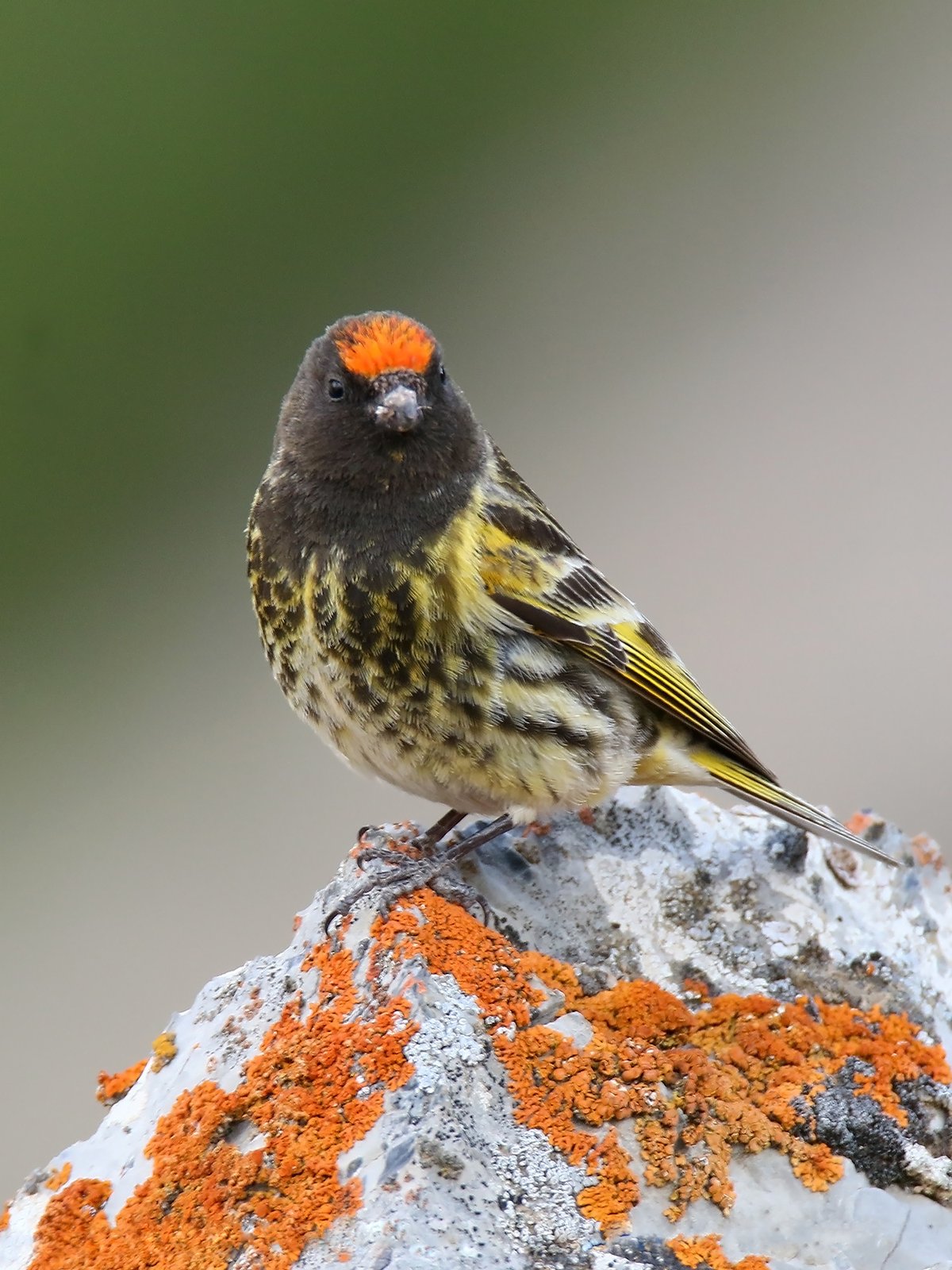
A small, dark serin of the high mountains, with a fiery red patch on the forehead. In the region it reaches the south-western edge of its range: on Mount Hermon and in the Kurdish mountains of northern Iraq.
Voice
The song is a fast, liquid, rippling twitter with trills, softer and less glassy than that of European Serin. The call is a rolling drrit or a high, twittering tirrrilit, often in chorus in flight.
Recording: Frantz Barrault — CC BY-NC-SA 4.0 · converted to mono · xeno-canto
Identification
Small and compact, with a short, pointed bill and a fairly long, forked tail. Adults have a sooty-black head, throat and upper breast with a bright scarlet patch on the forehead; the rest of the underparts are golden to orange-yellow with dark streaks on the flanks. The back is brown with black streaks, the rump orange-yellow, and the wings show orange-yellow edges and two pale wing-bars. The sexes are almost alike. Juveniles lack the black and red and have a warm cinnamon-brown head and a streaked body.
Confusion species
European Serin (Serinus serinus) has a yellow head and breast and no black or red. Juveniles with their cinnamon heads may resemble a young Syrian Serin (Serinus syriacus), which is paler and plainer and lacks the orange tone. European Goldfinch (Carduelis carduelis) has red around the whole bill base and a broad golden wing-bar.
Habitat
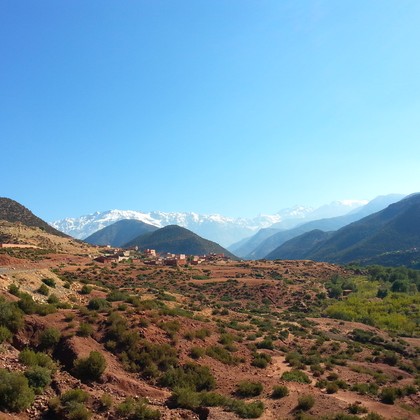
Open mountain slopes above the tree line or with scattered junipers and dwarf shrubs, rocky alpine meadows and scree, mostly above 1800 m. Feeds on the ground and on seed heads of herbs, often near meltwater and small springs. In winter lower, on dry slopes and near villages.
Where the bird is most at home, classified by the habitats of North Africa and the Middle East.
Range and movements
In the region a breeding bird on Mount Hermon (on the border of Israel, Syria and Lebanon), probably also elsewhere in the Anti-Lebanon range, and in the high mountains of Iraqi Kurdistan. In winter rarely lower down in northern Israel; elsewhere in the region a very rare vagrant. Beyond the region from Turkey and the Caucasus through Iran and Central Asia to the Himalayas.
- Resident
- Summer visitor (c. Apr–Sep)
- Winter visitor (c. Oct–Mar)
- Passage (Mar–Apr, Oct–Nov)
- dark = core range, pale = thinly spread
How and when to look
The high slopes of Mount Hermon above the ski area are the place in May and June; look for small groups feeding low among rocks and cushion plants and showing their orange rump as they flush.
Conservation status
Not globally threatened. In the region a rare breeding bird with a small, local population on Mount Hermon; grazing and recreation in the high mountains may play a role here.
Scientific name
Serinus pusillus | (Pallas, 1811)
Pallas described the species in 1811 as Passer pusillus; because it was later moved to another genus, the author and year stand in brackets. The genus Serinus was introduced in 1816 by Koch. Serinus is Neo-Latin for 'canary-yellow'. pusillus is Latin for 'very small' or 'tiny'. The specimen the first description was based on came from Caucasus and Caspian Sea region.