All species › Grebes › Grebes › Red-Necked Grebe
Red-Necked Grebe | Podiceps grisegena
Roodhalsfuut | Somormujo cuellirrojo
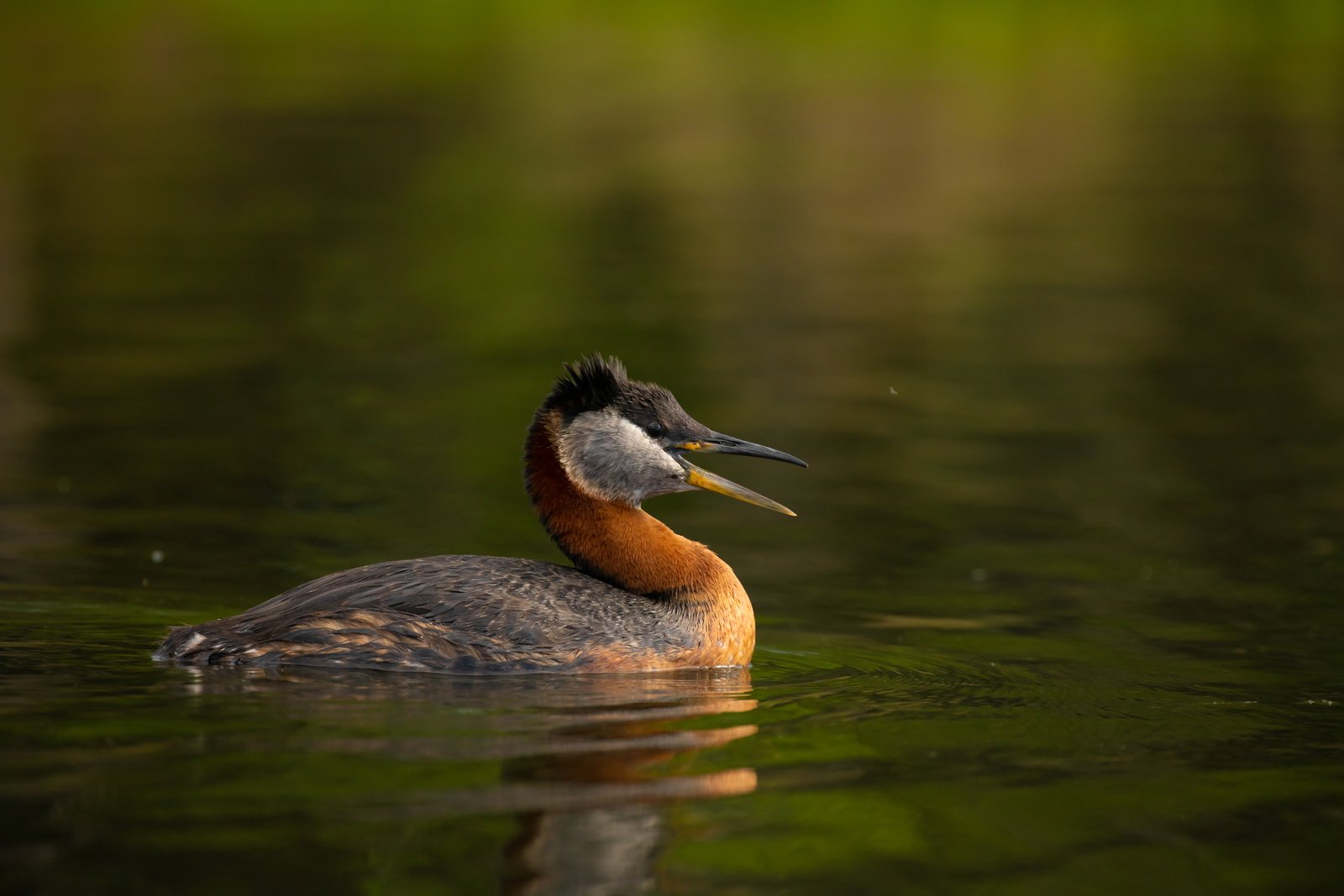
The Red-necked Grebe is a sturdy, rather dark grebe, slightly smaller than the Great Crested Grebe, with a thick neck and a yellow bill base. It winters mainly on the Black Sea and the Baltic; in the region it is a rare winter visitor and vagrant, most often in Israel.
Voice
Noisy on the breeding grounds, with a whinnying, pig-like wailing and squealing calls. Almost silent as a winter visitor to the region.
Recording: Stanislas Wroza — CC BY-NC-SA 4.0 · shortened to the first 60 s, mono · xeno-canto
Identification
Medium-sized and compact, with a shorter, thicker neck and heavier head than Great Crested Grebe, and a dark bill with an obvious yellow base. In breeding plumage a black cap, pale grey cheeks bordered white and a rusty-red neck. In winter drab: a dark cap extending below the eye, dusky grey cheeks and foreneck, and often a pale crescent behind the cheek. The eye is dark. In flight white patches on the leading and trailing edges of the wing, as in Great Crested Grebe.
Confusion species
Great Crested Grebe (Podiceps cristatus) is larger and slimmer, with a longer white neck, a pink bill without a yellow base and, in winter, a white line over the eye. Eared Grebe (Podiceps nigricollis) and Horned Grebe (Podiceps auritus) are much smaller, with a red eye. At sea it can suggest a small loon such as Red-throated Loon (Gavia stellata), which sits lower in the water and lacks the yellow bill base.
Habitat
Breeds on shallow, richly vegetated lakes and fishponds in eastern Europe and Asia. Winters mainly at sea in coastal waters, and in smaller numbers on large lakes and reservoirs. In the region it has been seen on reservoirs, fishponds, the Sea of Galilee and along the Mediterranean coast.
Where the bird is most at home, classified by the habitats of North Africa and the Middle East.


Range and movements
In Israel a rare, not annual winter visitor, with a few birds in a good winter on the Sea of Galilee, reservoirs and the Mediterranean coast. Elsewhere isolated records in Tunisia and Kuwait, among others. The nearest breeding birds are in eastern Europe, Turkey and the Caucasus, and it winters in large numbers on the Black Sea, the Aegean and the Caspian. Beyond that it breeds from eastern Europe to Siberia and in North America.
How and when to look
In winter look among groups of Great Crested Grebes for a bird with a shorter, drabber neck and a yellow bill base, especially on the Sea of Galilee and along the Israeli coast. A cold spell in south-east Europe increases the chance of birds moving south.
Conservation status
Not threatened and numerous worldwide, but declining in parts of Europe with the loss of shallow, vegetated lakes and fishponds. As a rare winter visitor the species plays no part in conservation in the region.
Scientific name
Podiceps grisegena | (Boddaert, 1783)
Boddaert described the species in 1783 as Colymbus grisegena; because it was later moved to another genus, the author and year stand in brackets. The genus Podiceps was introduced in 1787 by Latham. Podiceps is Latin, from podex, genitive podicis, 'rear end', and pes 'foot', after the legs set far back on the body. grisegena joins Medieval Latin griseus 'grey' to gena 'cheek': grey-cheeked. The specimen the first description was based on came from France.