All species › Nightjars › Nightjars › Red-Necked Nightjar
Red-Necked Nightjar | Caprimulgus ruficollis
Moorse nachtzwaluw | Chotacabras cuellirrojo
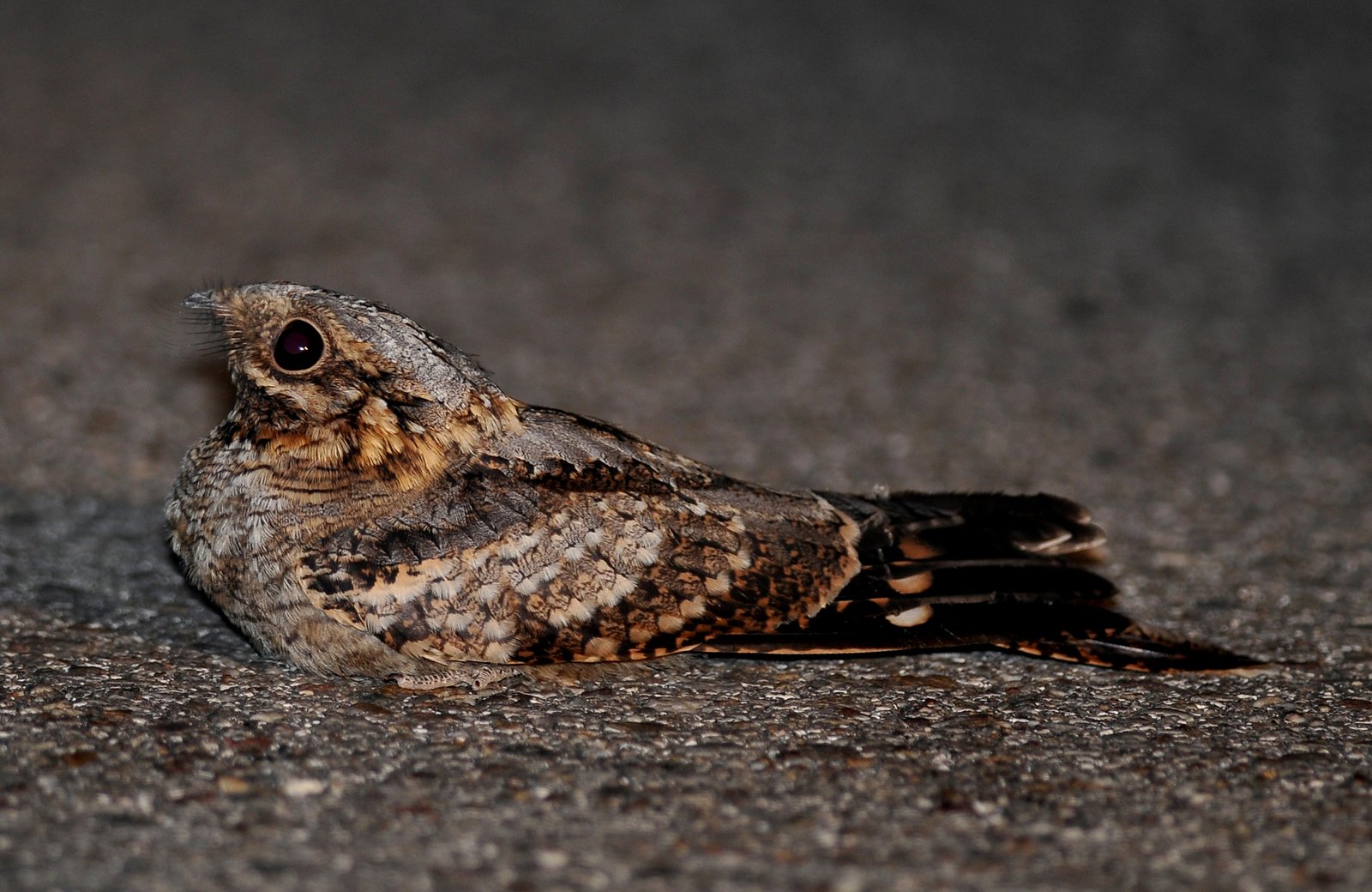
The largest nightjar of the region, a pale, long-tailed species with a rufous collar that breeds only in north-west Africa. In the Maghreb it is a common summer visitor to open woodland, scrub and argan groves, where its knocking song fills the summer nights.
Voice
A mechanical, endlessly repeated knocking, kutuk-kutuk-kutuk, like wood being chopped in the distance; it continues for minutes and varies in volume as the bird turns its head. Quite different from the sustained churring of Eurasian Nightjar. In display the wings are clapped audibly above the back.
Recording: Pablo Guillemaud — CC BY-NC-SA 4.0 · converted to mono · xeno-canto
Identification
Large, long-winged and long-tailed, sandy to pale grey with fine vermiculation. Characteristic are the warm rufous collar across nape and neck sides and the large, sharply defined white throat patch. Both sexes have white spots on the three outer primaries and white tail corners; in the female they are slightly smaller and duller. North African birds (subspecies desertorum) are paler and greyer than Iberian ones. Flight slow, buoyant and silent.
Confusion species
Eurasian Nightjar (Caprimulgus europaeus) is clearly smaller and darker, lacks the rufous collar and large throat patch, and only the male shows white in wing and tail. Egyptian Nightjar (Caprimulgus aegyptius) of the Saharan oases is uniformly sandy without obvious white spots. In darkness the song is the surest feature.
Habitat
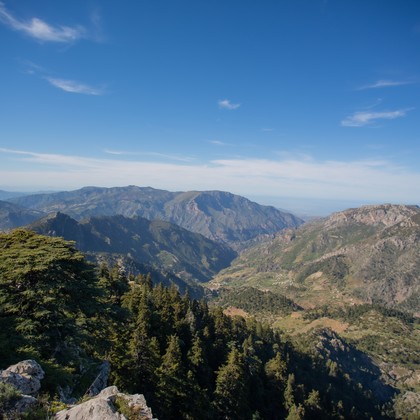
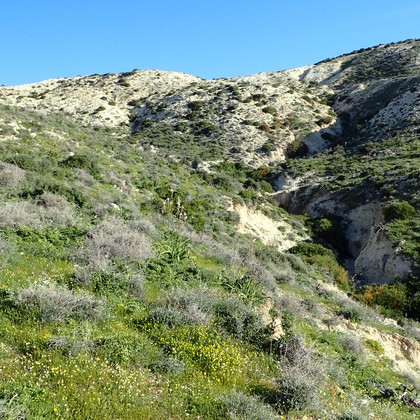
Open, dry woodland of cork oak, holm oak, pine and argan, scrub on sandy soils, coastal dunes with broom, orchards and olive groves; often near tracks and clearings where it sits on the ground. In the Atlas it reaches about 1,500 m. Hunts large moths and beetles, also around street lights.
Where the bird is most at home, classified by the habitats of North Africa and the Middle East.

Range and movements
In Morocco it breeds widely north of the Sahara: on the Atlantic coastal plain from Tangier to the Souss valley, in the Rif, the foothills of the Middle Atlas and the argan woodland around Agadir and Taroudant, south to the Anti-Atlas. In Algeria it breeds in the Tell and on the High Plateaux, in Tunisia in the north and the central uplands. There are only few data from Libya (Tripolitania). On migration it appears on the edge of the Sahara and in Western Sahara. Beyond the region it breeds only in Iberia and winters in the western Sahel and West Africa.
- Resident
- Summer visitor (c. Oct–Mar)
- Winter visitor (c. Apr–Sep)
- Passage (Mar–Apr, Oct–Nov)
- dark = core range, pale = thinly spread
How and when to look
The cork-oak forest of Maâmora near Rabat and the argan woodland around Agadir and Oued Massa are classic sites. Drive or walk forest tracks on a calm June evening: birds sit on the track and light up in the headlights, and the song starts about half an hour after sunset.
Conservation status
Near Threatened. The species is listed globally as Near Threatened because of a suspected decline. In the Maghreb, road casualties on tracks and roads, loss of scrub and argan woodland to grazing, felling and agricultural expansion, and the use of insecticides are the main threats.
Scientific name
Caprimulgus ruficollis | Temminck, 1820
Temminck described the species in 1820 and placed it straight away in the genus where it still stands. The genus Caprimulgus was introduced in 1758 by Linnaeus. Caprimulgus is Latin, from capra 'nanny goat' and mulgere 'to milk', after the old belief that nightjars suckled goats at night. ruficollis is Latin, from rufus 'red' and collum 'neck', after the rufous neck-collar. The specimen the first description was based on came from Algeciras, Spain.