All species › Passerines › Wagtails and pipits › Red-Throated Pipit
Red-Throated Pipit | Anthus cervinus
Roodkeelpieper | Bisbita gorgirrojo
The Red-throated Pipit is a tundra bird that passes in large numbers through the east of the region and winters in the Nile valley, the Levant and the green areas of Arabia. In spring males with rusty-red throats and breasts pass through.

Voice
The call is the best feature: a long, thin and explosive pseeeh, descending and drawn out, slightly sharper than that of Tree Pipit. Also a short chup. The song, sometimes heard on passage in spring, is a lively series of trills and drawn-out notes.
Recording: Stanislas Wroza — CC BY-NC-SA 4.0 · shortened to the first 60 s, mono · xeno-canto
Identification
14–15 cm. Slightly more compact than Meadow Pipit. The upperparts are heavily streaked, with dark streaks on the rump too and two pale 'braces' along the mantle. Adults in spring have a brick-red to pink throat, supercilium and upper breast, more extensive and brighter in males than in females. In autumn and winter the throat is often pale, with a dark malar stripe, heavy black streaks on breast and flanks and white underparts; adults often keep some pink in the face. The legs are pink and the hind claw is long.
Confusion species
Meadow Pipit (Anthus pratensis) has an unstreaked rump, less contrasting braces and finer flank streaks, and calls a thin ist-ist. Tree Pipit (Anthus trivialis) is warmer and less streaked above, with fine flank streaks. Olive-backed Pipit (Anthus hodgsoni) is green and nearly unstreaked above, with a white and a black spot on the ear coverts. Water Pipit (Anthus spinoletta) is pinkish buff in spring but has a grey head and unstreaked greyish-brown upperparts.
Habitat
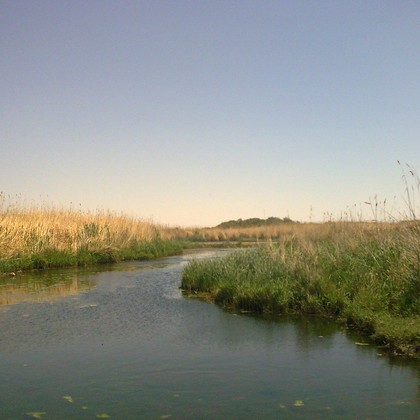
Damp grassland, irrigated fields and fodder crops, rice and clover fields, marsh edges, sewage works, the lawns of parks and golf courses; on passage also in oases and along the coast.
Where the bird is most at home, classified by the habitats of North Africa and the Middle East.


Range and movements
A common winter visitor to the Nile valley and Delta, Israel, Jordan, Lebanon, Syria and Iraq, and to eastern and southern Arabia: Kuwait, Bahrain, Qatar, the United Arab Emirates, Oman, eastern and south-western Saudi Arabia and Yemen. A passage migrant throughout the region; in Libya, Tunisia, Algeria and Morocco mainly a scarce migrant, with small numbers wintering. Breeds on the tundra from northern Scandinavia to Alaska and winters in sub-Saharan Africa, the Middle East and South-East Asia.
- Winter visitor (c. Oct–Mar)
- Passage (Mar–Apr, Oct–Nov)
- dark = core range, pale = thinly spread
How and when to look
In March and April on wet fields and in the kibbutz areas around Eilat and the Hula valley, where flocks with red-throated males rest. In winter on irrigated fields and lawns in the United Arab Emirates and Oman, and everywhere in the Nile Delta. Listen for the long, thin pseeeh of birds flying over.
Conservation status
Not globally threatened and common. The loss of wet grassland in the wintering range is a concern; in Arabia the species has actually benefited from irrigation and urban greening.
Scientific name
Anthus cervinus | (Pallas, 1811)
Pallas described the species in 1811 as Motacilla cervina; because it was later moved to another genus, the author and year stand in brackets. The genus Anthus was introduced in 1805 by Bechstein. Anthus is the Latin word for a small bird of grasslands mentioned by Pliny the Elder. cervinus is Latin for 'stag-coloured', from cervus 'stag', after the rusty red throat of the breeding bird. The specimen the first description was based on came from the Kolyma River, Siberia.