All species › Passerines › Wagtails and pipits › Tawny Pipit
Tawny Pipit | Anthus campestris
Duinpieper | Bisbita campestre
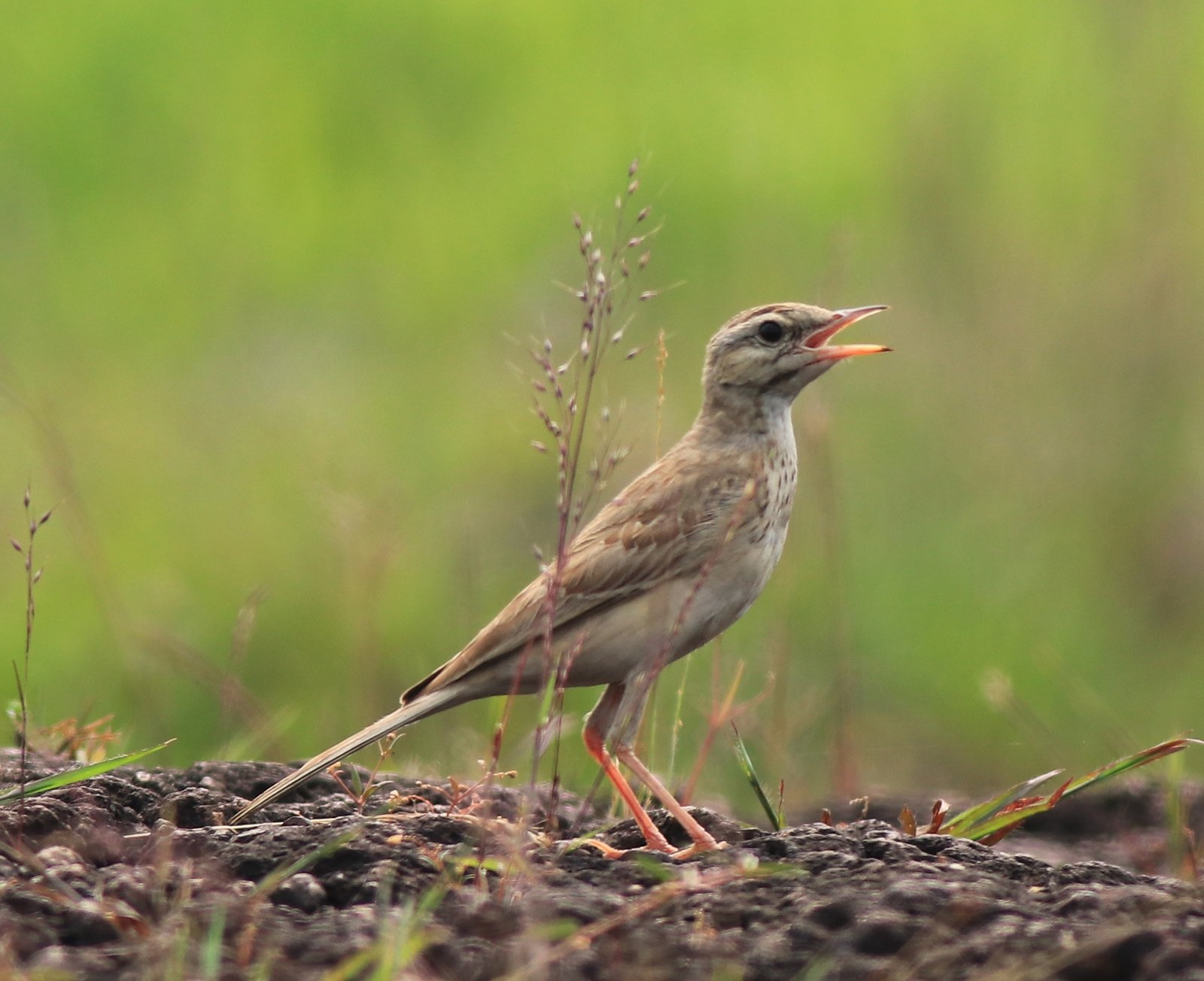
The Tawny Pipit is a large, pale, slender pipit of dry open plains that walks across the ground like a wagtail. In the region it breeds on the high plateaux of the Maghreb and in the steppes of the Levant, and it migrates through the whole region to the Sahel and Arabia.
Voice
The call is a sparrow-like chilp or a softer tsli. The song is a monotonous, endlessly repeated phrase, tsirlee… tsirlee… tsirlee, given in an undulating song flight high over the territory or from a stone or bush.
Recording: András Schmidt — CC BY-NC-SA 4.0 · converted to mono · xeno-canto
Identification
16–18 cm. Long and slim, with a long tail and long, flesh-coloured legs. Adults are plain sandy brown above with only faint streaks on the mantle, almost unstreaked creamy white below, with at most a few fine streaks on the breast sides. Diagnostic are the clear pale supercilium, a dark loral stripe (unlike Richard's Pipit), a narrow dark malar stripe and a row of dark median coverts with pale fringes that forms a dark bar across the folded wing. The bill is fairly long and pointed, with a yellowish-pink base to the lower mandible. Juveniles are distinctly streaked on the mantle and breast in their first autumn and can then suggest Richard's Pipit.
Confusion species
Richard's Pipit (Anthus richardi) is bulkier, more upright and longer-legged, with a heavier bill, pale lores, a very long hind claw and warmer flanks with a band of fine breast streaks; its call is a loud, hoarse shreep. Blyth's Pipit (Anthus godlewskii) is smaller and shorter-legged, with streaked upperparts and square-cut dark centres to the median coverts. Long-billed Pipit (Anthus similis) is darker and greyer, with a longer bill, warm buff rather than whitish outer tail feathers and a less distinct supercilium.
Habitat
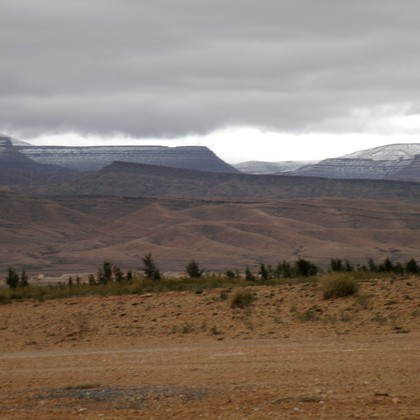
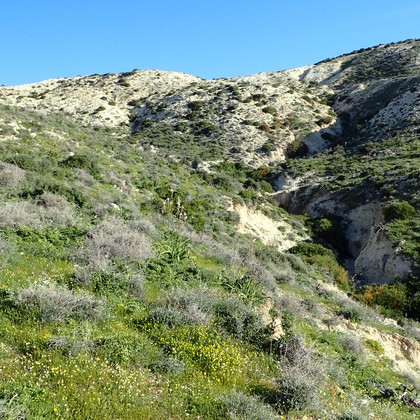
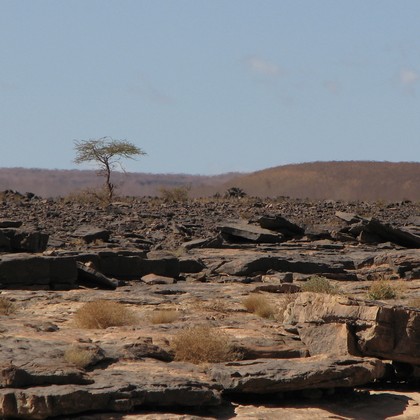
Breeds on dry, sparsely vegetated plains: alfa steppe and high plateaux, garrigue, bare fields and sandy or stony slopes, in the Atlas up to about 2500 m. On passage and in winter in any open, dry terrain: stone desert, sandy plains, wadis, fallow fields and coastal plains.
Where the bird is most at home, classified by the habitats of North Africa and the Middle East.
Range and movements
Breeds in Morocco (plateaux and Atlas to the edge of the Sahara), northern Algeria and Tunisia and locally in north-western Libya and Cyrenaica; also in Israel, Jordan, Lebanon, Syria and northern Iraq. On passage throughout the region, including Egypt, Sinai and the Saharan oases. Winters in Saudi Arabia, Yemen, Oman, the United Arab Emirates and the Gulf states, and south of the region in the Sahel. Beyond the region it breeds from southern and central Europe to Mongolia; Asian birds winter in Arabia and north-west India.
- Resident
- Summer visitor (c. Apr–Sep)
- Winter visitor (c. Oct–Mar)
- Passage (Mar–Apr, Oct–Nov)
- dark = core range, pale = thinly spread
How and when to look
In May and June on the high plateaux of eastern Morocco or in the Negev, where singing males hang over the steppe. In autumn on Arabian desert plains and fallow fields, where the bird runs about like a wagtail and, when flushed, flies off low with a sparrow-like chilp.
Conservation status
Not globally threatened. It has declined in Europe through agricultural intensification and the scrubbing-over of open land; in the region it still appears widespread, but suitable steppe is being lost here too to ploughing, overgrazing and irrigation.
Scientific name
Anthus campestris | (Linnaeus, 1758)
Linnaeus described the species in 1758 as Alauda campestris; because it was later moved to another genus, the author and year stand in brackets. The genus Anthus was introduced in 1805 by Bechstein. Anthus is the Latin word for a small bird of grasslands mentioned by Pliny the Elder. campestris is Latin for 'of the fields', from campus 'field, plain'. The specimen the first description was based on came from Sweden.