All species › Passerines › Wagtails and pipits › Blyth's Pipit
Blyth's Pipit | Anthus godlewskii
Mongoolse pieper | Bisbita de Blyth
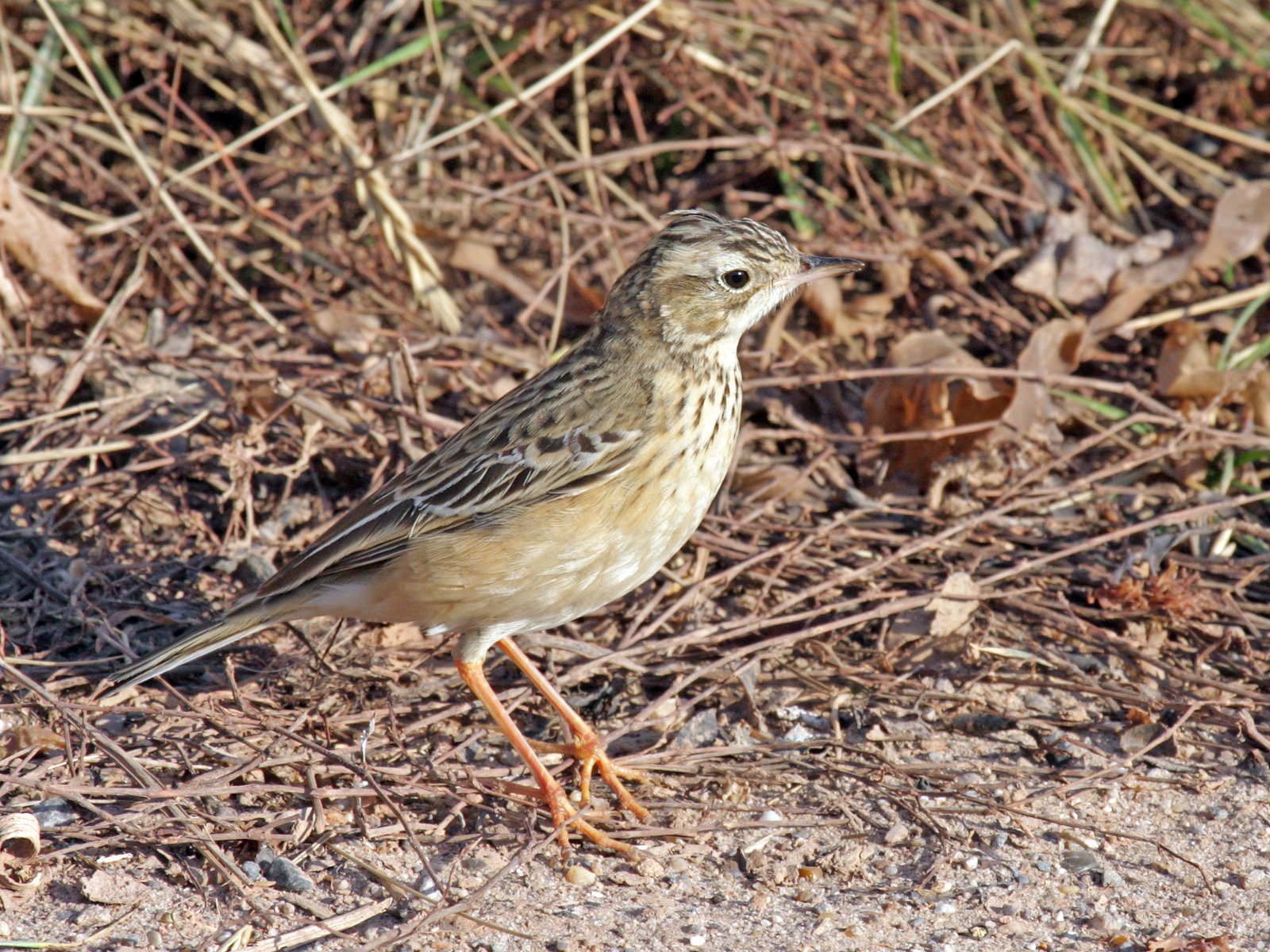
Blyth's Pipit is a medium-sized streaked pipit of the Mongolian steppes that winters in India and turns up as a scarce winter visitor in the east of the region. It closely resembles Richard's and Tawny Pipits, and in the Gulf states is found mainly on grassy fields, farmland and golf courses.
Voice
The call is a short, slightly hoarse pshyoo or chup, softer and less explosive than the shreep of Richard's Pipit, often followed by a nasal chup-chup. On the wintering grounds usually heard on take-off.
Recording: Richard E. Webster — CC BY-NC-SA 4.0 · converted to mono · xeno-canto
Identification
15.5–17 cm, noticeably more compact, shorter-tailed and shorter-legged than Richard's Pipit, with a Tree Pipit-like impression and a less upright stance. The bill is shorter and more pointed, the hind claw shorter and more curved. The upperparts are warm sandy brown with dark streaks; the breast is buff with fine, short streaks, and the moustachial stripe is narrow. The best feature is on the median coverts of adults: a black centre cut off square, with a broad, sharply defined creamy tip. On the second outermost tail feather the white forms a short, sharp wedge. First-autumn birds still have juvenile feathers in the wing and are harder.
Confusion species
Richard's Pipit (Anthus richardi) is larger, longer-tailed and longer-legged, with a heavy bill and a long, almost straight hind claw; its median coverts have a pointed dark centre, and its call is an explosive, shrill shreep. Tawny Pipit (Anthus campestris) is paler and plainer, with a dark lore and little breast streaking, and calls a soft tchilp. Tree Pipit (Anthus trivialis) is olive-brown, with short pink legs, streaked flanks and a hoarse teez. In the region, call and median coverts in a photograph are decisive.
Habitat
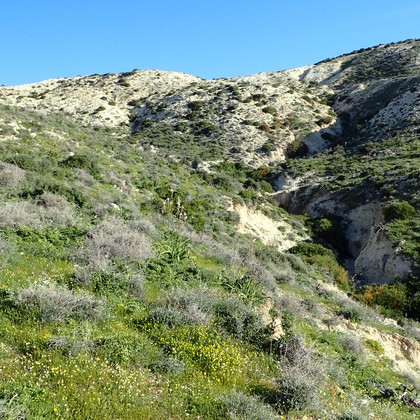
On the wintering grounds open dry grassland and fallow land with short vegetation, fields and alfalfa, golf courses, sports fields and the edges of irrigated land. It walks quietly through the grass and flushes late. In the breeding range dry steppe and grassy mountain slopes.
Where the bird is most at home, classified by the habitats of North Africa and the Middle East.


Range and movements
In the region a scarce to rare passage migrant and winter visitor in eastern Arabia: in the United Arab Emirates irregular to scarce since the first record in 1993 (Abu Dhabi), also in Oman, Qatar, Bahrain, Kuwait and eastern Saudi Arabia. In Israel and Egypt a vagrant. Beyond the region it breeds in Mongolia, southern Siberia (Transbaikalia) and northern China, and winters mainly in India and Sri Lanka.
- Winter visitor (c. Oct–Mar)
- dark = core range, pale = thinly spread
How and when to look
From October to March on golf courses, alfalfa fields and grassy fields in the Emirates or Oman, often with Richard's Pipits. Flush the bird and listen to the call; then photograph the median coverts, as these are decisive on an adult.
Conservation status
Not globally threatened. In the region a scarce winter visitor at the western edge of the wintering range; because of its close similarity to Richard's Pipit it is probably partly overlooked.
Scientific name
Anthus godlewskii | (Taczanowski, 1876)
Taczanowski described the species in 1876 as Agrodoma godlewskii; because it was later moved to another genus, the author and year stand in brackets. The genus Anthus was introduced in 1805 by Bechstein. Anthus is the Latin word for a small bird of grasslands mentioned by Pliny the Elder. godlewskii honours the Polish nobleman and field naturalist Wiktor Godlewski (1831–1900), who collected birds during his Siberian exile. The specimen the first description was based on came from the Argun valley, Transbaikalia.