All species › Passerines › Sparrows › Rock Sparrow
Rock Sparrow | Petronia petronia
Rotsmus | Gorrión chillón
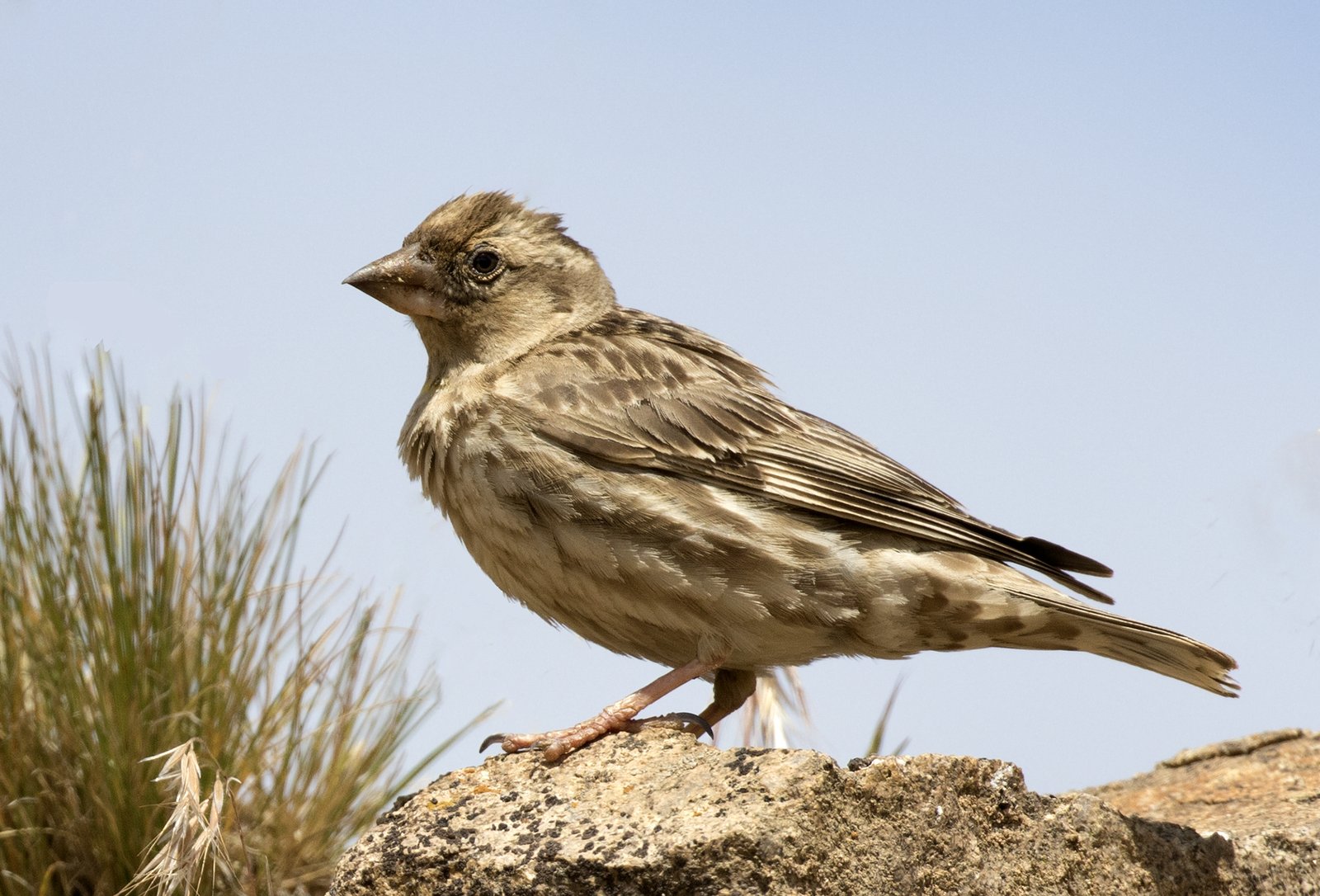
The Rock Sparrow is a large, pale, streaked sparrow of bare mountain slopes, gorges and ruins. It is noticed less for its plumage than for its loud, nasal call, a fixture of many Atlas valleys and Levantine canyons.
Voice
A loud, nasal, plaintive pew-ee, often from an unseen rock face, and a short chip. The song is a slow repetition of the same nasal notes from a rock pinnacle or a wall.
Recording: Meena Haribal — CC BY-NC-SA 4.0 · shortened to the first 60 s, mono · xeno-canto
Identification
14–15.5 cm. Stocky, with a heavy, pale conical bill and a short tail. The head is striped: an off-white crown stripe between two dark brown bands, a broad pale supercilium and a dark eye-stripe. Upperparts sandy brown with dark streaks, underparts off-white with diffuse streaking on breast and flanks. The lemon-yellow throat spot is small and usually hidden. In flight, and when the tail is spread, the white spots at the tips of the tail feathers stand out. Sexes alike; juveniles warmer buff.
Confusion species
House Sparrow (Passer domesticus) and Spanish Sparrow (Passer hispaniolensis) lack the crown stripe and the white tail spots, and their females have unstreaked underparts. Pale Rockfinch (Carpospiza brachydactyla) has a completely plain head and long, pointed wings. Corn Bunting (Emberiza calandra) is larger, more heavily streaked and has no white tail spots.
Habitat
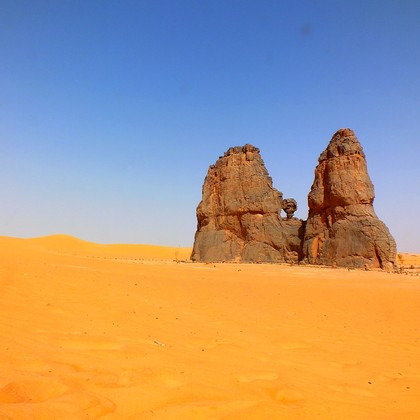
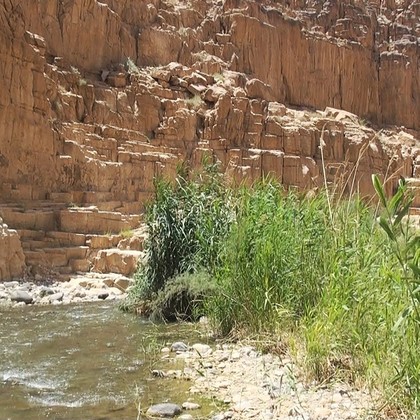
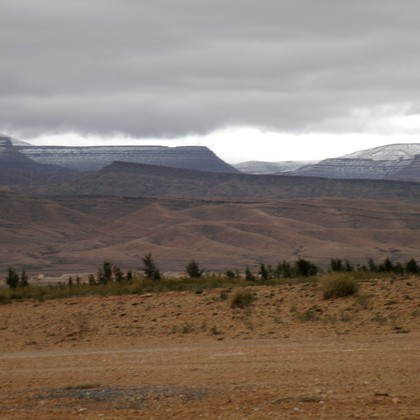
Dry, rocky mountain slopes, gorges and canyons with scattered bushes, alfa-grass plateaus, old villages, kasbahs and ruins, to above 2500 m in the Atlas. Nests in rock crevices, holes in walls and old buildings. Outside the breeding season in flocks on fields and steppe, often with finches and larks.
Where the bird is most at home, classified by the habitats of North Africa and the Middle East.
Range and movements
Resident in Morocco (Rif, Middle, High and Anti-Atlas and the eastern high plateaus), northern Algeria (Tell and Saharan Atlas, Aurès), western and central Tunisia and north-west Libya (Jebel Nafusa). In the east in Lebanon, Syria, northern Israel including the Golan and Mount Hermon, the Jordanian highlands and northern Iraq (Kurdistan). In winter flocks wander to lower steppe, scarce south to northern Saudi Arabia and Kuwait; rare in Egypt and the rest of Arabia. Beyond the region from Madeira and the Canary Islands through southern Europe, Turkey and Iran to Central Asia and northern China.
- Resident
- Summer visitor (c. Apr–Sep)
- Winter visitor (c. Oct–Mar)
- Passage (Mar–Apr, Oct–Nov)
- dark = core range, pale = thinly spread
How and when to look
In the gorges of the High Atlas (Oukaïmeden, the Todra Gorge) or on Mount Hermon, listen for the nasal call, then find the bird on a rock pinnacle. A flushed flock gives itself away by the white spots at the tail tip.
Conservation status
Not globally threatened and locally common in the mountains of the Maghreb. The trend in the Middle East is poorly known.
Scientific name
Petronia petronia | (Linnaeus, 1766)
Linnaeus described the species in 1766 as Fringilla Petronia; because it was later moved to another genus, the author and year stand in brackets. The genus Petronia was introduced in 1829 by Kaup. Petronia goes back to a local name for the rock sparrow from the Bologna area of Italy. The specific name repeats the genus name. The specimen the first description was based on came from northern Italy.