All species › Passerines › Starlings › Rosy Starling
Rosy Starling | Pastor roseus
Roze spreeuw | Estornino rosado
The Rosy Starling is a restless steppe bird that breeds in large colonies wherever locusts are plentiful and then migrates in flocks to India. In this region it is mainly a passage migrant in Iraq, Kuwait, eastern Arabia and the Gulf states; in irruption years flocks also appear further west.

Voice
Chattering and noisy, especially in flocks: an endless twittering of harsh, grating and rattling notes, rougher than in Common Starling. Calls include a short, sharp shrr and in flight a high keek.
Recording: Erik Hansson — CC BY-NC-SA 4.0 · converted to mono · xeno-canto
Identification
19–22 cm. Slightly smaller and stockier than Common Starling, with a shorter, thicker bill. The breeding male is salmon pink with a glossy black head, neck, breast, wings and tail, a long drooping crest and a pinkish-yellow bill. The female is duller, with a shorter crest. In late summer and winter adults are less clean-cut, with pale fringes to the black and a dingy pink body. Juveniles are pale sandy brown with a paler rump, pale-fringed brown wings and a yellowish bill; the first pink appears only in winter.
Confusion species
Juveniles resemble juvenile Common Starlings (Sturnus vulgaris), which are darker and uniformly grey-brown, with a longer, dark bill and no pale rump. Wattled Starling (Creatophora cinerea), a rare vagrant to Arabia, has a whitish rump, a bare yellow patch behind the eye and a dark malar stripe. An adult male is unmistakable.
Habitat
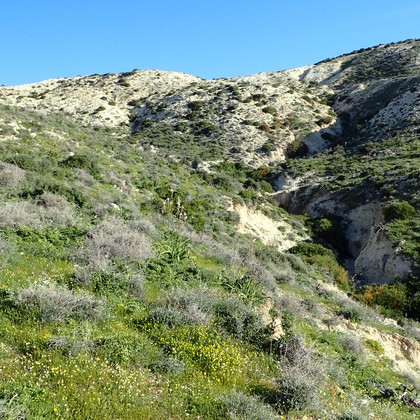
Open steppe, farmland and grassland, often with livestock; on passage also irrigated land, gardens, parks, golf courses and orchards with ripe mulberries and dates. Breeds in colonies in rock crevices, stone piles, walls and ruins. In the breeding season eats mainly locusts, on passage also fruit and seeds.
Where the bird is most at home, classified by the habitats of North Africa and the Middle East.


Range and movements
Passage migrant in the east of the region: common in Iraq, Kuwait, Bahrain, Qatar, eastern Saudi Arabia, the UAE and Oman, with flocks of hundreds to thousands in spring and late summer; small numbers winter in the UAE and Oman. In Syria, Jordan, Israel and Lebanon a scarce passage migrant, with influxes in some years; scarce in Yemen. Rare in Egypt and the Maghreb. Old breeding records from irruption years are known from northern Syria and Iraq. Beyond the region it breeds from eastern Europe and Turkey through the steppes of Central Asia to western Mongolia and Iran; winters in India and Sri Lanka.
- Summer visitor (c. Oct–Mar)
- Winter visitor (c. Apr–Sep)
- Passage (Mar–Apr, Oct–Nov)
- dark = core range, pale = thinly spread
How and when to look
In late April and May in the UAE, Oman or Kuwait on golf courses, lawns and irrigated fields: flocks of Rosy Starlings among the mynas. In late summer, July – August, mainly juveniles pass through, turning up in mulberry and date gardens.
Conservation status
Not globally threatened. Numbers fluctuate strongly with locust plagues. Valued as a locust destroyer in much of its range, but sometimes controlled in fruit growing.
Scientific name
Pastor roseus | (Linnaeus, 1758)
Linnaeus described the species in 1758 as Turdus roseus; because it was later moved to another genus, the author and year stand in brackets. The genus Pastor was introduced in 1815 by Temminck. Pastor is the Latin word for 'shepherd'. roseus is Latin for 'rose-coloured', for the pink of the back and breast. The specimen the first description was based on came from Lapland and Switzerland.