All species › Passerines › Starlings › Violet-Backed Starling
Violet-Backed Starling | Cinnyricinclus leucogaster
Amethistspreeuw | Estornino amatista
Violet-backed Starling is a small African starling whose male glitters amethyst-purple and white in the sun. In this region it is a summer visitor to the mountains and foothills of south-west Arabia, where it searches fig and acacia trees for fruit.

Voice
Fairly quiet. The song is a soft, short series of whistling and twittering notes; calls a soft, rising chip or a whistled choo-weet.
Recording: David C. Moyer — CC BY-NC-SA 4.0 · shortened to the first 60 s, mono · xeno-canto
Identification
16–17 cm. Small and compact, with a short, slightly forked tail and a short black bill; adults have a yellow iris. The male is glossy amethyst to violet-purple above and on the head, throat and upper breast, sharply set off from the pure white rest of the underparts; in shade the gloss can look almost black. The female is completely different: warm brown above with pale, scaly feather edges, white below with dense dark brown drop-shaped streaks, like a small thrush. Young males resemble the female and gradually acquire purple feathers.
Confusion species
The male is unmistakable. Females may recall a small thrush such as Song Thrush (Turdus philomelos), but are smaller, shorter-tailed and shorter-billed, with a strongly scaled back and a straight, starling-like flight. Female Rosy Starlings (Pastor roseus) are larger, unstreaked and sandy.
Habitat
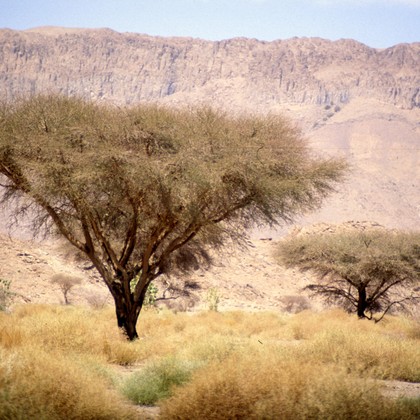
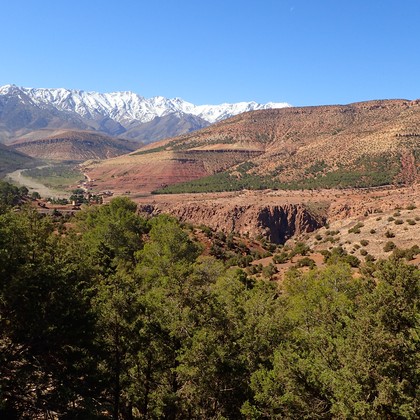
Wooded country with fruiting trees: acacia savanna, montane woodland with juniper and figs, wadis with large trees and riverine woodland, also large gardens and orchards. Lives mainly in the canopy, in pairs or small groups; eats fruit and insects, also caught in flight. Nests in tree holes.
Where the bird is most at home, classified by the habitats of North Africa and the Middle East.

Range and movements
Breeds as a summer visitor in south-west Arabia: in Saudi Arabia in Asir and the Tihama foothills, south through the western highlands and wadis of Yemen, and in Dhofar in Oman, where it arrives in the wooded coastal mountains with the monsoon. A rare vagrant further north, including Israel and Jordan; very rare in Egypt. Beyond the region widespread in sub-Saharan Africa, from Senegal to Ethiopia and south to South Africa; Arabian birds probably winter in East Africa.
- Resident
- Summer visitor (c. Oct–Mar)
- Winter visitor (c. Apr–Sep)
- Passage (Mar–Apr, Oct–Nov)
- dark = core range, pale = thinly spread
How and when to look
From May to August in the fig trees of the wadis of Asir or the khareef woodland of Dhofar near Salalah: a glittering purple male on a bare branch is unforgettable.
Conservation status
Not globally threatened. In Arabia dependent on large fruiting trees in wadis and montane woodland, which are under pressure from felling and grazing.
Scientific name
Cinnyricinclus leucogaster | (Boddaert, 1783)
Boddaert described the species in 1783 as Turdus leucogaster; because it was later moved to another genus, the author and year stand in brackets. The genus Cinnyricinclus was introduced in 1840 by Lesson. Cinnyricinclus combines Cinnyris, the sunbird genus, with the New Latin cinclus, 'thrush' — a 'sunbird-thrush', presumably for the male's iridescent plumage. leucogaster comes from the Greek leukos, 'white', and gastēr, 'belly' — for the white belly contrasting sharply with the male's violet upperparts. The specimen the first description was based on came from no locality given; later fixed as Ouidah, Benin.