All species › Birds of prey › Hawks, eagles and kites › Rough-Legged Hawk
Rough-Legged Hawk | Buteo lagopus
Ruigpootbuizerd | Busardo calzado
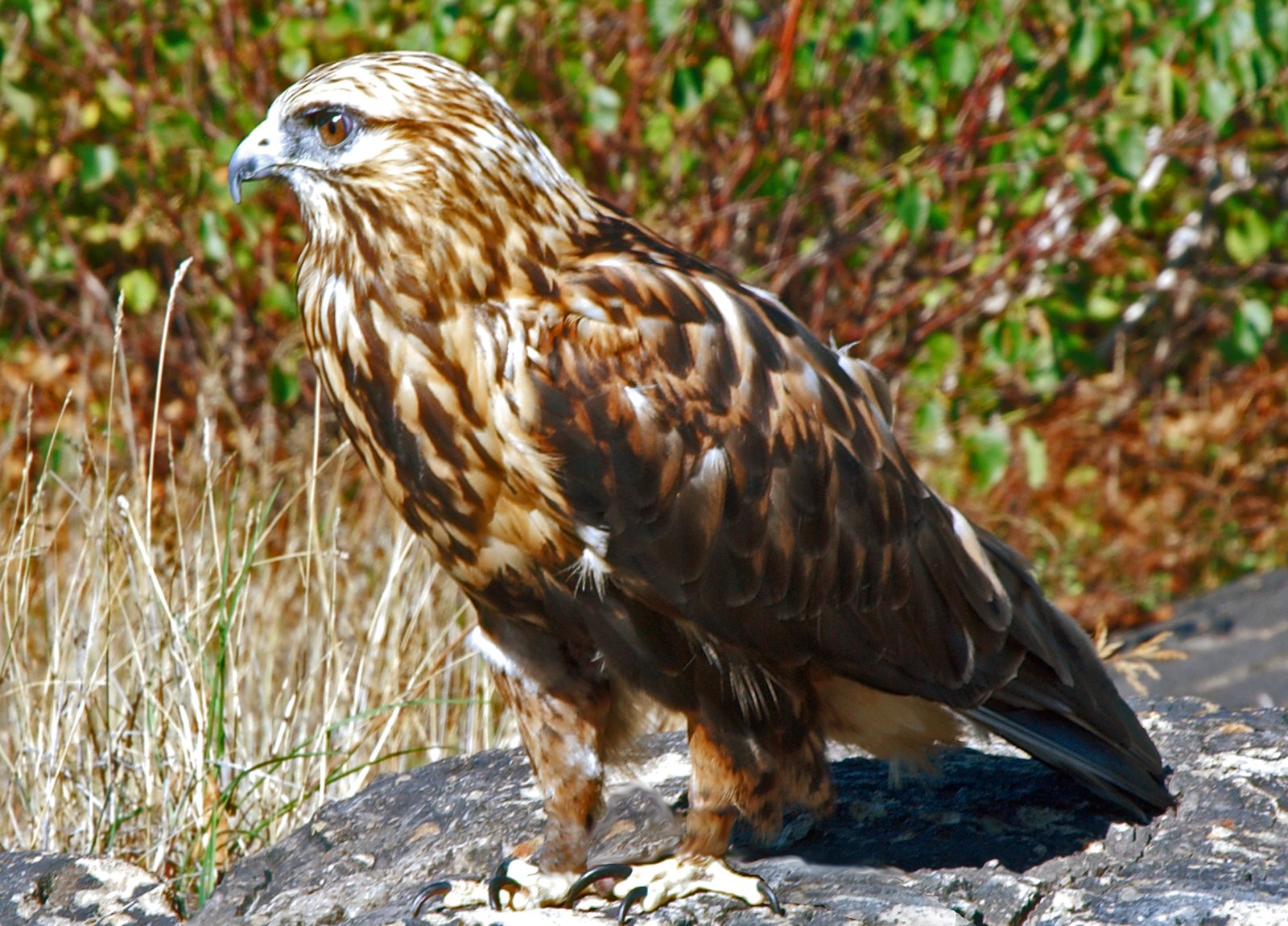
The Rough-legged Hawk is a buzzard of tundra and taiga with feathered legs, which moves south in winter to the steppes and farmland of Europe and Central Asia. The region lies far south of its normal winter range: only a handful of records are known.
Voice
Almost always silent in winter. Sometimes a drawn-out, plaintive peeeee-yoo, higher and thinner than the call of Common Buzzard.
Recording: Stanislas Wroza — CC BY-NC-SA 4.0 · converted to mono · xeno-canto
Identification
49–59 cm, wingspan 120–150 cm. Slimmer and longer in wing and tail than Common Buzzard, with a pale head and breast. The decisive feature is the tail: bright white at the base with a sharply defined, broad dark terminal band, in the adult male with a few narrower bands above it. Also a dark, often almost black belly patch contrasting sharply with the pale breast, and large black carpal patches on a mainly white underwing. The legs are feathered to the toes. Often hovers for long periods. The juvenile has a more diffuse tail band, a more uniform dark belly and a pale iris.
Confusion species
Common Buzzard (Buteo buteo) is more compact, with a finely barred tail lacking a sharp contrast between white base and terminal band. Long-legged Buzzard (Buteo rufinus) is the main pitfall in the region: pale birds also have a pale head, a dark belly and black carpal patches, but the tail is plain pale orange-brown to whitish without a broad dark terminal band. Pale Steppe Buzzards can also show a pale tail base; check the sharpness of the terminal band and the white uppertail coverts.
Habitat
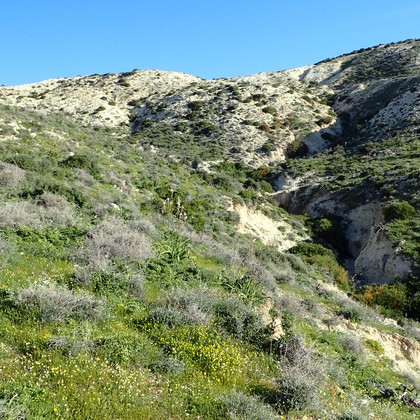
In winter open, flat country: fields, fallow land, steppe and saltmarsh with plenty of voles. In the region to be expected in open farmland and steppe, as in the northern Negev.
Where the bird is most at home, classified by the habitats of North Africa and the Middle East.

Range and movements
Two records in Israel: in the winter of 1984/85, and an adult male at Urim in the northwestern Negev from 30 November to 2 December 2012. No confirmed records elsewhere in the region; the species is sometimes reported in the Maghreb and Arabia, but these usually concern pale Long-Legged or Common Buzzards. Beyond the region it breeds around the Arctic in Scandinavia, Russia, Alaska and Canada, and winters in Europe south to France and the Balkans, in Central Asia and in North America.
How and when to look
A candidate in the region must be well documented, with photographs of the upper and underside of tail and wings: look for the white tail base with a sharp terminal band and the feathered legs, and rule out a pale Long-legged Buzzard.
Conservation status
Not threatened. Numbers fluctuate with vole cycles in the north; southern vagrants are somewhat more frequent in hard winters.
Scientific name
Buteo lagopus | (Pontoppidan, 1763)
Pontoppidan described the species in 1763 as Falco Lagopus; because it was later moved to another genus, the author and year stand in brackets. The genus Buteo was introduced in 1799 by De Lacépède. Buteo is the Latin word for a buzzard. lagopus is Greek, from lagōs 'hare' and pous 'foot': 'hare-foot', after the legs feathered down to the toes. The specimen the first description was based on came from Denmark.