All species › Birds of prey › Hawks, eagles and kites › Bateleur
Bateleur | Terathopius ecaudatus
Bateleur | Águila volatinera
The Bateleur is an African snake-eagle with a unique silhouette: very long, broad wings and an almost absent tail, with which it glides low and rocking over the savanna for hours. Its range barely reaches Arabia; in the rest of the region it is a great rarity.
Voice
Mostly silent. In display and at the nest a loud, barking kow-kow-kaow; in display flight it also makes a clapping sound with the wings.
Recording: Vikram — CC BY-NC-SA 4.0 · converted to mono · xeno-canto
Identification
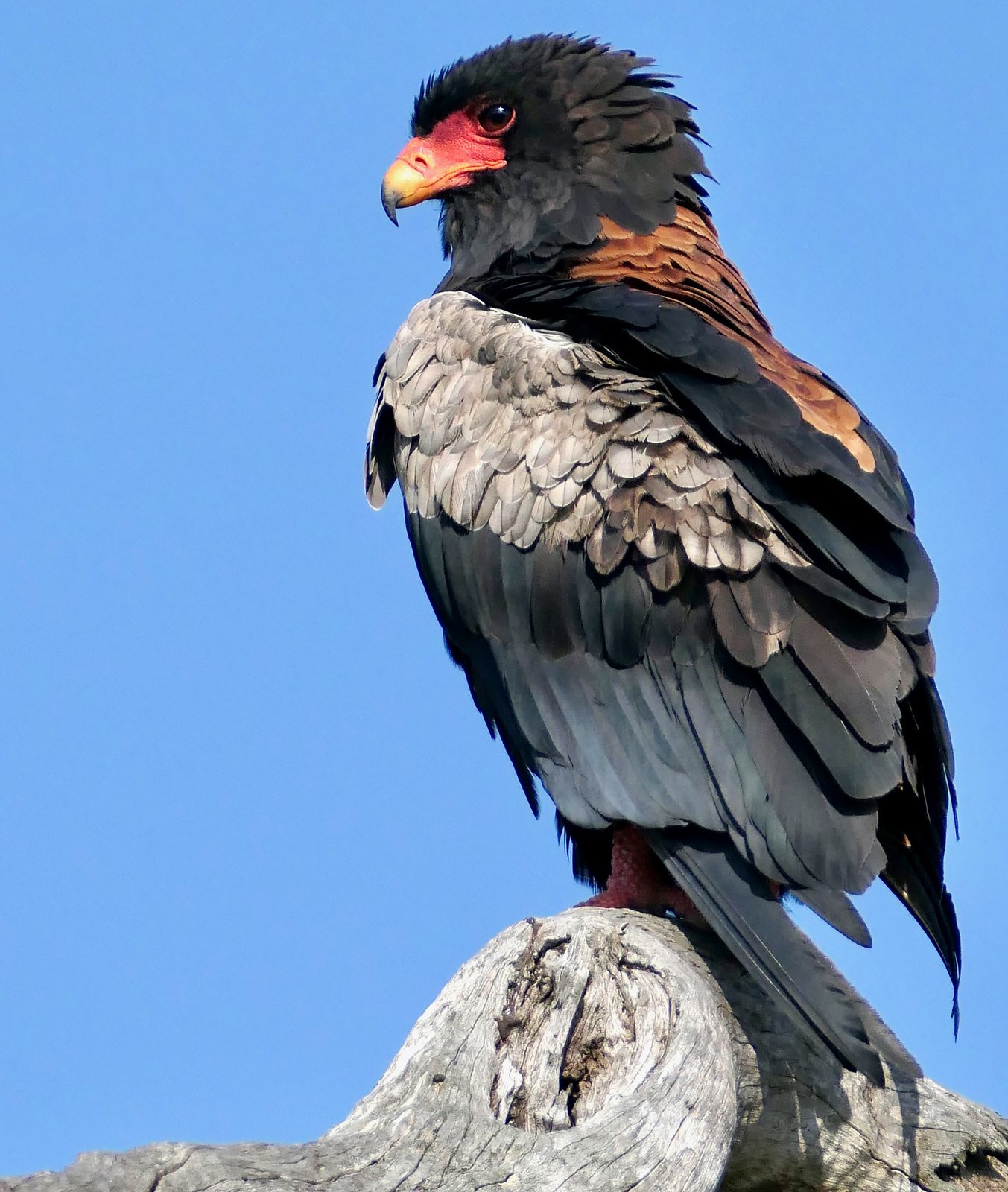
55–70 cm, wingspan 168–190 cm. The adult is black with a chestnut back and tail (cream in a rare morph), grey shoulders and wing coverts, bright red bare facial skin and red legs. From below in flight white underwing coverts contrast with black flight feathers; the male has a broad black trailing edge, the female greyer secondaries with a narrow black edge. The tail is so short that the feet project beyond it. Flies with slightly raised wings and constantly tilts from side to side, like a tightrope walker. The juvenile is plain brown with a greenish-blue to grey face, a longer tail and a less extreme shape; adult plumage takes seven or eight years.
Confusion species
The adult is unmistakable. A young bird may recall a dark eagle at range, such as Tawny Eagle (Aquila rapax) or Short-toed Snake-Eagle (Circaetus gallicus), but these have a normal, much longer tail and do not rock in flight. Note the pointed, swept-back wings and the short tail with projecting feet.
Habitat
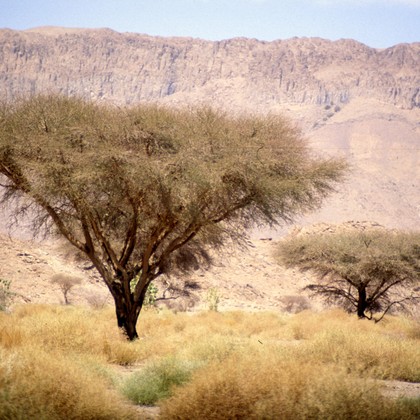
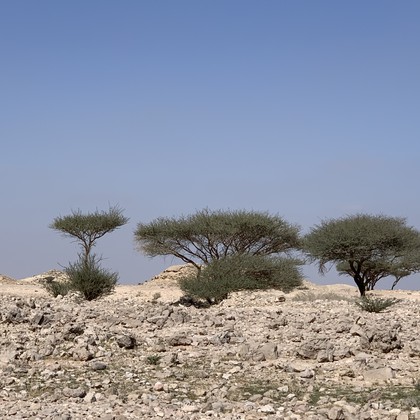
Open savanna and thorn scrub with scattered acacias, dry wadis and the edges of farmland, from sea level into the hills. In Arabia mainly on the Tihama plain and the foothills of the mountains.
Where the bird is most at home, classified by the habitats of North Africa and the Middle East.
Range and movements
In the extreme south-west of Saudi Arabia and in western Yemen a rare remnant population is said to persist, but recent confirmation is largely lacking. Elsewhere a vagrant: in Israel at least seven records, including a bird at Beit Guvrin in February 2002 and a juvenile at Eilat in March 2008; also rare in Egypt, Tunisia and Iraq. A juvenile at Algeciras (Spain) in April 2012 almost certainly came via Morocco. Breeds in Africa south of the Sahara, from Senegal to Ethiopia and Somalia and south to South Africa.
How and when to look
There is a chance only on the Tihama and in the foothills of the Asir and the Yemeni mountains; scan over open acacia country for a raptor gliding low and rocking, without a tail. Elsewhere vagrants appear mainly in spring, usually young birds among other migrating raptors at Eilat.
Conservation status
Endangered. Across much of Africa it has declined sharply outside protected areas through poisoning (including via carcasses poisoned for predators), persecution, habitat loss and the trade in body parts. The Arabian birds are probably very few in number.
Scientific name
Terathopius ecaudatus | (Daudin, 1800)
Daudin described the species in 1800 as Falco ecaudatus; because it was later moved to another genus, the author and year stand in brackets. The genus Terathopius was introduced in 1830 by Lesson. Terathopius comes from Greek teras, 'marvel', and ops, 'face' — for the Bateleur's bright red, bare face. ecaudatus is Latin for 'tailless', from e-, 'without', and cauda, 'tail' — for the strikingly short tail. The specimen the first description was based on came from Knysna, South Africa.