All species › Birds of prey › Hawks, eagles and kites › Socotra Buzzard
Socotra Buzzard | Buteo socotraensis
Socotrabuizerd | Busardo de Socotora
The Socotra Buzzard is a small, pale buzzard found only on the island of Socotra. For a long time it was taken for a Common Buzzard; it was described as a separate species only in 2010. With a few hundred adults it is one of the rarest raptors in the region.

Voice
Little known. A plaintive, buzzard-like mewing, repeated with gaps of less than a second, mainly near the nest.
No recording with a suitable Creative Commons licence is available for this species yet.
Identification
43–50 cm, wingspan 105–125 cm; slightly smaller and more compact than Common Buzzard. The upperparts are grey-brown with pale fringes, the head pale and finely streaked, sometimes with a white throat and upper breast. Below yellowish-white to creamy white, with brown streaks on throat and breast that become heavier on the breast, belly, flanks and thighs, where they sometimes merge into blotches. In flight a pale underwing with dark carpal patches and a dark trailing edge, and a pale, finely barred grey-brown tail with a narrow dark terminal band. Adults and juveniles are very alike; juveniles differ mainly in the strength of the streaking below.
Confusion species
On Socotra it is the only breeding buzzard. Egyptian Vulture (Neophron percnopterus), numerous on the island, is larger, with long, narrow wings and a wedge-shaped tail; young Egyptian Vultures are dark brown. Common Kestrel (Falco tinnunculus) is much smaller, with pointed wings and a long tail. A migrant Steppe Buzzard (Buteo buteo) or Long-legged Buzzard (Buteo rufinus) would be possible but is hardly known from the island; those are warmer brown and less finely streaked.
Habitat
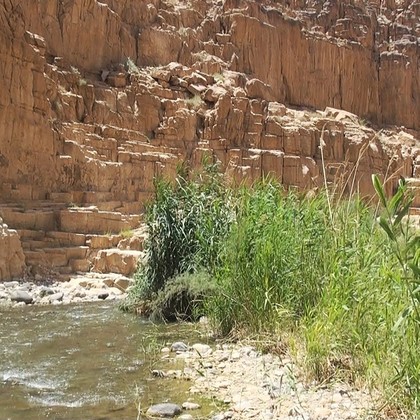
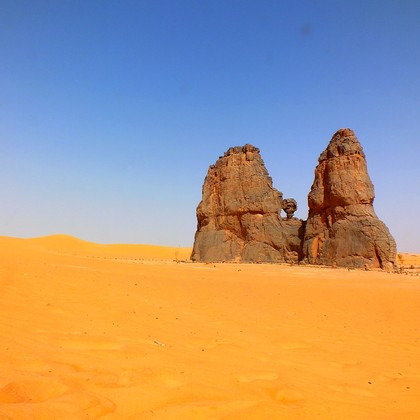
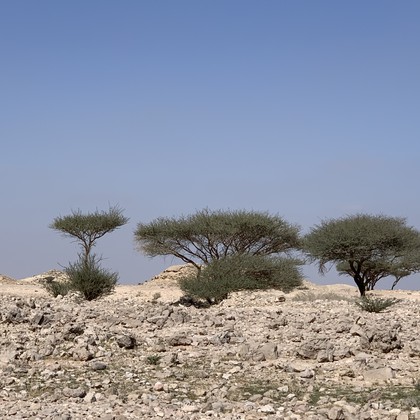
Hills, plateaus and deep gorges of Socotra, with shrubland of bottle trees, frankincense and dragon's blood trees, mostly between 150 and 800 m. The nest is on a shaded ledge or in a niche in a cliff, usually between 150 and 650 m; the species does not depend on trees for nesting. Hunts lizards, insects, small birds and rodents.
Where the bird is most at home, classified by the habitats of North Africa and the Middle East.
Range and movements
Endemic to Socotra (Yemen): scattered over the main island, especially in the hills and gorges of the interior and the edges of the Hajhir Mountains. Not known from the other islands of the archipelago. Occurs nowhere outside Socotra.
- Winter visitor (c. Oct–Mar)
- Passage (Mar–Apr, Oct–Nov)
- dark = core range, pale = thinly spread
How and when to look
Look for it in the gorges and on the slopes of the interior, such as around the Diksam Plateau and in Wadi Ayhaft, where it often sits watching from a rock or over a slope. It is easier to see than its small numbers would suggest.
Conservation status
Vulnerable: the population is estimated at 250 to 500 adults and appears to be declining. Its habitat is under pressure from overgrazing by goats, road building and increasing development, and the species competes with Egyptian Vultures, ravens and falcons for nest sites on cliffs.
Scientific name
Buteo socotraensis | Porter & Kirwan, 2010
Porter & Kirwan described the species in 2010 and placed it straight away in the genus where it still stands. The genus Buteo was introduced in 1799 by De Lacépède. Buteo is the Latin word for a buzzard. socotraensis means 'of Socotra', after the island where the species lives. The specimen the first description was based on came from Socotra, Yemen.