All species › Passerines › Chats and flycatchers › Rufous-Tailed Scrub-Robin
Rufous-Tailed Scrub-Robin | Cercotrichas galactotes
Rosse waaierstaart | Alzacola rojizo
The Rufous-tailed Scrub-Robin is a sandy, long-tailed songbird of dry, bushy landscapes that conspicuously cocks and fans its long rufous tail with black-and-white tips. In this region it is a widespread summer visitor, from the Maghreb and the Nile to the Levant, Iraq and eastern Arabia.

Voice
The song is a clear, somewhat jerky series of varied fluty phrases with pauses, lark- or thrush-like, often from a bush top or wire and also in a short song flight. Calls are a hard tchek and a harsh tchrr.
Recording: Stanislas Wroza — CC BY-NC-SA 4.0 · converted to mono · xeno-canto
Identification
15–17 cm. Upperparts sandy brown (western birds) to greyish-brown (eastern birds), with a clear pale supercilium, a dark eye-stripe and pale underparts. The long, rounded tail is bright rufous with a black subterminal band and white tips, which flash as a black-and-white pattern when fanned. Wings with pale fringes. The bill is fairly long and slightly decurved, the legs long and pink. Three forms occur in the region: galactotes (Maghreb, Egypt), warm rufous-brown above; syriaca (Levant), greyer on mantle and crown; and familiaris (Iraq, eastern Arabia), greyer still with less rufous in the tail. Sexes are alike.
Confusion species
Common Nightingale (Luscinia megarhynchos) also has a rufous tail but no supercilium and no black-and-white tail tips, and keeps hidden. Female Common Redstart (Phoenicurus phoenicurus) is smaller, quivers rather than fans its tail and lacks the supercilium. Grey eastern birds may recall Eastern Olivaceous Warbler (Iduna pallida), but that has a plain brownish-grey tail.
Habitat
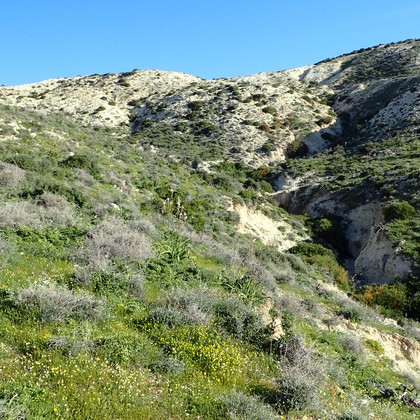
Dry, open country with scattered bushes: olive and almond groves, vineyards, date-palm gardens and oases, cactus hedges, tamarisk scrub in wadis, garrigue and field edges; in eastern Arabia also coastal vegetation and gardens. Forages on the ground, in the shade beneath bushes.
Where the bird is most at home, classified by the habitats of North Africa and the Middle East.


Range and movements
Breeds as a summer visitor in Morocco (mainly in the south and east, including the oases south of the Atlas), in Algeria and Tunisia (mainly in the steppe zone and oases), in Libya along the coast and in the oases, in Egypt along the Nile Valley, the Delta and in the oases, and in the Levant: Israel, Jordan, Lebanon and Syria. In Iraq it breeds along the Euphrates and Tigris, and in eastern Arabia in Kuwait (confirmed since the early 2000s), Bahrain and the Eastern Province of Saudi Arabia. On passage throughout the region, including Saudi Arabia, Yemen, Oman and the Gulf states. Winters in the Sahel and East Africa. Beyond the region it breeds in southern Spain and Portugal, south-eastern Europe, Turkey and Iran to Central Asia; the subspecies minor is resident in the Sahel.
- Resident
- Summer visitor (c. Apr–Sep)
- Winter visitor (c. Oct–Mar)
- Passage (Mar–Apr, Oct–Nov)
- dark = core range, pale = thinly spread
How and when to look
In May and June in the date-palm gardens of the Moroccan oases (Merzouga, the Draa Valley) or in the olive groves of Tunisia: it sings from a post or bush top, then drops to the ground with its tail fanned. In Kuwait and Bahrain in any scrubby patch.
Conservation status
Not globally threatened. In Europe it has declined steeply through agricultural intensification; in this region it locally loses breeding habitat as traditional oases and orchards disappear, but elsewhere it benefits from planting and irrigation.
Scientific name
Cercotrichas galactotes | (Temminck, 1820) (GBIF: Erythropygia galactotes)
Temminck described the species in 1820 as Sylvia galactotes; because it was later moved to another genus, the author and year stand in brackets. The genus Cercotrichas was introduced in 1831 by Boie. Cercotrichas is Greek, from kerkos 'tail' and trikhas 'thrush'. galactotes means 'milk-like', from Greek gala 'milk'. The specimen the first description was based on came from Algeciras, southern Spain.