All species › Passerines › Sylvia warblers › Rüppell's Warbler
Rüppell's Warbler | Curruca ruppeli
Rüppells grasmus | Curruca de Rüppell
Rüppell's Warbler is the most striking warbler of the eastern flyway: a breeder of the Aegean and southern Turkey that passes in numbers through the Levant, Sinai and Egypt in spring and autumn, to and from its winter quarters in Chad and Sudan. A male with black throat and white moustache in a flowering acacia at Eilat or in Sinai is one of the highlights of spring migration.

Voice
The call is a hard, wooden chek, often in series, and a dry rattle tserrr when agitated. The song is a fast, stuttering chatter of rattling and scratchy notes between clear whistles, fuller than in Sardinian Warbler; migrant males sing regularly in spring, even from an acacia in a wadi.
Recording: Stanislas Wroza — CC BY-NC-SA 4.0 · converted to mono · xeno-canto
Identification
13–14 cm. Slim, with a fairly long, pointed wing. The male is unmistakable: black cap, chin and throat, separated by a broad white moustache from the bill base to the neck side, clean grey upperparts and pale grey to white underparts. Tertials and greater coverts have conspicuous pale fringes forming a pale panel on the closed wing. Eye-ring and iris reddish brown, tail black with white outer feathers. The female is grey with a pale throat, often a faint dark wash on the chin and a hint of a moustache, but keeps the pale tertial fringes, which are also the best feature on young birds.
Confusion species
Sardinian Warbler (Curruca melanocephala) has a white throat without a moustache, plain tertials and a shorter wing point. Cyprus Warbler (Curruca melanothorax), wintering in the same area, has a white moustache in the male but a black-spotted rather than solidly black throat and breast. Ménétriés's Warbler (Curruca mystacea) is paler, with a pink wash below, and constantly pumps its tail. Barred Warbler (Curruca nisoria), on the same route, is much bulkier, with two pale wing-bars and a yellow eye.
Habitat
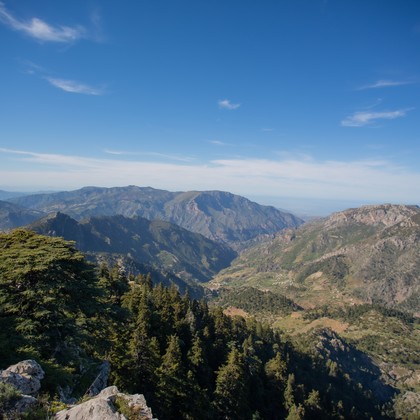
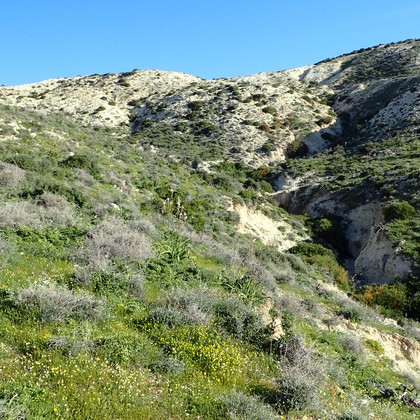
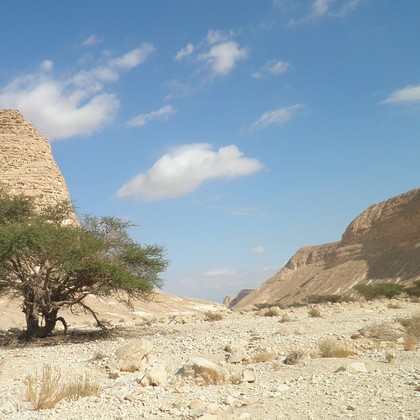
Breeds on dry, rocky slopes with low scrub, garrigue and scattered trees. On migration in any terrain with bushes: wadis with acacia and tamarisk, oases, kibbutz gardens, parks and coastal dunes, even in mid-desert wherever a few trees stand.
Where the bird is most at home, classified by the habitats of North Africa and the Middle East.
Range and movements
Breeds in small numbers in western Syria, adjoining the population of southern Turkey; breeding in Lebanon is unconfirmed. Common on passage in Israel (especially the Arava and Eilat), Sinai, Jordan and Lebanon, and scattered through Egypt along the Nile and the Red Sea; in spring also along the coast of Cyrenaica in eastern Libya and scarce in north-west Saudi Arabia. A rare vagrant to Iraq, Kuwait and the Gulf states, exceptional further west in the Maghreb. Beyond the region it breeds in the southern Balkans, the Aegean islands, Crete and western and southern Turkey, and winters on the southern edge of the Sahara in Chad and Sudan.
- Summer visitor (c. Oct–Mar)
- Passage (Mar–Apr, Oct–Nov)
- dark = core range, pale = thinly spread
How and when to look
The best time is mid-March to mid-April at Eilat: the parks and the ringing station by the salt pans regularly produce singing males. The wadis around St Catherine in Sinai and Azraq oasis in Jordan are also good during spring passage. In autumn birds are quieter and more often females or young: check the pale tertial fringes.
Conservation status
Not globally threatened and the population appears stable. Its small breeding range makes it sensitive to loss of scrub to building and fires, and in winter to drought and overgrazing in the Sahel.
Scientific name
Curruca ruppeli | (Temminck, 1823) (GBIF: Sylvia ruppeli)
Temminck described the species in 1823 as Sylvia ruppeli; because it was later moved to another genus, the author and year stand in brackets. The genus Curruca was introduced in 1802 by Bechstein. Curruca is Latin, the name of an unidentified small bird mentioned by the Roman poet Juvenal. ruppeli honours the German naturalist and traveller Eduard Rüppell (1794–1884), who collected in north-east Africa and Arabia. The specimen the first description was based on came from Iraklion, Crete.