All species › Falcons › Falcons › Saker Falcon
Saker Falcon | Falco cherrug
Sakervalk | Halcón sacre
The Saker Falcon is a heavy, brown steppe falcon from central Europe and Central Asia that winters in small numbers in the Middle East. In the Arab falconry tradition it is the most coveted falcon of all, and trapping for falconry is one of the reasons the species is globally threatened.

Voice
Almost silent in the wintering area. At the nest a hard, hoarse kyek-kyek-kyek, deeper and rougher than the Peregrine's alarm.
Recording: András Schmidt — CC BY-NC-SA 4.0 · converted to mono · xeno-canto
Identification
45–57 cm, wingspan 97–126 cm. Large and heavily built, bulkier than a Peregrine, with broad wings and a long, fairly broad tail. Upperparts warm brown with pale fringes, underparts creamy white with coarse, drop-shaped dark spots concentrated on the flanks and thighs. The head is strikingly pale, often almost creamy white, with a thin eyestripe and at most a faint, narrow moustache. In flight the dark thighs and underwing coverts contrast with the paler flight feathers. Juveniles are darker and more heavily streaked, with blue-grey legs.
Confusion species
Lanner Falcon (Falco biarmicus) is smaller and slimmer, with a rufous or creamy crown, a clearer moustache and finer spots; juveniles in particular are very similar. Peregrine Falcon (Falco peregrinus) is more compact, slate-grey above with a broad black moustache and barred underparts. In the Gulf states many escaped falconry birds fly around, including Saker × Gyrfalcon hybrids; a wild Saker there is recognised mainly by season and place (autumn or winter, away from towns).
Habitat
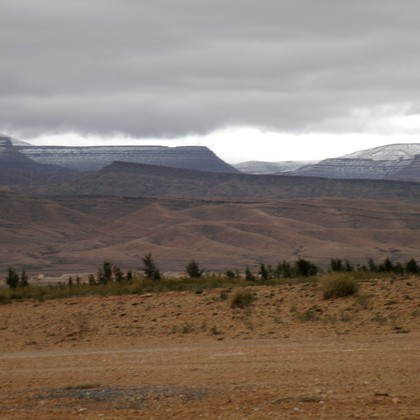
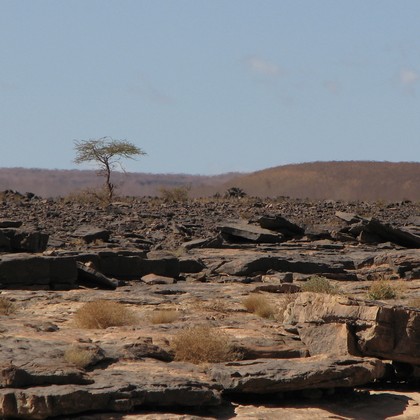
In winter open plains: steppe and semi-desert, stony desert with burrowing rodents, farmland, and the edges of salt pans and wetlands. Likes to perch on pylons, poles and boulders. Hunts low over the ground for rodents, sandgrouse, pigeons and crows.
Where the bird is most at home, classified by the habitats of North Africa and the Middle East.

Range and movements
Breeds from central Europe via the Pontic steppe and Turkey across the Asian steppe to Mongolia and western China; does not breed in the region covered by this guide. Winters in small numbers in the Middle East: most often seen in Israel, Iraq and Syria, more scarcely in Jordan, Saudi Arabia, Kuwait, Qatar, the UAE and Egypt; a rarity in Libya, Tunisia and Morocco. Some records in the Gulf states concern escaped falconry birds.
- Winter visitor (c. Apr–Sep)
- dark = core range, pale = thinly spread
How and when to look
The best chance is from November to February in Israel, in the Hula Valley, the Jezreel Valley or the northern Negev, where wintering birds perch on pylons above farmland. Compare head, tail and size carefully with Lanner, and check a bird in the Gulf states for rings or transmitters.
Conservation status
Globally threatened. Numbers on the Asian steppe have fallen sharply through trapping for falconry, electrocution on medium-voltage poles and poisoning. In Saudi Arabia about 25 to 40 birds a year have been trapped for twenty years, mainly young migrants from Central Asia; an international action plan aims to regulate trapping and trade.
Scientific name
Falco cherrug | Gray, 1834
Gray described the species in 1834 and placed it straight away in the genus where it still stands. The genus Falco was introduced in 1758 by Linnaeus. Falco is Late Latin for 'falcon', from falx, falcis 'sickle', after the sickle-shaped claws of the bird. cherrug comes from Sindhi, where charg is the name for a female saker. The specimen the first description was based on came from India.