All species › Falcons › Falcons › Merlin
Merlin | Falco columbarius
Smelleken | Esmerejón
The Merlin is the smallest falcon in the region, a compact, fast hunter that chases small birds low over open country. It is a scarce winter visitor from Europe and the Central Asian steppes, wintering mainly in the Maghreb, along the north coast of Egypt and in the Levant.
Voice
Almost always silent in winter; when disturbed sometimes a fast, shrill kee-kee-kee.
Recording: Don Profota — CC BY-NC-SA 4.0 · converted to mono · xeno-canto
Identification
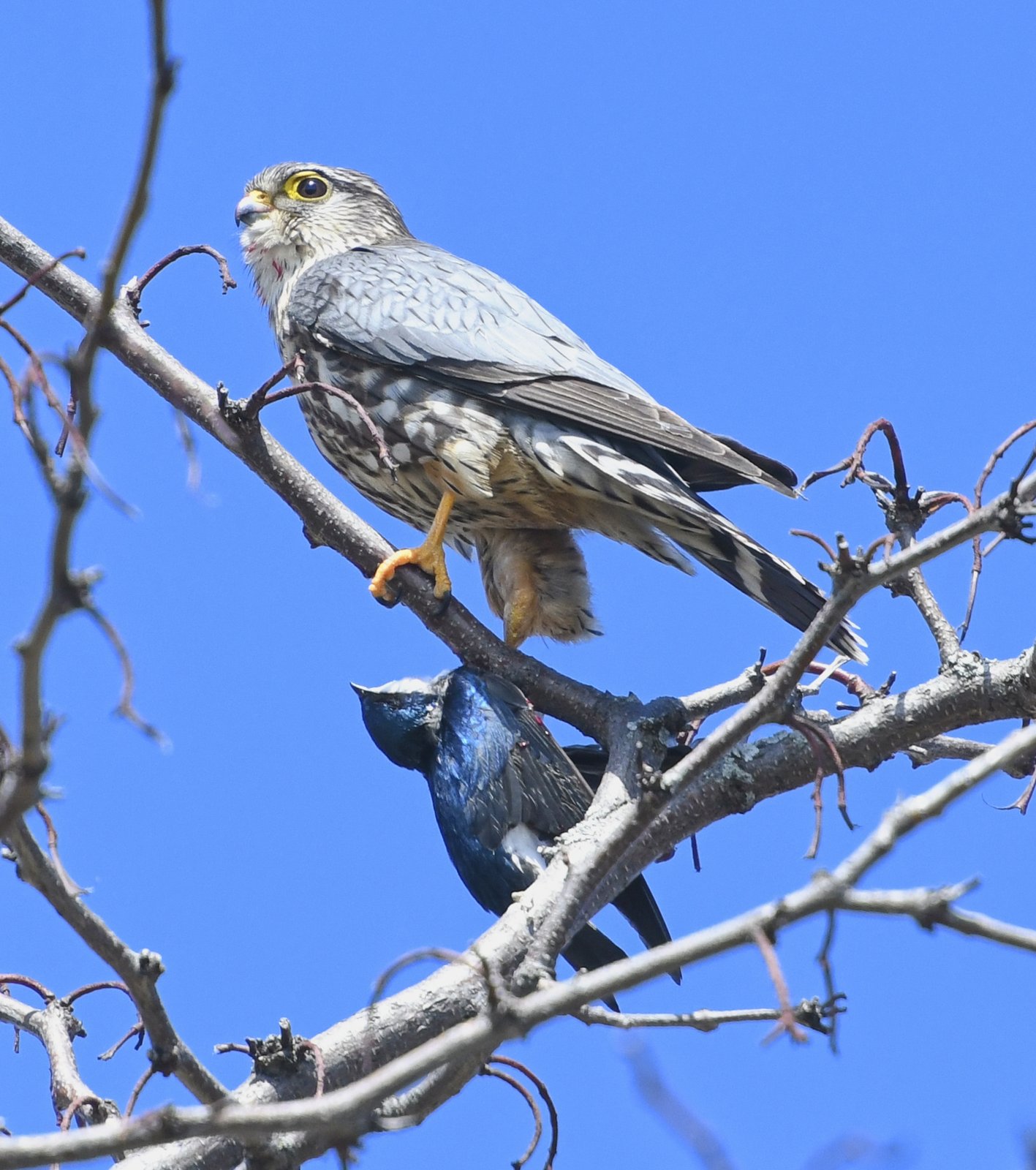
25–30 cm, wingspan 50–62 cm; the female is clearly larger than the male. Compact, with fairly short, pointed, broad-based wings and a medium-length tail. The male is blue-grey above with a dark terminal tail band and warm orange-buff, dark-streaked underparts and a faint moustache. Female and juvenile are dark greyish-brown above, with a strongly barred tail and creamy, heavily brown-streaked underparts. Birds of the eastern steppe form, which reach Iraq and the Gulf, are much paler and sandier. Flight is fast and low, with short bursts of wingbeats and brief glides; it almost never hovers.
Confusion species
Common Kestrel (Falco tinnunculus) is larger and longer-tailed, with a rufous back, and often hovers. Eurasian Hobby (Falco subbuteo) is absent in winter, has longer, scythe-shaped wings, a sharp black moustache and, in adults, rufous thighs. A female Eurasian Sparrowhawk (Accipiter nisus) has broad, rounded wings and a long tail. A small, pale steppe Merlin may recall a young Lanner Falcon (Falco biarmicus), but that is much larger.
Habitat
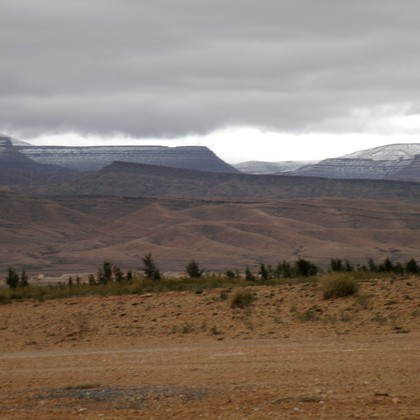
Open, flat country with few trees: steppe, fields and stubble, coastal plains, dunes, salt flats and the edges of lagoons and chotts, where larks and pipits feed. Often perches low on a stone, post or mound. Hunts almost exclusively small birds such as larks, pipits and finches, which it catches in a low pursuit.
Where the bird is most at home, classified by the habitats of North Africa and the Middle East.


Range and movements
Scarce winter visitor to the northern half of the region: in Morocco mainly on the Atlantic coastal plains and the eastern plateaus, in northern Algeria, Tunisia, coastal Libya and the north coast and Nile delta of Egypt. In the Levant scarce in Israel, Jordan, Lebanon and Syria, and in Iraq and Kuwait. In Arabia a scarce winter visitor to northern Saudi Arabia and the Gulf states, rare to vagrant further south in Oman, the UAE and Yemen. Breeds in northern Europe, northern Asia and North America; the pale steppe birds breed in Kazakhstan and Central Asia.
- Winter visitor (c. Oct–Mar)
- Passage (Mar–Apr, Oct–Nov)
- dark = core range, pale = thinly spread
How and when to look
In winter search the coast of northern Morocco or Tunisia, the Nile delta or the plains of the Beit She'an valley and the Hula in Israel for a small, dark falcon dashing low and fast over the ground or sitting flat on a mound. Flocks of larks and pipits suddenly flushing often betray a hunting Merlin.
Conservation status
Not threatened; the world population is large and stable. In Europe it has declined locally through afforestation and the loss of heath and moorland; in the wintering areas trapping and shooting play a minor role.
Scientific name
Falco columbarius | Linnaeus, 1758
Linnaeus described the species in 1758 and placed it straight away in the genus where it still stands. He introduced the genus Falco in that same work. Falco is Late Latin for 'falcon', from falx, falcis 'sickle', after the sickle-shaped claws of the bird. columbarius is Latin for 'of doves', from columba 'dove'. The specimen the first description was based on came from South Carolina.