All species › Gamebirds › Pheasants and partridges › Sand Partridge
Sand Partridge | Ammoperdix heyi
Arabische woestijnpatrijs | Perdiz desértica
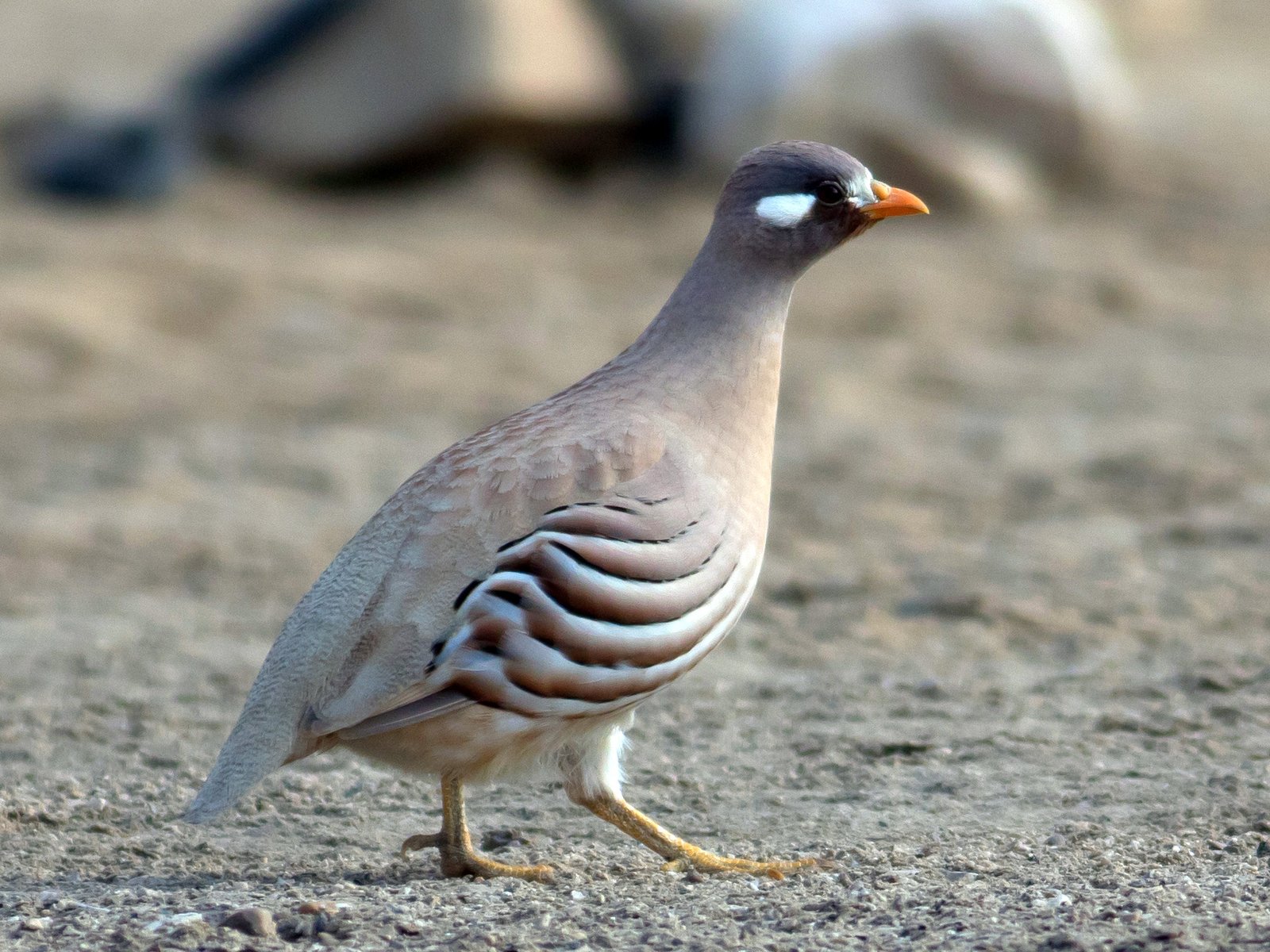
The gamebird of the bare, hot rocky deserts around the Red Sea: from Sinai and the Dead Sea through the Hejaz and Yemen to the Hajar Mountains of Oman. As small as a large quail and as sandy as the scree it walks on, it only catches the eye when a covey starts moving or when a male sends its clear call echoing through a canyon at dawn.
Voice
A clear, rather plaintive kwee-kwee-kwee or woo-wit, woo-wit that quickens and echoes from wall to wall in a quiet canyon. Also a sharp kwip when alarmed and a soft chatter within a covey. Mainly in the first hour of light and again towards evening.
Recording: David Darrell-Lambert — CC BY-NC-SA 4.0 · converted to mono · xeno-canto
Identification
About 24 cm, round and short-tailed. The male has a grey head with a small white spot between bill and eye and a larger white ear patch behind the eye; throat and neck sides are greyish brown, the breast pinkish sand. The flanks carry broad, wavy bars of chestnut, black and creamy white; the upperparts are plain sandy with fine vermiculation. Bill orange, legs yellowish. The female is plain sandy and finely vermiculated, lacking the white head spots, with a duller yellowish bill. Birds of the dark Jordan Rift are darker and redder than those of the pale sandstone of Sinai and the Arabian coast. It flushes with a whirring sound and then glides obliquely down the slope, showing rufous outer tail feathers.
Confusion species
See-see Partridge (Ammoperdix griseogularis) of northern Iraq and eastern Syria is the eastern sister species: its male has a black band across the forehead and through the eye with a white stripe below, and lacks the white ear patch. Females are barely separable in the field, but the ranges hardly overlap in the region. Chukar Partridge (Alectoris chukar) in the Levant and Arabian Partridge (Alectoris melanocephala) and Philby's Partridge (Alectoris philbyi) in western Arabia are much larger, with red bill and legs and a black-bordered throat. Common Quail (Coturnix coturnix) is streaked and keeps to grass and crops, not bare rock.
Habitat
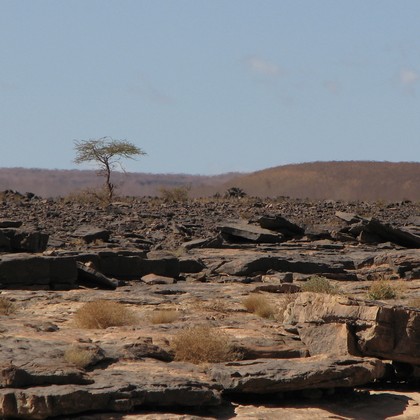
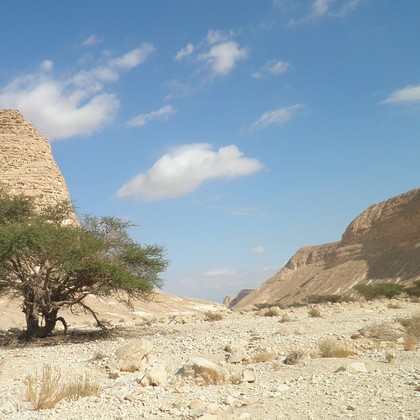
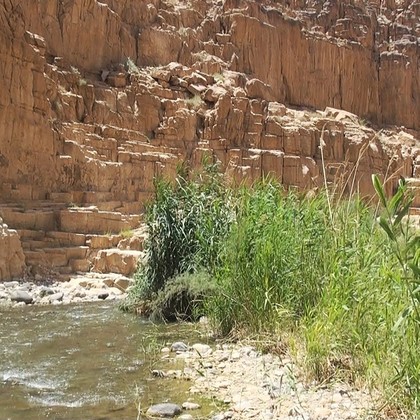
Bare, stony desert with relief: boulder-strewn slopes, scree fans, gorges and canyons, rocky wadis with scattered acacias and dwarf shrubs. From more than 400 metres below sea level by the Dead Sea to above 2,000 metres in the mountains of Sinai and Oman. Drinking water within walking distance is essential: springs, falaj channels (Omani irrigation channels), seepages and troughs are visited on foot in the morning and evening. In Oman and the Emirates also in terraced fields and around mountain villages.
Where the bird is most at home, classified by the habitats of North Africa and the Middle East.
Range and movements
Within the region in Egypt in the mountains of Sinai and the Eastern Desert between the Nile and the Red Sea, in Israel and the West Bank in the Judean Desert, the Negev and the Arava, in Jordan along the Jordan Rift, the Dead Sea and south to Wadi Rum and Aqaba, in Saudi Arabia along the mountains of the Hejaz and Asir and the Tihama foothills, in Yemen, in Oman in the Hajar Mountains and Dhofar, and in the United Arab Emirates in the Hajar region and at Jebel Hafeet. Four subspecies divide this range, including A. h. heyi in Sinai and the Levant, A. h. nicolli in north-eastern Egypt and A. h. intermedia in south-western Arabia and Oman. Beyond the region in the hills along the Red Sea in Sudan and Eritrea.
- Resident
- Summer visitor (c. Apr–Sep)
- Winter visitor (c. Oct–Mar)
- Passage (Mar–Apr, Oct–Nov)
- dark = core range, pale = thinly spread
How and when to look
At first light go to a spring or trough and sit down: Ein Gedi and Ein Avdat in Israel, Wadi Mujib and Wadi Rum in Jordan, the wadis around Jebel Hafeet near Al Ain or the falajes of the Hajar Mountains in Oman are reliable. Look for movement rather than a bird shape. If a covey flushes, note where it lands and wait: the birds usually walk back.
Conservation status
Not globally threatened and still widespread across its desert range. It has declined locally through hunting, disturbance at drinking sites and altered water management; elsewhere it benefits from livestock troughs and irrigation. In protected areas in Israel and Jordan it is often tame and easy to see.
Scientific name
Ammoperdix heyi | (Temminck, 1825)
Temminck described the species in 1825 as Perdix heyi; because it was later moved to another genus, the author and year stand in brackets. The genus Ammoperdix was introduced in 1851 by Gould. Ammoperdix is Greek, from ammos 'sand' and perdix 'partridge': the partridge of the sand. heyi honours Michael Hey, the surgeon and taxidermist who accompanied Eduard Rüppell on his first journey through Egypt and Arabia and who first collected the bird in the desert near Aqaba. The specimen the first description was based on came from the desert near Aqaba.