All species › Passerines › Sylvia warblers › Sardinian Warbler
Sardinian Warbler | Curruca melanocephala
Kleine zwartkop | Curruca cabecinegra
Sardinian Warbler is the commonest warbler of the Mediterranean fringe of the region, from Morocco's Atlantic coast to the Levant. It is heard before it is seen: the angry, rattling che-che-che comes from almost every bush, garden and olive grove. In winter birds from the north and east move to Egypt, the Saharan oases and northern Arabia.

Voice
The call is a hard, rattling che-che-che-che, fast and on one pitch, heard all year; also a single chek. The song is a short, fast, scratchy chatter interspersed with that rattle and the occasional shrill whistle, delivered from a bush top or in a short, dancing song flight.
Recording: Pablo Guillemaud — CC BY-NC-SA 4.0 · shortened to the first 60 s, mono · xeno-canto
Identification
13–14 cm. Slim and long-tailed, the tail often cocked or flicked. The male has a glossy black cap extending below the eye and over the ear-coverts, a clean white throat, a bright red eye-ring, grey mantle and white to pale grey underparts with grey flanks; the tail is black with white outer feathers. The female has a grey to grey-brown head, brownish-grey mantle and dull cream underparts, but also the red eye-ring. Birds of the Levant and Sinai (momus) are slightly smaller and paler, with lighter flanks.
Confusion species
Eurasian Blackcap (Sylvia atricapilla) has a black cap that stops above the eye, no red eye-ring and a grey throat. Rüppell's Warbler (Curruca ruppeli) has a black throat with a white moustache in the male, and pale tertial fringes. Cyprus Warbler (Curruca melanothorax) is spotted black from throat to flanks in the male. Ménétriés's Warbler (Curruca mystacea), a winter visitor and migrant in the east, is paler sandy grey with a duller cap and a pink tinge to the breast, and constantly moves its tail. Arabian Warbler (Curruca leucomelaena) is larger, with a heavy bill, a dark tail with little white and a white eye-ring.
Habitat
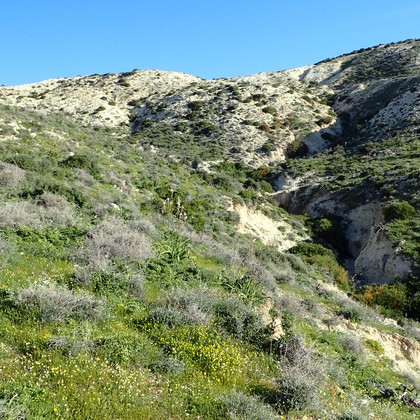
Maquis, garrigue, scrub and open woodland, olive groves, orchards, gardens and parks, from the coast into the middle mountains of the Atlas and the Levant. Winter visitors also in oases, palm groves, tamarisks along canals and bushes in wadis.
Where the bird is most at home, classified by the habitats of North Africa and the Middle East.


Range and movements
Resident in the Mediterranean north of the Maghreb: Morocco south to the Anti-Atlas, northern Algeria, northern Tunisia and north-west Libya, also in Cyrenaica; in Egypt a local breeder along the Mediterranean coast and in the Nile Delta. In the Levant the form momus: Israel, Lebanon, western Syria, western Jordan and Sinai. In winter it spreads into the northern Saharan oases, through Egypt along the Nile, and scarcely into northern Saudi Arabia, Iraq and Kuwait; a vagrant in the Gulf states. Beyond the region around the whole Mediterranean, from Iberia and the Canary Islands to Turkey.
- Resident
- Summer visitor (c. Apr–Sep)
- Winter visitor (c. Oct–Mar)
- Passage (Mar–Apr, Oct–Nov)
- dark = core range, pale = thinly spread
How and when to look
Any garden in Rabat, Tunis or Tel Aviv will do; to see it as well you must wait for it to climb onto a bush top. In winter it is regular in the palm groves of the Moroccan oases and in Sinai.
Conservation status
Not globally threatened and numerous in the region; the species adapts well to gardens, plantations and overgrown farmland.
Scientific name
Curruca melanocephala | (Gmelin, 1789)
Gmelin described the species in 1789 as Motacilla melanocephala; because it was later moved to another genus, the author and year stand in brackets. The genus Curruca was introduced in 1802 by Bechstein. Curruca is Latin, the name of an unidentified small bird mentioned by the Roman poet Juvenal. melanocephala is Greek, from melas 'black' and kephale 'head', after the male's black cap. The specimen the first description was based on came from Sardinia.