All species › Passerines › Waxbills › Scaly-Breasted Munia
Scaly-Breasted Munia | Lonchura punctulata
Muskaatvink | Capuchino punteado
The Scaly-breasted Munia is a stocky, dark brown estrildid with a finely scaled breast, native to tropical Asia. It is not native to the region: the birds roaming the parks and gardens of the Gulf states derive from escaped cage birds.

Voice
A soft, plaintive and slightly nasal kee-tee or pee-tee, heard constantly within the flock; a sharper tchit on take-off. The song is very quiet: a series of squeaks and clicks ending in a long, thin whistle.
Recording: Bo Shunqi 薄顺奇 — CC BY-NC-SA 4.0 · converted to mono · xeno-canto
Identification
11–12 cm, stocky, with a heavy, conical, bluish-grey to almost black bill and a short, pointed tail. Head, throat and upper breast plain chocolate brown; back and wings warm brown. The white underparts are densely marked on breast and flanks with dark crescent-shaped edges, giving a scaled look; the belly is off-white. Rump and uppertail coverts ochre-yellow to olive-yellow. Sexes alike. Juveniles are plain pale brown above and dull buff below, without scales or dark head, but with the same heavy dark bill.
Confusion species
The adult cannot be confused with any other species in the region. The juvenile resembles a young House Sparrow (Passer domesticus), but lacks the supercilium and streaked back and has a much heavier, dark bill. Indian Silverbill (Euodice malabarica), with which it often associates, is much paler, with a silvery-grey bill, unmarked white underparts, a white rump and a long pointed black tail. Red Avadavat (Amandava amandava) and other waxbills have a red bill.
Habitat
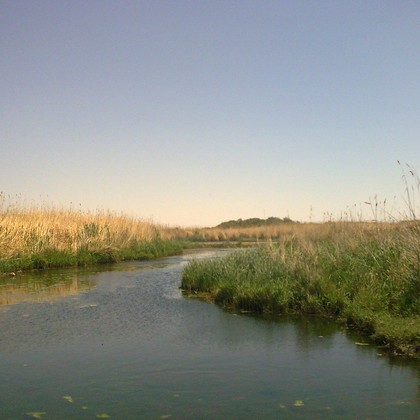
In the region mainly in urban green space: parks with lawns, irrigated grass, gardens, golf courses, field edges and reedbeds near water. Feeds on the ground and on ripe grass heads, taking seeds, often together with Indian Silverbills and sparrows.
Where the bird is most at home, classified by the habitats of North Africa and the Middle East.


Range and movements
Native from India and Sri Lanka through South-East Asia and southern China to the Philippines and Indonesia; the species does not occur naturally in the region. Small feral flocks, derived from escaped cage birds, have been reported mainly in the last two decades in Bahrain, eastern Saudi Arabia, the United Arab Emirates, Qatar and Kuwait; whether they are self-sustaining without new escapes is uncertain. Elsewhere in the region only single escapes. Beyond the region widely introduced, including Hawaii, Puerto Rico, Florida, California, Australia and the Iberian Peninsula.
- Resident
- Winter visitor (c. Apr–Sep)
- Passage (Mar–Apr, Oct–Nov)
- dark = core range, pale = thinly spread
How and when to look
Check the parks and irrigated lawns of Manama, Dubai or Abu Dhabi for flocks of small seed-eaters in the grass; munias are often mixed in with Indian Silverbills. The dark head and heavy black bill stand out first.
Conservation status
Not globally threatened, though declining in parts of South-East Asia through trapping for the bird trade. In the region an introduced species derived from escaped cage birds; numbers are small and the effects on native seed-eaters unknown.
Scientific name
Lonchura punctulata | (Linnaeus, 1758)
Linnaeus described the species in 1758 as Loxia punctulata; because it was later moved to another genus, the author and year stand in brackets. The genus Lonchura was introduced in 1832 by Sykes. Lonchura is Greek, from lonkhē 'spear-head' and oura 'tail', after the pointed tail. punctulata is modern Latin for 'finely spotted', after the scaly markings on the breast. The specimen the first description was based on came from Calcutta, India.