All species › Passerines › Treecreepers › Short-Toed Treecreeper
Short-Toed Treecreeper | Certhia brachydactyla
Boomkruiper | Agateador europeo
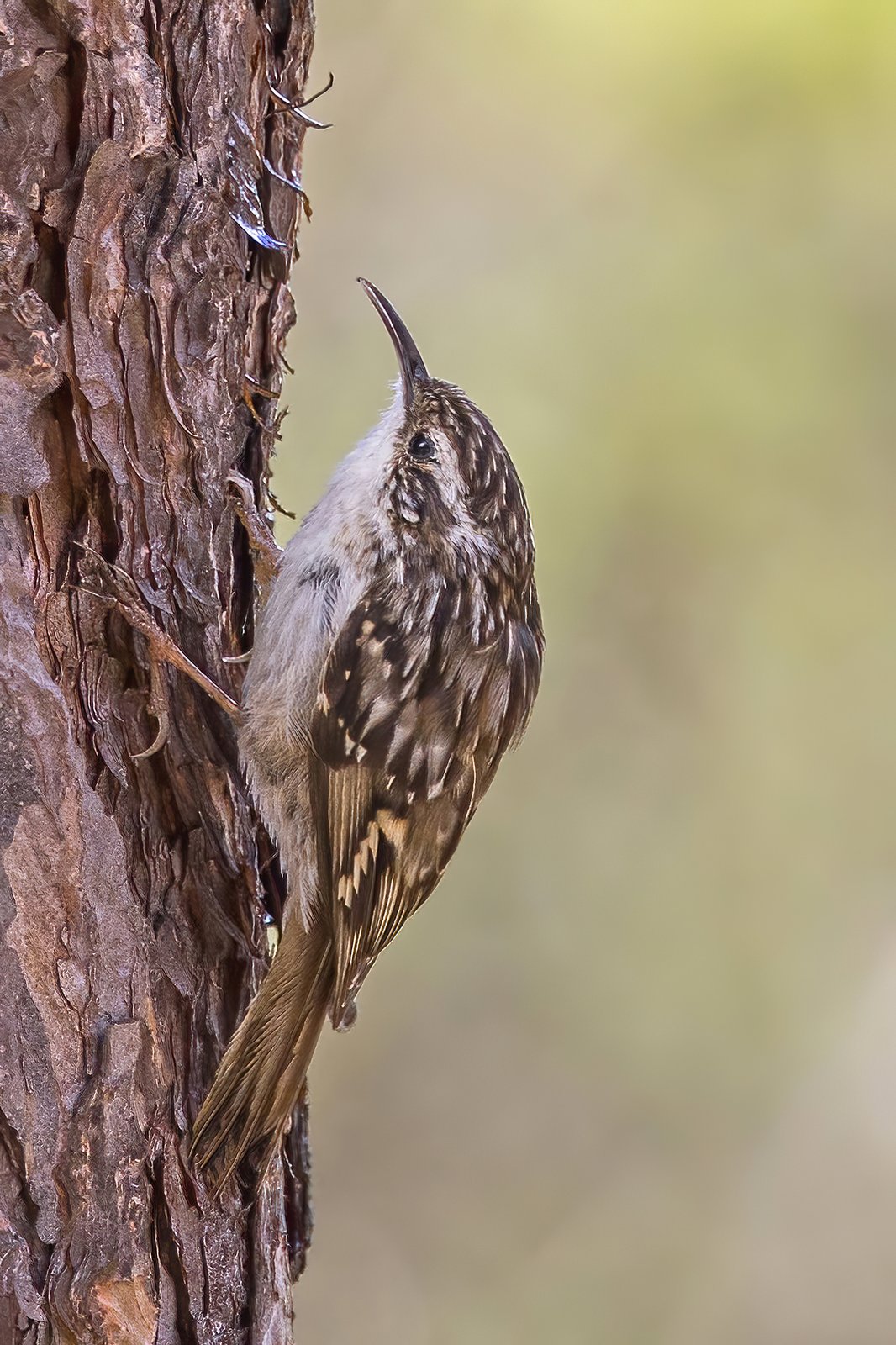
The Short-toed Treecreeper is a small, brown, mouse-like bird that climbs tree trunks in spirals. In the region it is almost confined to the forests of the Maghreb, home to the form mauritanica: darker than European birds and with its own, lower song. In the east of the region it is scarce and poorly known. There is no other treecreeper in the region, which makes identification easy.
Voice
The call is a loud, penetrating teut, often repeated a few times, and a thin, high srree. The song is short and always in the same rhythm, ending in an emphatic final note, teut teut te-roi-TIT; in mauritanica it is lower and differently structured, and European birds barely respond to it.
Recording: Esperanza Poveda — CC BY-NC-SA 4.0 · converted to mono · xeno-canto
Identification
12–13 cm. Upperparts brown with pale spots and streaks, a warm rufous rump and a long, stiff, pointed tail. Underparts off-white, grey-brown to brownish buff towards the flanks. A fairly short, indistinct white supercilium and a long, fine, decurved bill. The wing shows a stepped pale band. The North African form mauritanica is colder and darker brown above and more strongly buff-washed below than European birds.
Confusion species
There is no second treecreeper in the region; Eurasian Treecreeper (Certhia familiaris), the main pitfall in Europe, does not occur. The nuthatches – Eurasian Nuthatch (Sitta europaea) and Algerian Nuthatch (Sitta ledanti) – are blue-grey, have a straight bill and also climb head-first down trunks. Eurasian Wren (Troglodytes troglodytes) is also small and brown, but has a short cocked tail, a straight bill and lives low in the undergrowth.
Habitat
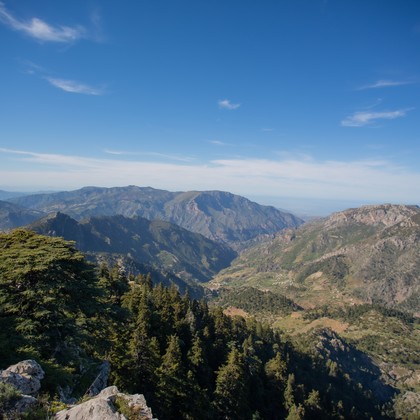
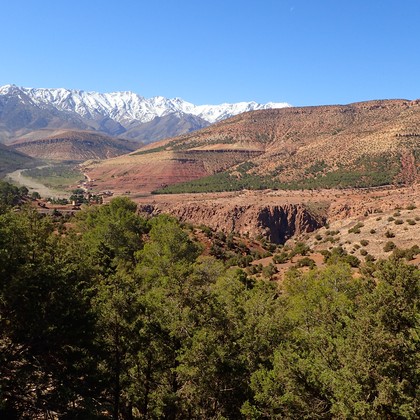
Forest with old, rough-barked trees: cork oak, holm oak and cedar forest, also pine forest, high into the Atlas; also old olive groves, orchards, poplar avenues and parks in wooded and hilly country. Searches bark crevices for insects and spiders, spiralling up from the base of the trunk, then flies to the foot of the next tree. Nests behind loose bark or in a crevice.
Where the bird is most at home, classified by the habitats of North Africa and the Middle East.

Range and movements
In North Africa the form mauritanica: in Morocco in the Rif, Middle Atlas and High Atlas, in the forests of the northern interior and the Atlantic cork oak forests, in northern Algeria from the coast to the Saharan Atlas, and in northern Tunisia. In the Middle East scarce and poorly documented: only in the mountain forests along the Turkish border in north-western Syria, and possibly in Lebanon. Absent from Libya, Egypt, Israel, Jordan, Iraq and Arabia. Beyond the region in southern, western and central Europe, Turkey and Cyprus.
- Resident
- Summer visitor (c. Oct–Mar)
- Winter visitor (c. Apr–Sep)
- Passage (Mar–Apr, Oct–Nov)
- dark = core range, pale = thinly spread
How and when to look
In the Maâmora cork oak forest near Rabat and in the cedar forests around Ifrane the Short-toed Treecreeper is common; follow the loud teut and watch the base of the trunks, where it starts each climb anew. In Tunisia around Aïn Draham.
Conservation status
Not globally threatened. Widespread in the Maghreb in forest and old orchards; degradation of the cork oak and cedar forests and the grubbing-up of old olive groves cost habitat locally. Little is known about the eastern populations.
Scientific name
Certhia brachydactyla | Brehm, 1820
Brehm described the species in 1820 and placed it straight away in the genus where it still stands. The genus Certhia was introduced in 1758 by Linnaeus. Certhia is from Ancient Greek kerthios, a small tree-dwelling bird described by Aristotle and others. brachydactyla is Greek, from brakhus 'short' and daktulos 'finger, toe', for the bird's short toes. The specimen the first description was based on came from the Roda valley, Thuringia.