All species › Passerines › Wrens › Eurasian Wren
Eurasian Wren | Troglodytes troglodytes
Winterkoning | Chochín común
The Eurasian Wren is one of the smallest birds in the region, almost a ball with a cocked tail, but with a voice that fills a whole valley. In the region it lives in the humid forests and dense vegetation of the Maghreb, the Green Mountain (Jebel Akhdar) in Libya, the northern Levant and Kurdistan. A series of distinct forms, of which the Libyan one is the most isolated.

Voice
The song is an explosion of clear, loud notes with a characteristic rattle or trill somewhere in the middle, a few seconds long and very loud for a bird of this size; heard almost year-round, most in spring. Alarms with a hard, rattling cherrrr and a dry, ticking tek-tek-tek.
Recording: SWIFT Olivier — CC BY-NC 4.0 · shortened to the first 60 s, mono · xeno-canto
Identification
9–10.5 cm. Small, round and warm brown, finely barred dark on wings, tail and flanks, with a short, often vertically cocked tail. A pale supercilium, a fairly long, thin, straight bill and pinkish-brown legs. Underparts paler, buff to grey-brown. The North African form kabylorum is paler and greyer than European birds; the Libyan juniperi is paler still and more heavily barred; the Levantine syriacus is warm, reddish brown.
Confusion species
Dunnock (Prunella modularis) is larger, grey on head and breast, streaked on the back and has a longer tail that is not cocked. Short-toed Treecreeper (Certhia brachydactyla) climbs trunks, has white underparts and a long decurved bill. Cetti's Warbler (Cettia cetti) is larger, plain rufous-brown without barring, with a broad, rounded tail, and lives in reedbeds and bushes by water.
Habitat
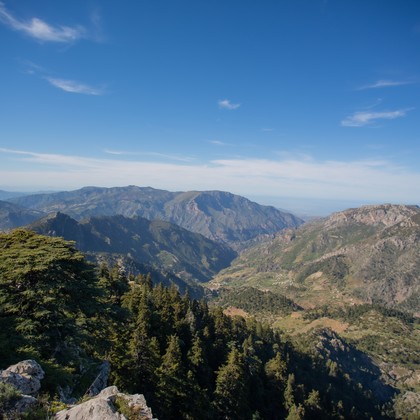
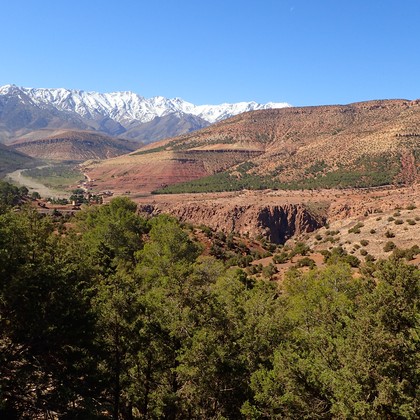
Dense, humid undergrowth in forest: cork oak, cedar and oak forest with ferns and bramble, stream valleys with riparian woodland, ravines with scrub, also dense juniper and maquis; in the High Atlas above the tree line among rocks and dwarf shrubs. In Libya in the juniper maquis of the Jebel Akhdar. In winter also in gardens, hedges, reedbeds and dense scrub in the lowlands. Searches for insects and spiders close to the ground.
Where the bird is most at home, classified by the habitats of North Africa and the Middle East.

Range and movements
In North Africa the form kabylorum: in Morocco in the Rif, the Atlas and the forests of the northern interior and the Atlantic coast, in northern Algeria and in northern Tunisia. An isolated form, juniperi, in the Jebel Akhdar in Cyrenaica (north-eastern Libya). In the Levant the form syriacus in Lebanon, western Syria and northern Israel (Hermon, Golan, Upper Galilee and Mount Carmel), scarcer to the south, and very scarce in north-western Jordan. In northern Iraq a form of the Kurdish mountains. In winter also scattered at lower altitudes in Israel and the Levant; beyond that a rare vagrant to Egypt, Kuwait and the Gulf States. Outside the region throughout Europe and the temperate zone of Asia to Japan.
- Resident
- Summer visitor (c. Apr–Sep)
- Winter visitor (c. Oct–Mar)
- Passage (Mar–Apr, Oct–Nov)
- dark = core range, pale = thinly spread
How and when to look
On Mount Carmel and in the forests of Upper Galilee the loud song is one of the first sounds of the day in spring. In Morocco everywhere in the undergrowth of the cedar forests near Ifrane and in the stream valleys of the Rif; in Libya in the wadis of the Jebel Akhdar.
Conservation status
Not globally threatened. Common in suitable forest in the Maghreb and the northern Levant. The Libyan form juniperi lives in a small, isolated area where the juniper forest of the Jebel Akhdar is under pressure from cutting, grazing and agricultural expansion; genetic studies show that Cyrenaican and Maghreb wrens differ clearly from European ones.
Scientific name
Troglodytes troglodytes | (Linnaeus, 1758)
Linnaeus described the species in 1758 as Motacilla Troglodytes; because it was later moved to another genus, the author and year stand in brackets. The genus Troglodytes was introduced in 1809 by Vieillot. Troglodytes is Greek, from troglē 'hole, crevice' and dyein 'to creep into': 'cave-dweller', after the habit of disappearing into crevices and holes while foraging. The specific name repeats the genus name. The specimen the first description was based on came from Sweden.