All species › Waders, gulls and terns › Plovers and lapwings › Sociable Lapwing
Sociable Lapwing | Vanellus gregarius
Steppekievit | Avefría sociable
A sandy-coloured, critically endangered lapwing of the Kazakh steppe, part of whose world population migrates through Syria and Iraq to winter quarters in Saudi Arabia and Sudan. In the region it is a rare, much-sought species, usually found in small groups on dry fields or irrigated circular fields.

Voice
Usually silent outside the breeding season. On taking off a harsh, short kretch or cherk, drier than the pee-wit of Northern Lapwing; on the breeding grounds a rapid rattling rek-rek-rek.
Recording: Jarek Matusiak — CC BY-NC-SA 4.0 · converted to mono · xeno-canto
Identification
Slightly smaller and slimmer than Northern Lapwing, crestless, with long black legs and a short black bill. In winter plumage, in which it is almost always seen here, sandy to grey-brown with a dirty white belly and a strongly patterned head: dark crown, dark eye-stripe and between them a broad creamy supercilium meeting on the forehead and nape. In spring the breeding plumage appears, with black crown, white supercilium, ochre cheek and a black belly patch grading to chestnut at the rear. In flight the upperwing shows three zones: brown coverts, bright white secondaries and black primaries; rump and tail white with a black terminal band. Juveniles have pale feather fringes and a streaked breast.
Confusion species
White-tailed Lapwing (Vanellus leucurus) has a plain head, long yellow legs and an all-white tail. Northern Lapwing (Vanellus vanellus) is black and white with a green gloss and has a crest. Eurasian Dotterel (Eudromias morinellus), which winters on the same desert plains, also has a pale supercilium, but is much smaller, has a pale breast band and shows no white wing panel in flight. European Golden-Plover (Pluvialis apricaria) is golden-spangled and short-legged.
Habitat
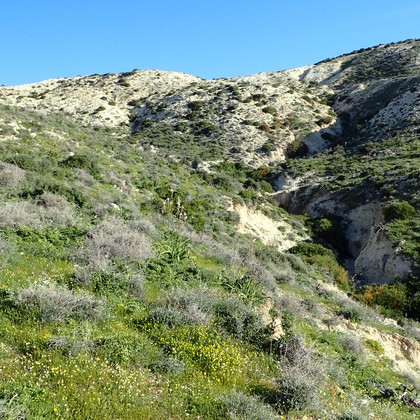
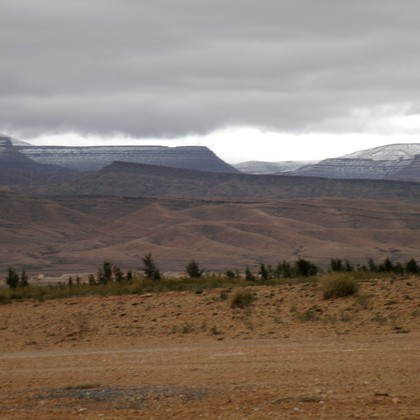
In the region dry, open plains with short vegetation: fallow, stubble, ploughed fields, semi-desert and grazed steppe, and above all the irrigated circular fields (pivots) of Saudi Arabia, Qatar and Oman, where alfalfa and grass are kept short. Likes to drink at nearby pools or sprinklers.
Where the bird is most at home, classified by the habitats of North Africa and the Middle East.

Range and movements
The western flyway runs from Kazakhstan via the Caucasus and south-eastern Turkey (Ceylanpınar, on the Syrian border) through north-eastern Syria and Iraq to the Arabian Peninsula and Sudan. In Syria and Iraq mainly a passage migrant and locally a winter visitor. In Saudi Arabia a regular winter visitor in small numbers on inland pivot fields, including at Haradh and Al Kharj. Scarce in Kuwait, Qatar, the Emirates and Oman; in Israel a rare but almost annual winter visitor in the Hula and Beit She'an valleys and the northern Negev; rare in Jordan and Lebanon. A vagrant to Egypt, Yemen, Bahrain and Morocco. Beyond the region it breeds in Kazakhstan and southern Russia and also winters in Pakistan and north-western India.
- Winter visitor (c. Apr–Sep)
- Passage (Mar–Apr, Oct–Nov)
- dark = core range, pale = thinly spread
How and when to look
From November to February work through flocks of lapwings and golden plovers on pivot fields and fallow land; look for a bird that is sandier and stands taller. Wait for the flock to fly: the white secondary panel between brown and black is the quickest feature at range. Note colour rings or tags and report every sighting; for this species every record counts.
Conservation status
Critically Endangered. Numbers fell steeply in the twentieth century; recent counts of thousands of birds in Central Asia show there are more than long feared, but low adult survival remains the core problem. Hunting along the flyway in Syria and Iraq is a major cause of death; on the steppe the loss of grazing and the ploughing of grassland also play a part.
Scientific name
Vanellus gregarius | (Pallas, 1771)
Pallas described the species in 1771 as Charadrius gregarius; because it was later moved to another genus, the author and year stand in brackets. The genus Vanellus was introduced in 1760 by Brisson. Vanellus is Latin for 'little fan', the diminutive of vannus 'winnowing fan'. gregarius is Latin for 'gregarious', from grex, gregis 'flock', after its sociability outside the breeding season. The specimen the first description was based on came from the Volga region, Russia.