All species › Owls › Typical owls › Socotra Scops Owl
Socotra Scops Owl | Otus socotranus
Socotradwergooruil | Autillo de Socotora
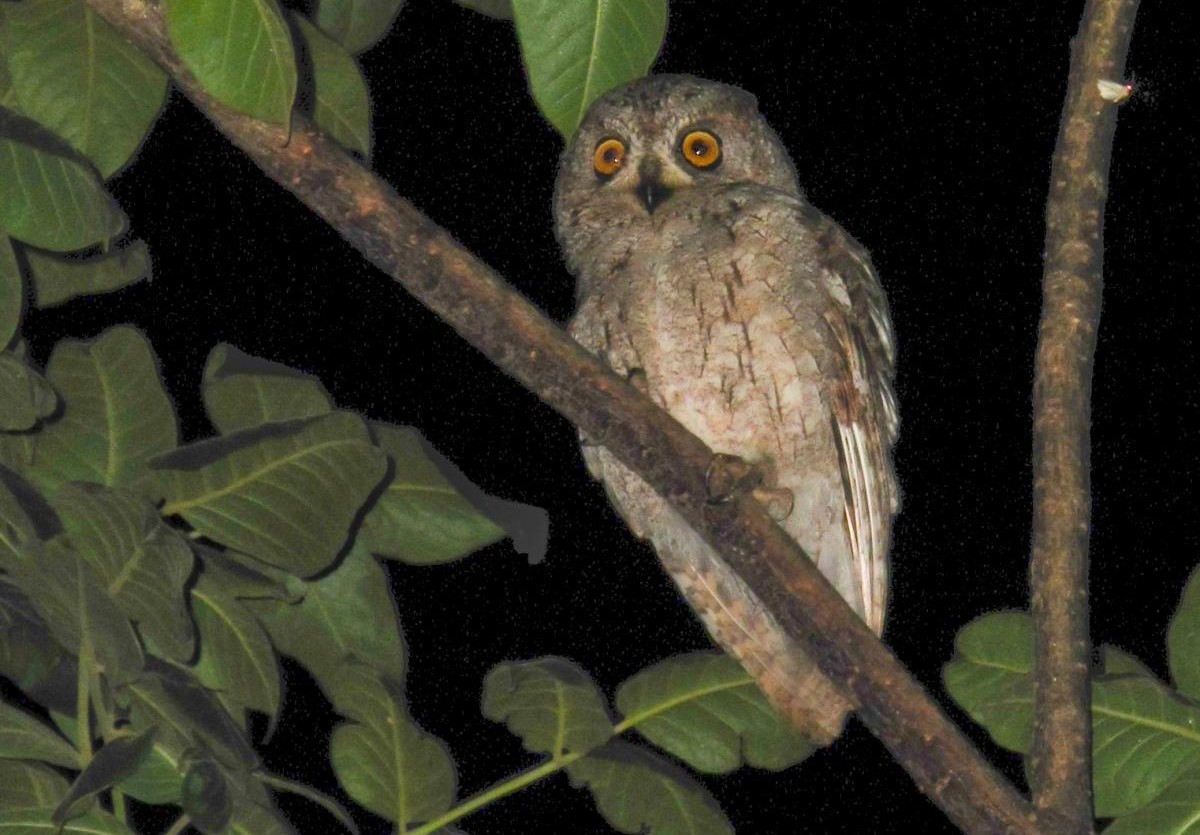
A small scops owl found only on the island of Socotra, where it is the only common owl. Long treated as a subspecies of African Scops Owl, it differs in plumage and above all in song; genetically it is closer to Oriental Scops Owl.
Voice
The song is a low, hollow wook-wook or kroo-ruk, repeated in a regular series; very different from the purring of Arabian and African Scops Owl, and more like that of Oriental Scops Owl.
Recording: Mischa Keijmel — CC BY-NC-SA 4.0 · converted to mono · xeno-canto
Identification
Very small, with short ear tufts and a round head. Plumage light grey-brown with fine vermiculation and thin dark shaft streaks, less contrasting than in Arabian Scops Owl. The face is pale grey with a narrow dark rim, the eyes are yellow. By day it roosts in cavities, rock crevices or dense foliage.
Confusion species
No other scops owl occurs on Socotra; wandering Eurasian Scops-Owls (Otus scops) on passage are much rarer and larger, with a whistled song. The Western Barn Owl (Tyto alba) of Socotra is much larger, with a white heart-shaped face.
Habitat
Rocky semi-desert with scattered trees and shrubs, wadis with figs and tamarisks, date palm groves and the slopes of the Haggeher mountains. Most numerous where there are old palms. Occurs over more than half of the island, from the coast into the hills. Probably nests in natural cavities; eggs are laid early in the year, around January.
Where the bird is most at home, classified by the habitats of North Africa and the Middle East.



Range and movements
Endemic to Socotra (Yemen), where it occurs across much of the island, from the coastal plains and palm groves near Hadibu to the slopes of the Haggeher and the Homhil plateau. Not recorded on the smaller islands of the archipelago (Abd al Kuri, Samha and Darsa). Found nowhere else.
- Passage (Mar–Apr, Oct–Nov)
- dark = core range, pale = thinly spread
How and when to look
The palm groves around Hadibu and the wadis of Homhil and Dixam are good sites; the song starts shortly after sunset and the bird often perches well on a low branch or palm frond.
Conservation status
Not threatened according to the Red List, but with its small, isolated range vulnerable to changes on the island: overgrazing by goats, felling of old palms and trees, road building and tropical storms.
Scientific name
Otus socotranus | (Ogilvie-Grant & Forbes, 1899)
Ogilvie-Grant & Forbes described the species in 1899 as Scops socotranus; because it was later moved to another genus, the author and year stand in brackets. The genus Otus was introduced in 1769 by Pennant. Otus is Latin for 'eared owl', borrowed from the Greek ōtos, from ous 'ear'. socotranus refers to Socotra, the island where the species occurs. The specimen the first description was based on came from Socotra, Yemen.